

Abdul Mannan: The Dual Biology of the Sickle Cell Mutation
Abdul Mannan, Consultant Haematologist at Betsi Cadwaladr University Health Board, shared a post on LinkedIn about an article by Gavin Band et al. published in Nature, adding:
“The sickle mutation is not simply ‘protective’.
It depends on whether you inherit one copy or two.
That is the whole paradox.
Here’s the simple version:
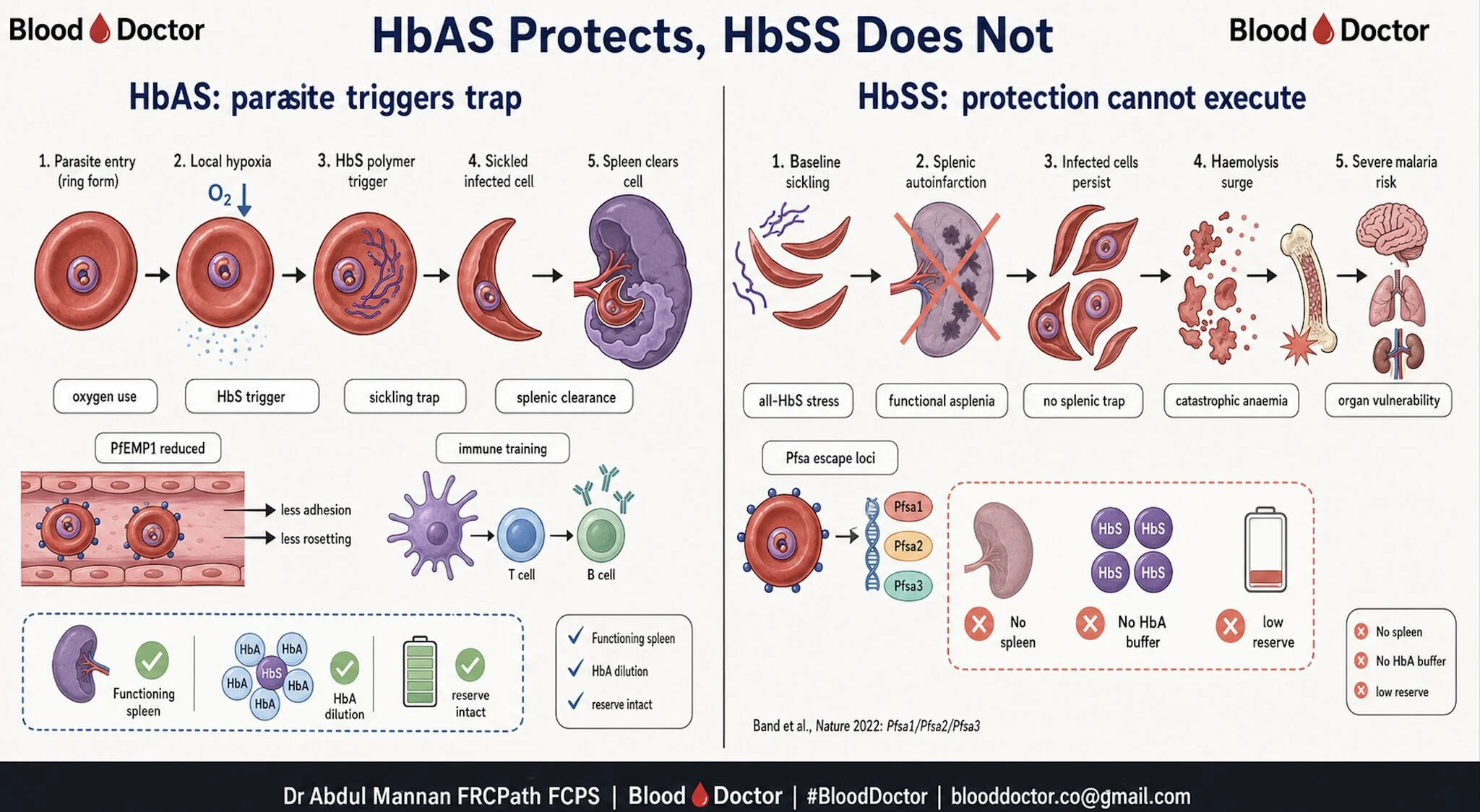
- HbAS protects because the parasite creates local hypoxia inside the red cell
- That triggers limited HbS polymerisation
- The infected red cell sickles
- A working spleen clears it, parasite included
- Less PfEMP1 reaches the cell surface, so there is less adhesion and rosetting
But HbSS is different:
- The spleen is often lost early through repeated infarction
- Red cells are already under sickling stress
- There is no HbA buffer
- Baseline anaemia leaves little reserve
- Malaria then adds haemolysis on top of haemolysis
So the same mutation can act like a trap in HbAS, but becomes a liability in HbSS.
A 2022 Nature paper by Band et al. added another layer: HbS protection also depends on parasite genotype, with Pfsa1, Pfsa2 and Pfsa3 loci linked to parasites that can cause severe malaria despite HbS.
For trainees, this is a beautiful teaching point:
Genetics is never isolated from environment.
And malaria wrote part of the sickle cell story.
What is your favourite example of evolution shaping haematology?”
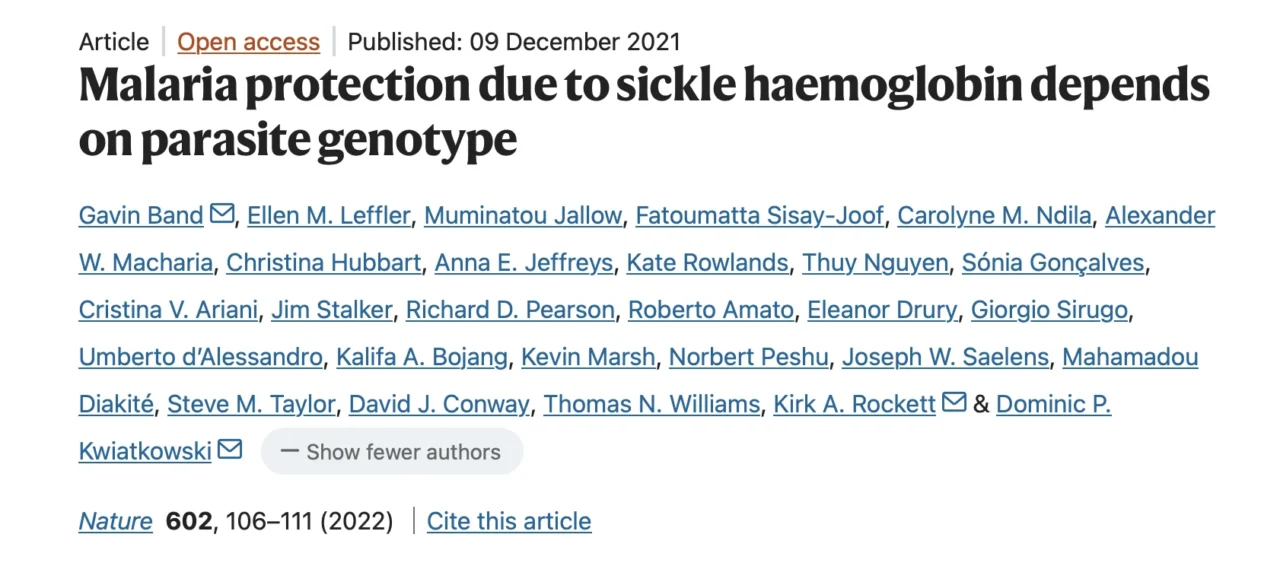
Title: Malaria protection due to sickle haemoglobin depends on parasite genotype
Authors: Gavin Band, Ellen M. Leffler, Muminatou Jallow, Fatoumatta Sisay-Joof, Carolyne M. Ndila, Alexander W. Macharia, Christina Hubbart, Anna E. Jeffreys, Kate Rowlands, Thuy Nguyen, Sónia Gonçalves, Cristina V. Ariani, Jim Stalker, Richard D. Pearson, Roberto Amato, Eleanor Drury, Giorgio Sirugo, Umberto d’Alessandro, Kalifa A. Bojang, Kevin Marsh, Norbert Peshu, Joseph W. Saelens, Mahamadou Diakité, Steve M. Taylor, David J. Conway, Thomas N. Williams, Kirk A. Rockett, Dominic P. Kwiatkowski
Other posts featuring Abdul Mannan on Hemostasis Today.
-
Sep 29, 2026, 22:45Victor Agunyego: Paracetamol – The Most Common Drug We Underestimate
-
Sep 29, 2026, 22:42Nova Sinclair: Advancing the Future of Hematology – Meet Our 2027 Organizing Committee
-
Sep 29, 2026, 22:41Lorenz Räber: Intracoronary Imaging in PCI – Why, When, How, and Which Modality?
-
Sep 29, 2026, 22:31Selma Turkovic: Pleased to Deliver the Opening Presentation at Kingston Hospital
-
Sep 29, 2026, 22:31Miguel Teran: Ultrasound and Simulation in Arterial Blood Sampling
-
Sep 29, 2026, 21:47Javed Anees: DADA2 – When a Young Stroke Is More Than a Stroke
-
Sep 29, 2026, 22:28Mohammad Refaei: Navigating Your Career in Hematology From Training to Practice
-
Sep 29, 2026, 22:27Matteo Foschi: 10 Clinical Pearls for Antithrombotic Therapy in Secondary Stroke Prevention
-
Sep 29, 2026, 22:26A Global Call for Action on Cardiovascular Health on World Heart Day – ISTH