


Andreas Calatzis: Clot Retraction and Lysis in Viscoelastometry Explained
Andreas Calatzis, Managing Director of Eonis GmbH and Dynabyte GmbH, shared a post on LinkedIn about a recent article by Anikó Smudla et al., published in Diagnostics, adding:
”Our article on ‘physiological lysis’ in viscoelastometry is online.
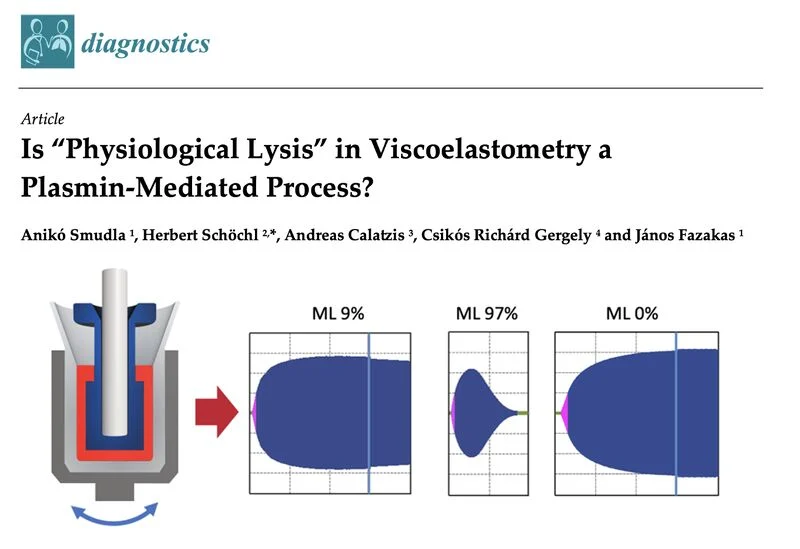
The article challenges the interpretation of a low maximum lysis in viscoelastometry as ‘hypofibrinolysis’ and attributes this phenomenon to low clot retraction.
This distinction is clinically relevant because fibrinolysis is mediated by plasmatic factors, whereas clot retraction is a cellular, platelet-dependent process.
The article is the first publication using the new Apiro reagents, and the first study from the clinical study program at the Semmelweis University in Budapest.
You find the article using the link, it is open access.”
Title: Is “Physiological Lysis” in Viscoelastometry a Plasmin-Mediated Process?
Authors: Anikó Smudla, Herbert Schöchl, Andreas Calatzis, Csikós Richárd Gergely, János Fazakas
Stay updated with Hemostasis Today.
-
Sep 29, 2026, 16:35Jonathan Douxfils: Navigating the VTE Risk Continuum in Reproductive Medicine
-
Sep 29, 2026, 16:35Chaima Rajeh: Types of Anemia and Their Laboratory Features
-
Sep 29, 2026, 16:27Scott Isaacs: How GLP-1 RAs Target Systemic Inflammation to Drive Cardio, Autoimmune, and Gut Health
-
Sep 29, 2026, 16:21Yitshak Kreiss: From Treating Patients to Defining the Standard of Knowledge
-
Sep 29, 2026, 16:18Edward Lee Carter: Why Periprocedural DOAC Guidance Needs a Common Output Standard
-
Sep 29, 2026, 16:07Yasmine Laraba: Deep Vein Thrombosis Causes, Signs and Management
-
Sep 29, 2026, 16:01Stephen Cornelissen: How Joining the Stem Cell Registry Can Save Patients with Blood Cancers
-
Sep 29, 2026, 15:45Alan Nurden: Could Mast Cell aIIb Integrin Play a Key Role in Septic Thrombus Stability?
-
Sep 29, 2026, 15:43Priyadarshani Sharma: Advocacy and Patient Rights Transform Indian Haemoglobinopathies Care