

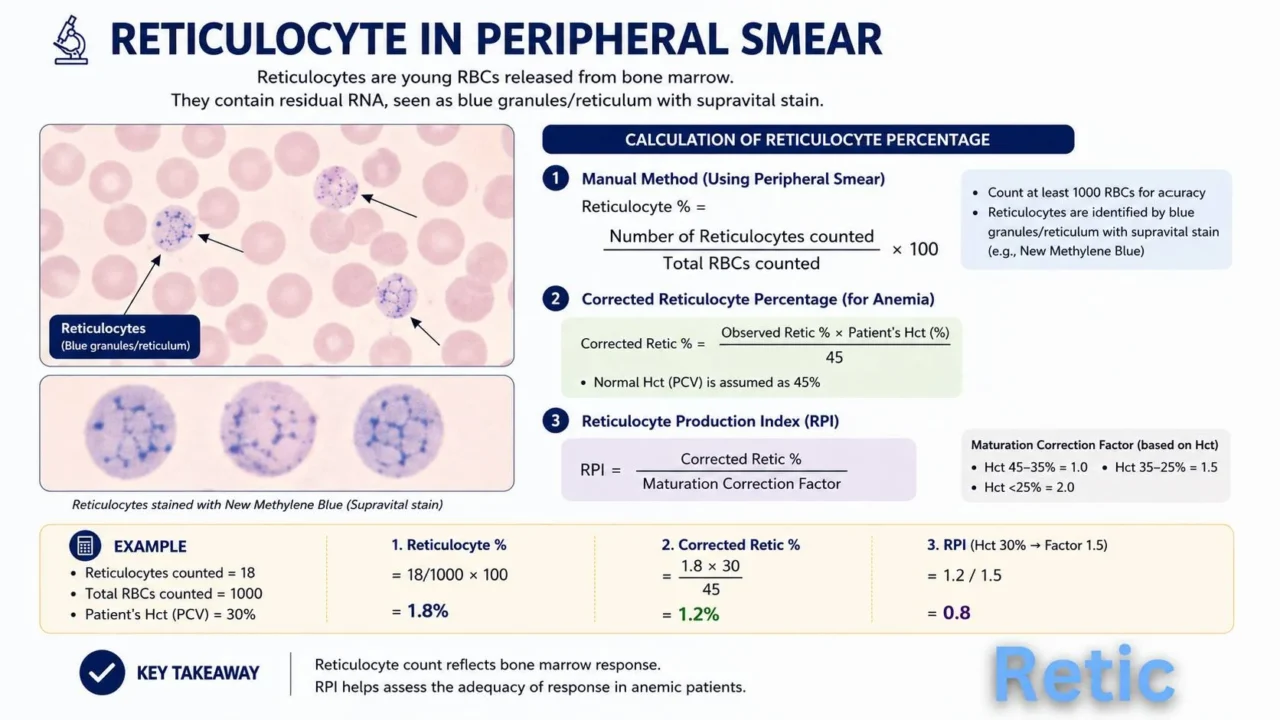
Abhijit D: Reticulocyte Count Methods in Hematology Laboratories
Abhijit D., Laboratory Supervisor at NSK Hospital, shared a post on LinkedIn:
”Reticulocyte Count Methods in Hematology Laboratories
Manual Reticulocyte Count Method
Manual reticulocyte counting is performed using a supravital stain such as New Methylene Blue (NMB) or Brilliant Cresyl Blue. The stain precipitates residual ribosomal RNA inside immature RBCs, appearing as blue granules or reticular networks under the microscope.
Procedure Summary:
- Mix equal volumes of EDTA blood and supravital stain.
- Incubate for 10–15 minutes.
- Prepare peripheral smear and examine under oil immersion.
- Count reticulocytes among 1000 RBCs.
Calculation:
Reticulocyte percentage is determined by dividing the number of reticulocytes counted by the total number of red blood cells counted, then multiplying the result by 100.
Advantages: Low cost, useful in low-resource settings.
Limitations: Subjective, labor-intensive, inter-observer variation.
Fully Automated Reticulocyte Analysis
Modern hematology analyzers use fluorescent flow cytometry for rapid and accurate reticulocyte enumeration. Immature RBCs are stained with fluorescent dyes targeting RNA, and cells are analyzed by laser optics and scatter signals.
Sysmex Asia Pacific Automated Reticulocyte Analysis
Sysmex Global
Sysmex analyzers (XN/XE series) use:
- Fluorescent flow cytometry
- RNA-specific fluorescent dye
- Forward scatter plus side fluorescence detection
Parameters Reported:
- Reticulocyte percent
- Absolute reticulocyte count
- RF (Immature Reticulocyte Fraction)
- RET-He (Reticulocyte Hemoglobin Equivalent)
Widely used for anemia evaluation, marrow response, and iron therapy monitoring.
Mindray Automated Reticulocyte Analysis
Mindray India
Mindray BC series analyzers use:
- Semiconductor laser technology
- Fluorescent staining methods
- Multi-angle light scatter analysis
Features:
- Fast turnaround time
- Automated retic scattergrams
- Reduced manual errors
- Useful for routine hematology workflow
Siemens Automated Reticulocyte Analysis
Siemens Healthineers
Siemens ADVIA analyzers perform reticulocyte analysis using:
- Oxazine fluorescent dyes
- Flow cytometric cell classification
- Dual-angle laser light scatter
Clinical Utility:
- Bone marrow activity assessment
- Monitoring chemotherapy recovery
- Evaluation of hemolytic anemia
Beckman Coulter Automated Reticulocyte Analysis
Beckman Coulter Diagnostics
analyzers use:
- VCS technology (Volume, Conductivity, Scatter)
- Fluorescent nucleic acid staining
- Automated maturity fraction analysis
Advantages:
- High precision and reproducibility
- Integrated CBC plus reticulocyte workflow
- Advanced reticulocyte maturity parameters
Key Clinical Importance of Reticulocyte Count
- Evaluates bone marrow response
- Helps differentiate anemia types
- Monitors treatment response
- Assesses erythropoietic activity”
Stay updated with Hemostasis Today.
-
Sep 29, 2026, 22:45Victor Agunyego: Paracetamol – The Most Common Drug We Underestimate
-
Sep 29, 2026, 22:42Nova Sinclair: Advancing the Future of Hematology – Meet Our 2027 Organizing Committee
-
Sep 29, 2026, 22:41Lorenz Räber: Intracoronary Imaging in PCI – Why, When, How, and Which Modality?
-
Sep 29, 2026, 22:31Selma Turkovic: Pleased to Deliver the Opening Presentation at Kingston Hospital
-
Sep 29, 2026, 22:31Miguel Teran: Ultrasound and Simulation in Arterial Blood Sampling
-
Sep 29, 2026, 21:47Javed Anees: DADA2 – When a Young Stroke Is More Than a Stroke
-
Sep 29, 2026, 22:28Mohammad Refaei: Navigating Your Career in Hematology From Training to Practice
-
Sep 29, 2026, 22:27Matteo Foschi: 10 Clinical Pearls for Antithrombotic Therapy in Secondary Stroke Prevention
-
Sep 29, 2026, 22:26A Global Call for Action on Cardiovascular Health on World Heart Day – ISTH