

Ayman Arif: Understanding PRP Therapy in Aesthetic Medicine
Ayman Arif, Medical Doctor at Abbasi Shaheed Hospital, shared a post on LinkedIn:
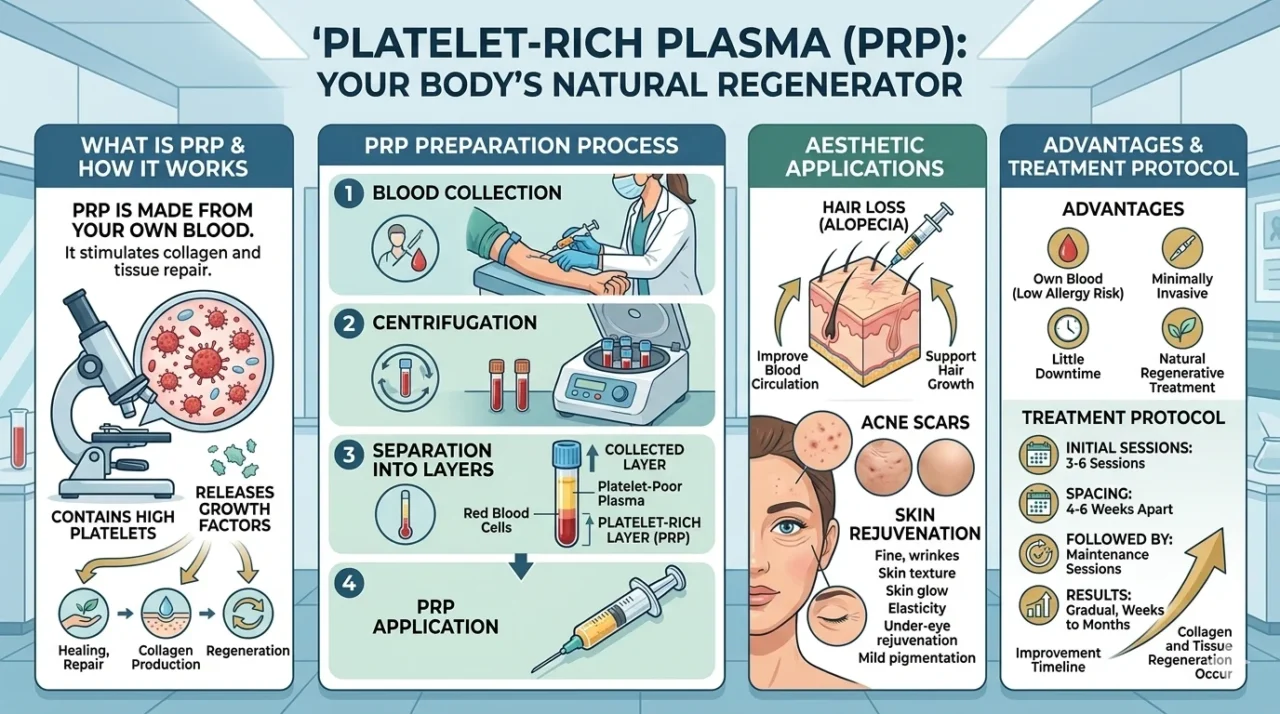
“Platelet-Rich Plasma (PRP) — is made from a person’s own blood, works by stimulating collagen and tissue repair.
It contains a high concentration of platelets, which release growth factors that help in healing, repair, collagen production, and regeneration.
How is PRP prepared?
- A small amount of blood is taken from the patient.
- The blood is placed in a centrifuge machine.
- The machine separates the blood into layers.
- The platelet-rich layer (PRP) is collected.
- PRP is then injected or applied to the treatment area.
Applications of PRP in aesthetics:
PRP for hair loss (Alopecia)
PRP is injected into the scalp to stimulate hair follicles, improve blood circulation, and support hair growth. It is commonly used in androgenetic alopecia.
PRP for skin helps improve:
- Acne scars
- Skin rejuvenation
- Fine lines and wrinkles
- Under-eye rejuvenation
- Skin texture
- Skin glow
- Elasticity
- Mild pigmentation
Advantages of PRP:
- Uses patient’s own blood
- Minimally invasive
- Low risk of allergy
- Little downtime
- Natural regenerative treatment
How many sessions are needed?
- 3–6 sessions initially
- Sessions spaced about 4–6 weeks apart followed by Maintenance sessions.
Results are gradual, not instant. Improvement usually appears over weeks to months as collagen and tissue regeneration occur.”
Stay updated with Hemostasis Today.
-
Oct 8, 2026, 23:27Shayan Mohammadmoradi: Happy to Be Back at the Midwest Platelet Conference for Its 20th Meeting
-
Oct 8, 2026, 23:18Lorena Arranz: Honoured to Contribute to the 6th Global MPN Symposium
-
Oct 8, 2026, 23:06Denis Oduor: Serving Citizens and Saving Lives Through Blood Donation During National Customer Service Week 2026
-
Oct 8, 2026, 22:51Jan Hartmann: Speaking on Global Trends in Plasma Collection at the 50th Meeting of the Japanese Society of Blood Services
-
Oct 8, 2026, 22:49Akshat Jain: Proud to Announce the Publication of Advances in Sickle Cell Disease
-
Oct 8, 2026, 22:49Ed Shovelin: Extending the Platelet Aggregation Testing Window to 72 Hours
-
Oct 8, 2026, 22:48Abdulla A. Damluji: Anticancer Drugs and Thrombosis Mechanisms, Risk Factors, and Prevention
-
Oct 8, 2026, 22:46Miguel Escobar: My Research on Oral Health and Hemophilia
-
Oct 8, 2026, 22:44ISTH 2027 Abstract Submission Opens November 23