


Lijing L. Yan: The Implementation Gap – How South Korea Cut Stroke Deaths by 87%
Lijing L. Yan, Professor of Global Health at Duke Kunshan University, shared Tom Frieden‘s post on LinkedIn:
”’The Implementation Gap’ Inspiring true story unfolding over 30 years in South Korea on how they narrowed the implementation gap and reduced stroke death by 87%.
It does not happen over night, not even over a decade.
Constrained by funding, implementation research usually does not last longer than 5 years – even when studying sustainability of particular programs.
But a historical perspective can bring insight not available otherwise.
Implementation reserach is often at the local level and rightly so given the vast differences in contexts.
However, valuable lessons can also be drawn from national level studies, especially for policy reseachers and policy makers.
Thanks Dr. Tom Frieden for bringing this success to the spotlight.
For any scholars interested in making a difference in cardiovascular disease, NCDs in general, and health services, systems, and policy reseach, seeing the invisible is worth subscribing.”
Tom Frieden, President and CEO of Resolve to Save Lives, shared on LinkedIn:
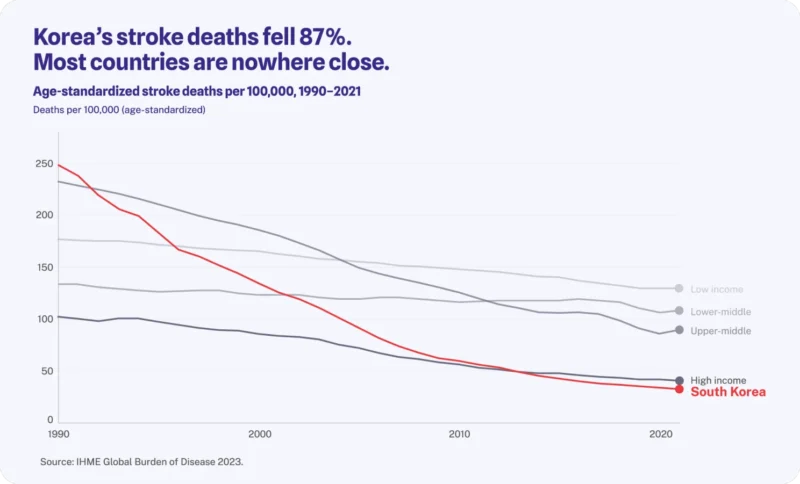
”In 1990, stroke killed South Koreans at a rate of 248 per 100,000. By 2023, that rate had fallen to 32.
That’s an 87 percent drop.
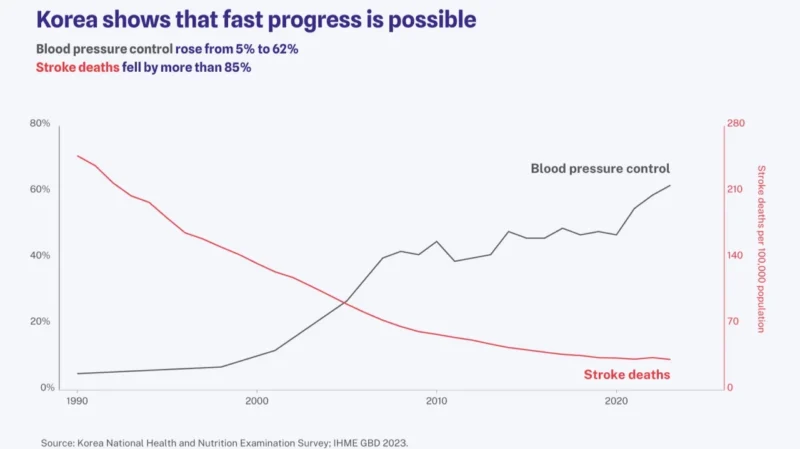
A generation ago, only about one in twenty Korean adults with high blood pressure, which is still the world’s biggest killer, had it under control.
Today, six in ten do.
I’ve worked on health programs in dozens of countries over four decades, and I can’t think of a single example of more impressive progress against cardiovascular disease.
Korea didn’t get lucky. It made a series of deliberate choices, sustained them across changes in government, and watched as its people stopped being hospitalized, disabled, and killed by preventable strokes and heart attacks.
The story deserves to be much better known – both because Korea has earned the credit and because every country in the world can make progress at least this fast.
Here’s what happened.
Korea got there by doing something most countries still haven’t done.
It made sure that every adult has a regular medical provider whose job is to keep blood pressure in check and whose performance is measured on whether they do.
That’s central to its success. Rather than launch a public awareness drive, South Korea prioritized the unglamorous, durable work of making sure the system identifies people at risk, follows up with them, and gives the professionals caring for them a real reason to do it well.
The country integrated multiple public health insurance programs, which had initially been established across different sectors, into a single national health insurance system that could see who was in care and who wasn’t.
It used standard medications, usually single-pill combinations of two anti-hypertensive medications, to simplify treatment.
And it made these medicines free for low-income patients and deeply subsidized for older adults. When the pills cost less than a cup of coffee, people take them.
When they cost a day’s wages, they don’t. This is especially important for hypertension, which is appropriately called the silent killer, since the first symptom is often a heart attack or stroke.
Then Korea did something harder. In 2012, it took on the food supply.
The government implemented a National Plan to Reduce Sodium Intake and worked with manufacturers, restaurants, schools, and households to cut salt out of the Korean diet.
The government funded research to help companies reformulate their products.
School and worksite cafeterias rolled out lower-sodium meals.
Even kimchi – the national staple and the single biggest source of dietary sodium in the country – got reformulated, with help from a kimchi refrigerator that let households use less salt to preserve it.
Within a few years, Koreans were eating nearly a quarter less sodium than before.
The combined effect on blood pressure and on stroke and heart disease is what you see in the chart above.
It’s progress matched by few countries, as the chart below shows.
None of this required exceptional technology, wealth, or anything specific to Korean culture.
A group of dedicated advocates pushed for it and never gave up
. The ingredients for success – a regular provider, consistent treatment, free medicines, and smart food policy – are possible in most countries.
A recent analysis modeled what would happen if Bangladesh, Ethiopia, Nigeria, and the Philippines scaled up the WHO HEARTS hypertension package, which is built on these ideas.
The result would be more than 300,000 deaths prevented in those four countries alone by 2040, at a cost that’s among the lowest of any intervention in global health.
There are at least 1.4 billion adults living with high blood pressure today
. If countries follow Korea’s playbook, there would be tens of millions fewer deaths over the next two decades.
That forecast is straightforward arithmetic, built on a concept that’s proven, affordable, and simple.
Korea did the hard work first. A generation ago, a Korean adult was about as likely to die of a stroke as anyone else on earth.
Today, they’re among the least likely.
Other countries around the world can replicate this astounding success.
 ”
”
Stay updated with Hemostasis Today.
-
Oct 6, 2026, 16:43Beth Shirley: Xylitol Consumption Increases Platelet Reactivity and Cardiovascular Risk
-
Oct 6, 2026, 16:37Jared Rice: What Sets the Transfusion Threshold in Anemia of Prematurity?
-
Oct 6, 2026, 16:30Thirunavukkarasu Angappan: Immunoglobulin Decides How Much Plasma Gets Collected
-
Oct 6, 2026, 16:18Gemma Davies: New CMML Research Selected for Presentation at the 68th ASH Annual Meeting
-
Oct 6, 2026, 16:03Professor Csongor Kiss Receives the Kálmán Laki Prize – Hungarian Society of Thrombosis and Haemostasis
-
Oct 6, 2026, 15:52Mark Kheifets: A Massive Stent Thrombosis Requiring Aspiration Thrombectomy
-
Oct 6, 2026, 15:40Joseph Aslan։ Targeting Mitochondrial Permeability Transition To Reduce Platelet Thrombogenicity
-
Oct 6, 2026, 15:36Nominations Open for ISTH Outstanding Mentor Awards – ISTH
-
Oct 6, 2026, 15:17Walaa Obaid: How Warfarin Went From Poison To Medicine