


Fredrick Chalinga: The Science Behind Recombinant Factor VIIa in Hemophilia A
Fredrick Chalinga, Medical Technologist at Aga Khan University Hospital, shared on LinkedIn:
”When Factor VIII Becomes the Enemy: The Science Behind Recombinant Factor VIIa in Hemophilia A
One of the greatest challenges in coagulation medicine is not the absence of clotting factors alone…but when the body develops inhibitors against the very treatment meant to save it.
In severe Hemophilia A, patients lack functional Factor VIII (FVIII).
Standard therapy involves FVIII replacement. However, repeated exposure may trigger the immune system to produce FVIII inhibitors (neutralizing antibodies), rendering infused FVIII ineffective.
So how do clinicians achieve hemostasis when Factor VIII can no longer function?
The answer lies in Recombinant Activated Factor VII (rFVIIa) — a powerful bypassing agent.
Why rFVIIa Works in the Presence of FVIII Inhibitors
Under normal physiology:
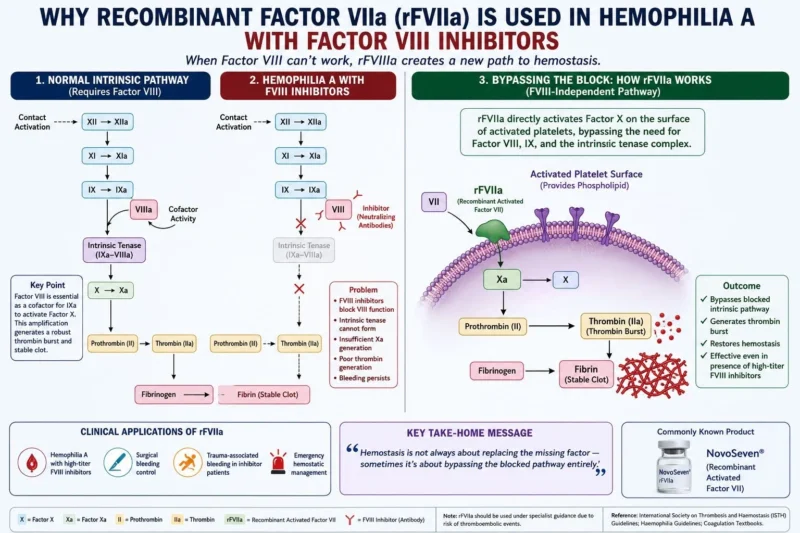
- Factor VIII acts as a cofactor for Factor IXa
- Together they form the intrinsic tenase complex.
- This complex activates Factor X to Xa
- Xa then converts prothrombin to thrombin, ultimately forming fibrin clot
But when FVIII inhibitors are present:
- The intrinsic pathway is blocked
- Adequate thrombin generation fails
- Bleeding persists despite FVIII infusion
This is where rFVIIa becomes clinically crucial.
Mechanism of Action of rFVIIa
Recombinant activated Factor VII directly activates Factor X on the activated platelet surface, largely bypassing the need for:
- Factor VIII
- Factor IX
- Intrinsic tenase complex
This generates a ‘thrombin burst’, leading to:
- Stable fibrin clot formation
- Improved hemostasis
- Control of life-threatening bleeding episodes
Why It’s Called a ‘Bypassing Agent’
Because rFVIIa essentially circumvents the blocked intrinsic pathway and utilizes an alternative route to generate thrombin.
Instead of repairing the defective pathway, it simply goes around it.
That is advanced coagulation therapeutics in action.
Clinical Importance
- rFVIIa is especially valuable in:
- Hemophilia A with high-titer FVIII inhibitors
- Surgical bleeding control
- Trauma-associated bleeding in inhibitor patients
- Emergency hemostatic management
Commonly known product: NovoSeven
Key Hemostasis Concept
Hemostasis is not always about replacing the missing factor-sometimes it’s about bypassing the blocked pathway entirely.”
Stay updated with Hemostasis Today.
-
Oct 20, 2026, 02:37M. Sekip Altunkan: Can Anticoagulation Be Safely Stopped After AF Ablation?
-
Oct 20, 2026, 02:26Ahmed Ammar: Managing VT Recurrence Post-Ablation
-
Oct 20, 2026, 01:43Oliver Weingärtner: Deprescribing of Lipid Lowering Drug after MI is Associated with Cardiovascular Events
-
Oct 19, 2026, 19:44Where You Live Should not Determine Whether You Receive Care – World Federation of Hemophilia
-
Oct 19, 2026, 19:42Belen Bianco: Prevention, Early Suspicion and an Interdisciplinary Approach Save Lives
-
Oct 19, 2026, 19:40Christina Chrysohoou: Catheter-Based LAAC vs OAC for Stroke Prevention in Atrial Fibrillation
-
Oct 19, 2026, 19:38Matthew Flick: A Two-Day Research Meeting on Fibrinogen, Hemostasis and Thrombosis
-
Oct 19, 2026, 19:37Hayat Saeed: Excited to Share Our Publication on the FGL1–Hepcidin Axis in Iron Homeostasis and Disease
-
Oct 19, 2026, 19:08IPAW 2026 Comes to a Close, but the Work Continues – PPTA