


Ney Carter Borges: Where the Benefit Appears in Dual Antiplatelet Therapy
Ney Carter Borges, Member Cardiologist of Global Physician Association at Cleveland Clinic Florida, shared on LinkedIn:
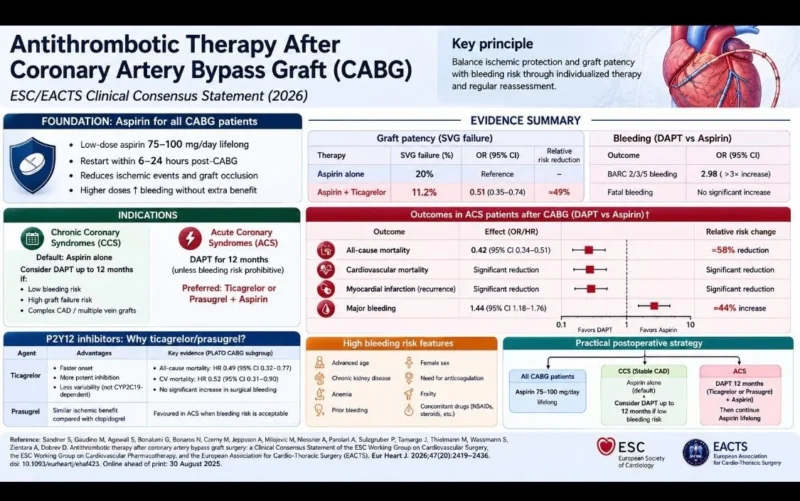
”Dual Antiplatelet Therapy (DAPT): Where the Benefit Appears
The major contemporary question is whether adding a P2Y12 inhibitor (ticagrelor or clopidogrel) to aspirin improves outcomes.
The strongest evidence involves saphenous vein graft (SVG) patency.
A pooled meta-analysis demonstrated:
- SVG failure with aspirin alone: approximately 20%
- SVG failure with ticagrelor plus aspirin: approximately 11.2%
- Relative risk reduction: approximately 49%
- OR 0.51 (95% CI 0.35–0.74; P < .001)
This means:
- Approximately 1 graft failure prevented for every 10 patients treated
- Number Needed to Treat (NNT) ≈ 10
However, this benefit came with increased bleeding:
- Clinically relevant bleeding nearly tripled
- BARC 2/3/5 bleeding OR 2.98
- No major increase in fatal bleeding was observed
CCS vs ACS: Important Clinical Difference
Chronic Coronary Syndromes (Stable CAD)
In stable CABG patients:
- Aspirin alone remains the default strategy
- DAPT may be considered in:
– Low bleeding risk
– High graft failure risk
– Complex coronary disease
– Multiple vein grafts
Evidence for mortality reduction is less robust here.
Acute Coronary Syndromes (ACS)
The evidence becomes much stronger after ACS.
Patients with ACS remain in a prolonged prothrombotic state after surgery.
Meta-analysis data including more than 77,000 CABG patients showed:
DAPT after ACS-CABG reduced:
All-cause mortality:
- OR 0.42
- approximately 58% relative reduction
Cardiovascular mortality:
- Significant reduction
- Myocardial infarction recurrence:
- Reduced
But bleeding increased:
Major bleeding:
- OR 1.44
- approximately 44% relative increase
Why Ticagrelor and Prasugrel Are Preferred
Compared with clopidogrel:
- Faster onset
- More potent platelet inhibition
- Less variability due to CYP2C19 metabolism
In the PLATO CABG subgroup:
Ticagrelor vs Clopidogrel
All-cause mortality:
- HR 0.49
- approximately 51% relative reduction
Cardiovascular mortality:
- HR 0.52
- No major increase in surgical bleeding
This is why current ESC guidelines favor ticagrelor or prasugrel after ACS-CABG whenever bleeding risk is acceptable.
Bleeding Risk: The Critical Limiting Factor
The document repeatedly emphasizes that bleeding risk often drives decision-making more than ischemic risk.
High-risk bleeding features include:
- Advanced age
- CKD
- Anemia
- Female sex
- Prior bleeding
- Need for anticoagulation
- Frailty
The PRECISE-DAPT and WILL-BLEED scores may help estimate risk, although CABG-specific validation remains limited.
Practical Modern Strategy
Stable CABG (CCS)
- Aspirin lifelong
- Consider 12 months DAPT only if:
- Low bleeding risk
- High graft thrombosis risk
ACS plus CABG
- DAPT for 12 months is standard
- Prefer:
- Ticagrelor plus aspirin
- Prasugrel plus aspirin
- Then lifelong aspirin
Final Clinical Perspective
The modern post-CABG approach is no longer ‘one-size-fits-all.”’
Stay updated with Hemostasis Today.
-
Oct 6, 2026, 08:55Konstantin Yenkoyan: CAR-T, GLP-1 or Orexin – Who Will Take the 2026 Nobel?
-
Oct 6, 2026, 08:39Emily Bury: Putting Patients at the Centre of VTE Care
-
Oct 6, 2026, 07:44Carolina Moreira Ponce: Thrombosis Month – Why Prevention Starts With Risk Assessment
-
Oct 6, 2026, 07:03Laila Ahmed: Stroke Imaging – A Practical Radiology Approach
-
Oct 6, 2026, 05:52David Esposito: Can Standard Ultrasound Detect May Thurner Syndrome?
-
Oct 6, 2026, 04:33Hessam Kakavand: Rethinking Thrombotic Risk in Modern Cancer Therapy
-
Oct 6, 2026, 04:07Moussa Zein Aldine: Acute Coronary Syndrome Every Minute Matters
-
Oct 6, 2026, 03:13Patrick Taylor: Glow Stack Trend What the Evidence Really Shows
-
Oct 6, 2026, 02:59Preventing Hospital Associated Venous Thromboembolism – Thrombosis Canada