


Kalpana Gupta Shekhawat: Ferritin Is More Than an Iron Marker
Kalpana Gupta Shekhawat, Chairperson at the Functional and Metabolic Medicine Academy, Gurugram, India, shared a post on LinkedIn:
”Ferritin and Methylation: A Link Worth Paying Attention To
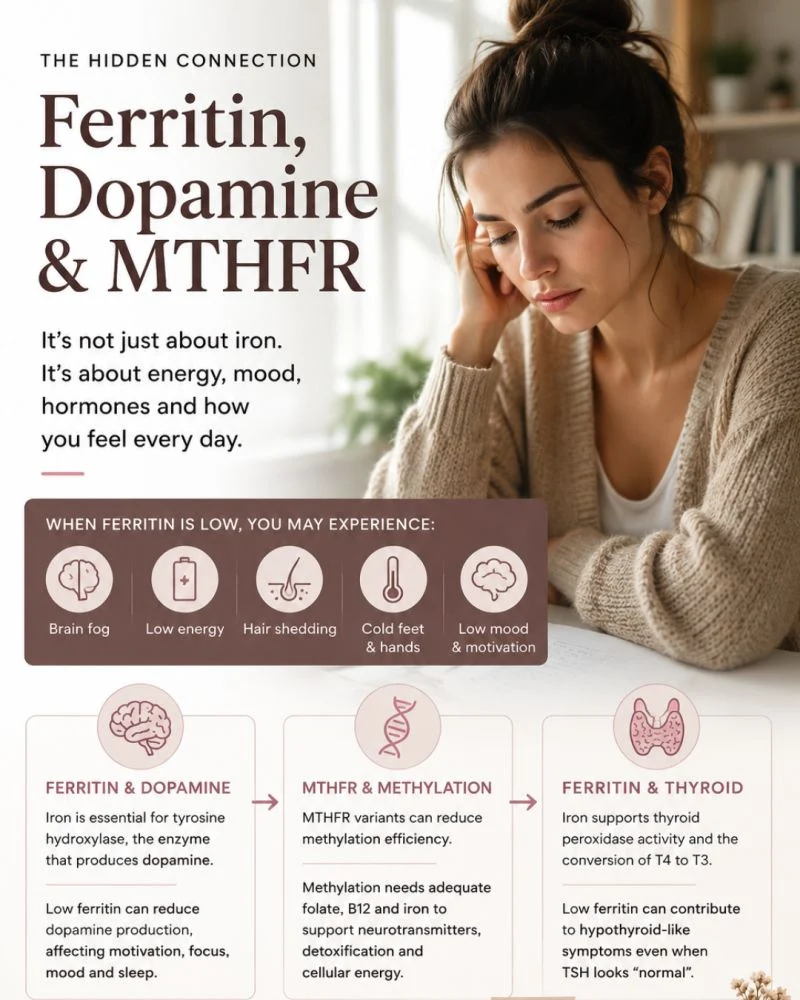
Ferritin is usually read as a simple iron storage marker used to rule out anemia. But in clinical practice, it often tells a much wider story – about energy production, brain chemistry, and overall metabolic resilience.
One connection that rarely gets enough attention is ferritin and dopamine. Iron is required for the enzyme tyrosine hydroxylase, which controls the rate of dopamine production.
When iron stores run low, dopamine synthesis can slow down – even when hemoglobin is still normal.
This is why some patients report low drive, poor focus, reduced motivation, sleep changes, or a general sense of ‘slowness,’ despite normal routine labs.
This becomes more relevant in patients with MTHFR variants.
The variant itself is not the issue in isolation – what matters is the biochemical environment around it.
Methylation is a high-demand process that depends on adequate nutrients, especially folate, B12, and iron.
When ferritin is low, the system simply doesn’t have enough reserve to maintain smooth neurotransmitter balance and cellular energy output.
In practice, these patients don’t always look ‘deficient’ on paper.
Hemoglobin may be normal, thyroid values unremarkable, and B-vitamin status adequate – yet symptoms persist. Fatigue, brain fog, hair shedding, and emotional flatness are often what bring them in.
Iron also has a direct role in thyroid physiology. It supports thyroid peroxidase activity and the conversion of T4 to active T3.
Low ferritin can therefore contribute to a hypothyroid-like picture even when TSH is within range, which is often missed in routine screening.
What makes this more complex is that standard reference ranges do not always reflect functional needs.
Ferritin between 15–40 ng/mL is often labeled as ‘normal,’ but many patients remain symptomatic in this range.
The body’s requirement is not uniform – it varies with physiology, stress load, and metabolic demand.
In the end, the real question is not whether ferritin is ‘normal,’ but whether it is enough for that individual’s neurological and metabolic function.
Ferritin sits quietly at the intersection of dopamine, thyroid function, and methylation.
When it is low, the effects are often subtle, but very real – and frequently overlooked in routine clinical interpretation.”
Stay updated with Hemostasis Today.
-
Oct 10, 2026, 17:58Archo Farzana Batool: Exploring Medical Writing Through an Article on Iron Deficiency Anemia
-
Oct 10, 2026, 17:53Assessing Frailty in Adults With Hemophilia – JTH
-
Oct 10, 2026, 17:52Fatma Sadeghi: Reducing Maternal Health Inequalities Through Nursing Advocacy
-
Oct 10, 2026, 17:50Grzegorz Hensler: How Apheresis Transformed Blood Cell Separation and Collection
-
Oct 10, 2026, 17:47Hemant K Sharma: Japan’s Universal Artificial Blood Research – A Potential Breakthrough in Transfusion Medicine
-
Oct 10, 2026, 17:40John Strouse: Learning About Bleeding Disorders and Sickle Cell Disease at FWGBD
-
Oct 10, 2026, 17:34Mae Caime: Speaking at the Annual Women’s Retreat for the Hemophilia Community in Florida
-
Oct 10, 2026, 17:30Chokri Ben Lamine: PNH beyond the Textbook Triad
-
Oct 10, 2026, 17:29Ruah Alyamany: Thrombosis and Anticoagulation in Hematological Malignancies at SOHO KSA 2026