


Smitirupa Mishra: Standardizing RBC Morphology Reporting – Why ICSH Guidelines Matter?
Smitirupa Mishra, Consultant Pathologist at Sparsh Hospitals and Lab Head at Pathkind Labs, shared a post on LinkedIn:
“Standardizing RBC Morphology Reporting: Why ICSH Guidelines Matter
Red blood cell morphology remains one of the most valuable components of peripheral smear examination.
However, it is also one of the areas where significant inter-observer variability exists.
Terms such as ‘few’, ‘occasional’, ‘mild’, or ‘moderate’ may mean different things to different observers, leading to confusion among clinicians and inconsistency across laboratories.
This is where the International Council for Standardization in Haematology (ICSH) guidelines play a crucial role.
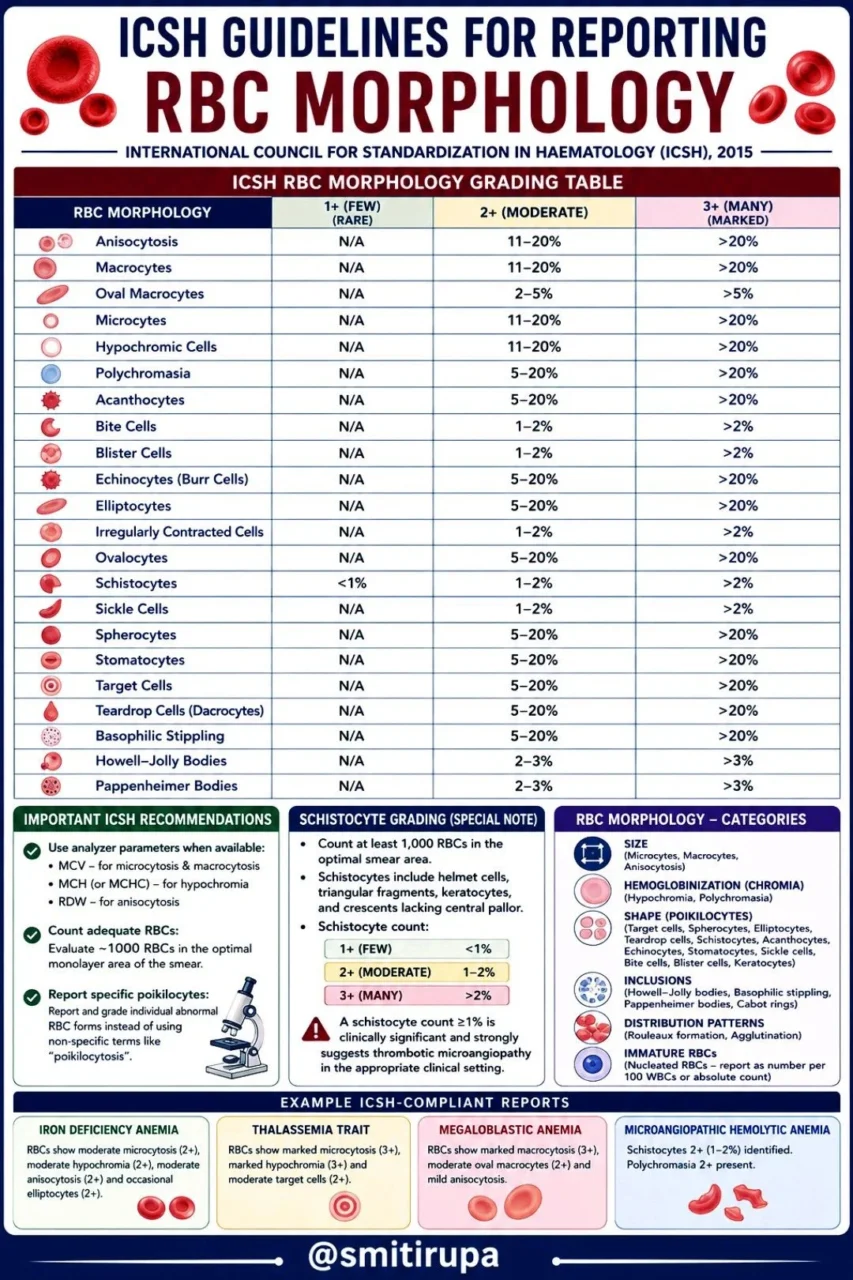
The ICSH recommendations provide a standardized framework for reporting RBC morphological abnormalities, including:
- Anisocytosis
- Microcytosis and Macrocytosis
- Hypochromia
- Target cells
- Elliptocytes
- Spherocytes
- Schistocytes
- RBC inclusions and other poikilocytes
By defining percentage-based grading criteria, the guidelines help:
- Reduce subjectivity in reporting
- Improve inter-laboratory consistency
- Enhance communication with clinicians
- Facilitate better patient management and follow-up
- Strengthen quality assurance practices in hematology laboratories
One particularly important aspect is the reporting of schistocytes, where even small percentages can have significant clinical implications and may point toward life-threatening thrombotic microangiopathies.
As laboratory professionals, adopting standardized reporting systems is not merely about compliance—it is about improving diagnostic accuracy and ensuring that every morphology report conveys clear, reproducible, and clinically meaningful information.
The next time you report an RBC morphology, ask yourself:
Are we describing what we see, or are we reporting it in a standardized manner that others can interpret consistently?
Standardization transforms morphology from an art into a reproducible science.”
Stay updated with Hemostasis Today.
-
Oct 20, 2026, 16:51Suzan Nakasendwa: A Growing Stroke Challenge in Uganda
-
Oct 20, 2026, 16:38Steve Moon: How Does Smoking Cessation Duration Affect Ischemic Stroke Risk
-
Oct 20, 2026, 16:25Cedrice Mentor: Reducing Platelet Wastage Through Cold Storage
-
Oct 20, 2026, 16:09Thirunavukkarasu Angappan: Can a Purified Fibrinogen Concentrate Replace Cryoprecipitate
-
Oct 20, 2026, 16:01Kalyan Roy: Platelet Conservation Through Evidence-Based Transfusion Practice
-
Oct 20, 2026, 15:28Stacy E. Croteau: 33 Countries, One Mission – Better Bleeding Disorder Care
-
Oct 20, 2026, 15:19Teresa Barnes: What Does a Pulmonary Embolism Mean for Jalen Hurts?
-
Oct 20, 2026, 15:04Laura S.: Could Speaking Up Prevent Maternal Deaths from Thrombosis?
-
Oct 20, 2026, 14:44Pete Stibbs: VTE in Professional Athletes – When Fitness Is Not Enough