


Karina Sultankulova: Smarter D-Dimer Strategies for Safe and Efficient DVT Exclusion
Karina Sultankulova, Clinical Director at American Medical Centers, shared on LinkedIn about a recent article by Menno V Huisman and Kenneth A Bauer, published in UpToDate, adding:
”In clinical practice, ruling out Deep Vein Thrombosis (DVT) using a fixed D-dimer cutoff of 500 ng/mL often leads to over-testing, especially in older adults where baseline levels naturally rise.
Modern, evidence-based strategies allow us to safely optimize efficiency without compromising patient safety:
1. Age-adjusted cutoff
For patients >50 years old with a low/moderate pretest probability, use the following validated formula:
Age (years) x 10 ng/mL
The evidence:
Data from a multicenter prospective study of 3,205 patients showed that this approach safely ruled out DVT without compression ultrasonography (CUS).
At 3 months, there were zero VTE events in patients who fell between the fixed 500 ng/mL and their higher age-adjusted limit.
The impact: In patients ≥75 yo, it tripled the number of people who could safely avoid unnecessary imaging (16% vs. 5% using the conventional cutoff), significantly increasing specificity.
2. Pretest probability (PTP)-Adjusted Cutoff
This strategy adjusts the D-dimer threshold based on clinical risk assessment (e.g., Wells Score):
Low PTP: DVT is excluded if D-dimer is <1000 ng/mL.
Moderate PTP: DVT is excluded if D-dimer is <500 ng/mL.
The Impact: Clinical studies show this reduces the overall need for ultrasound scans by 8% to 47%, maintaining an incredibly safe missed-thrombosis rate of less than 0.6% during follow-up.
Key takeaway:
Adopting adjusted D-dimer cutoffs reduces unnecessary diagnostic imaging, lowers healthcare costs, and spares elderly patients from redundant hospital stress – all while safely excluding thromboembolic events.”
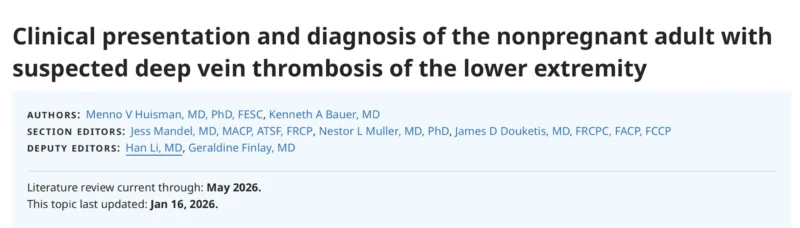
Title: Clinical presentation and diagnosis of the nonpregnant adult with suspected deep vein thrombosis of the lower extremity
Authors: Menno V Huisman, Kenneth A Bauer
Stay updated on all scientific advances with Hemostasis Today.
-
Sep 25, 2026, 07:25Varun Capoor: How Therapeutic Apheresis and Transfusion Medicine Can Complement Clinical Management in SCD
-
Sep 25, 2026, 07:14Manshi Kesharwani: SAK-GQDs Modulate Thrombus Burden and Endothelial Function in Deep Vein Thrombosis
-
Sep 25, 2026, 06:20Farjah Hassan Algahtani: How Can We Better Identify Patients at Risk of Blood Clots after Metabolic and Bariatric Surgery?
-
Sep 25, 2026, 05:59Carla Lewis: Kids Conquering Sickle Disease Joins Nemours Children’s Hospital for 2nd Annual Awareness Event
-
Sep 25, 2026, 05:47Omid Seidizadeh: Evolutionary Constraint and Population Variation Across Coagulation Genes
-
Sep 25, 2026, 05:40Gerald Bertrand: Presenting UMi-NGS Non-Invasive Foetal HPA Genotyping at DGTI 2026
-
Sep 25, 2026, 05:33Urge Congress to support the Sickle Cell Disease Comprehensive Care Act – ASH
-
Sep 25, 2026, 05:24Isabelle Mahé: Reduced-Dose Apixaban in Extended CAT Treatment
-
Sep 25, 2026, 05:15Maria Cherska: High Cholesterol Isn’t Always Diet or Lifestyle – Sometimes It’s Genetic