

John Jaksich: Heparin and Anticoagulants – Chemistry, Biotechnology, and Manufacturing
John Jaksich, Science Writer, shared a post on LinkedIn:
“If you have ever had surgery, the medical team will often inject you with a substance known as heparin.
It is an important pharmaceutical.
Heparin is an anticoagulant — or blood thinner, if you will.
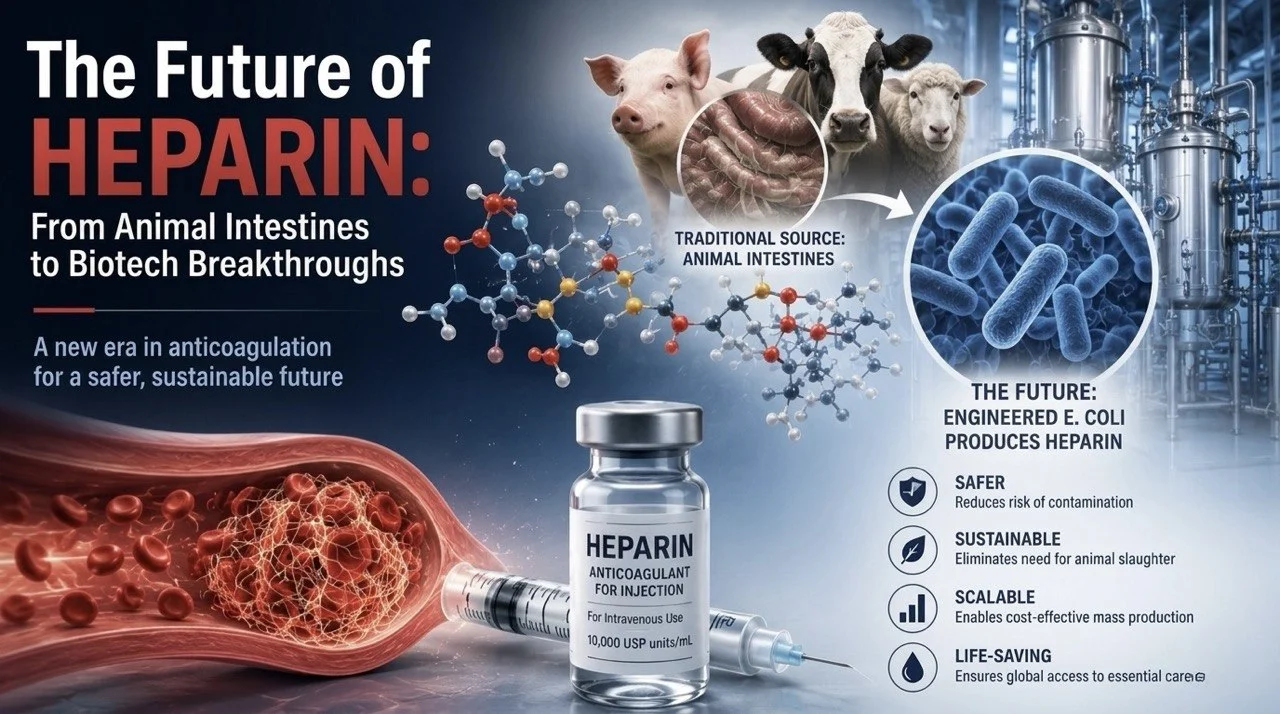
It is presently manufactured from the intestines of hogs, sheep, and cows.
The intestines are harvested through a process by which the intestines are rendered into substances called resins—a synthetic substance.
Resins are similar to scaffolding where heparin can be produced.
Interestingly, it is estimated that over 1 billion hogs are slaughtered yearly for the production of heparin supplies throughout the world.
Muslim countries prefer to use cow-derived heparin for religious reasons.
However, some good news appears on the horizon; there is a breakthrough in the manufacturing of heparin. Instead of pig’s intestines, Escherichia coli (the bacterium) is engineered to mass-produce heparin.
Heparin was discovered in 1916 at John Hopkins University by Jay McClean through experimentation with animals.
After the discovery, it took about 15 years until it could successfully be manufactured. The use of heparin during surgery ensured individuals did not needlessly die during life-saving procedures.
The success of animal heparin continued until 2007 when contaminated heparin entered the marketplace.
One side effect from the contaminated heparin included rapid drops in blood pressure that resulted in deaths.
It was later learned that the primary producer of heparin reported quality control problems that led to the contamination.
The US attempted to step up its own production of heparin, but it was cost prohibitive.
However, in the same year as the contaminated heparin entered the marketplace, a breakthrough occurred in the synthesis of heparin in the US. Drs. Linhard and Liu reported the first synthesis of heparin from bacteria, Escherichia coli.
Several other groups reported similar breakthroughs.
However, the successes were not transferred into the manufacturing of heparin.
So, the slaughter of animals continued until quite recently.
Chinese workers reported earlier this year that they had broken the bottleneck that was preventing the successful manufacture of heparin.
Through the utilization of evolutionary models and computational studies, the workers tested different ways to utilize known enzymatic pathways to synthesize heparin.
Namely, different species of animals and insects produce heparin-like substances.
By introducing genetically similar means of producing heparin from a higher species like a fruit fly or mosquito into E. coli, they were able to literally mass-produce a heparin equivalent. Moreover, this successfully surmounts the bottlenecks of potential animal contamination that occurred in 2007 and allows for the scale-up from lab bench production to mass production.
Alternatives to Heparin
While I have delved primarily into heparin, there are alternatives to it. First, there is Coumadin.
Coumadin is administered orally, while heparin is administered intravenously.
Coumadin (also known as Warfarin) acts as a Vitamin K antagonist (Vitamin K is an enzyme that naturally induces blood coagulation through the liver).
It is an older generation anticoagulant that must be monitored via blood draws.
There is a group of newer anticoagulants that have seen quite a bit of advertising on mainstream media: they include Eliquis, Xarelto, Pradaxa, and Savaysa.
I will not dwell on these new generations of blood thinners other than to say no blood monitoring is normally required.
There are two other injectable alternatives to heparin: Lovenox and Arixtra.
These are short-term blood thinners that are normally used during hospital stays and briefly at home.
- Li, Yi. et. al. ‘Wholly enzymatic programmable sulfation in nonanimal heparin synthesis.’ Trends in Biotechnology. 2026.
- Linhardt, Robert J., and Jian Liu. ‘Synthetic heparin.’ Current opinion in pharmacology 12.2 (2012): 217-219.
- Marcum, James A. ‘William Henry Howell and Jay McLean: the experimental context for the discovery of heparin.’ Perspectives in Biology and Medicine 33.2 (1990): 214-230.
- Toyoda, Hidenao, et al. ‘Structural analysis of glycosaminoglycans in animals bearing mutations in sugarless, sulfateless, and tout-velu: Drosophila homologues of vertebrate genes encoding glycosaminoglycan biosynthetic enzymes.’ Journal of Biological Chemistry 275.29 (2000): 21856-21861.
- Van der Meer, Jan-Ytzen, Edwin Kellenbach, and Leendert J. Van den Bos. ‘From farm to pharma: an overview of industrial heparin manufacturing methods.’ Molecules 22. (2017): 1025.”

Stay updated with Hemostasis Today.
-
Sep 29, 2026, 19:00Caitlin Raymond: Can Artificial Blood Solve Blood Supply Shortages?
-
Sep 29, 2026, 18:51Chaza Alaji: Dyslipidemia, Thrombosis and the DIC Diagnostic Trap
-
Sep 29, 2026, 17:31Rajnikant Patel: Bridging Ayurvedic Concepts and Modern Toxin-Mediated Disease
-
Sep 29, 2026, 17:13Nicholas Lang։ A Meaningful Case of Immune Thrombocytopenia
-
Sep 29, 2026, 16:55Ayatullah Gamal Wahab: When the CBC Lies
-
Sep 29, 2026, 16:35Jonathan Douxfils: Navigating the VTE Risk Continuum in Reproductive Medicine
-
Sep 29, 2026, 16:35Chaima Rajeh: Types of Anemia and Their Laboratory Features
-
Sep 29, 2026, 16:27Scott Isaacs: How GLP-1 RAs Target Systemic Inflammation to Drive Cardio, Autoimmune, and Gut Health
-
Sep 29, 2026, 16:21Yitshak Kreiss: From Treating Patients to Defining the Standard of Knowledge