


Nabil Tabish: The Paradox of Zero – Investigating Extreme VWF Discordance
Nabil Tabish, Regional Medical Director at Kaiser Permanente, shared a post on LinkedIn:
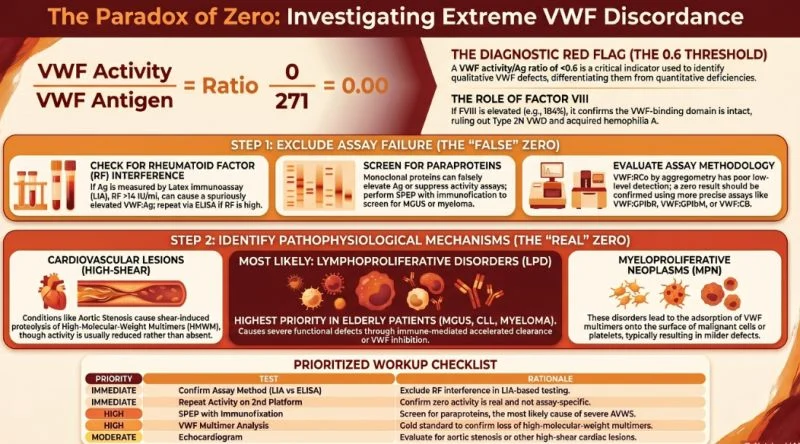
“The infographic highlights the investigation of extreme VWF discordance, specifically when a patient presents with a severe qualitative defect yielding a VWF activity/Ag ratio of 0.00.
It emphasizes that clinicians must first rule out potential assay failures, such as rheumatoid factor or paraprotein interference, before confirming a true diagnosis.
It details the primary causes of Acquired von Willebrand Syndrome (AVWS), illustrating pathophysiological mechanisms like antibody-mediated clearance, high-shear proteolysis, and tumor cell adsorption.
It identifies lymphoproliferative disorders as the most likely mechanism causing such a severe, near-zero VWF activity defect in elderly patients.
Lastly, it demonstrates how an elevated FVIII level helps confirm the defect is isolated to specific VWF domains by completely ruling out conditions like Type 2N VWD and acquired hemophilia A.”
Stay updated with Hemostasis Today.
-
Sep 29, 2026, 19:00Caitlin Raymond: Can Artificial Blood Solve Blood Supply Shortages?
-
Sep 29, 2026, 18:51Chaza Alaji: Dyslipidemia, Thrombosis and the DIC Diagnostic Trap
-
Sep 29, 2026, 17:31Rajnikant Patel: Bridging Ayurvedic Concepts and Modern Toxin-Mediated Disease
-
Sep 29, 2026, 17:13Nicholas Lang։ A Meaningful Case of Immune Thrombocytopenia
-
Sep 29, 2026, 16:55Ayatullah Gamal Wahab: When the CBC Lies
-
Sep 29, 2026, 16:35Jonathan Douxfils: Navigating the VTE Risk Continuum in Reproductive Medicine
-
Sep 29, 2026, 16:35Chaima Rajeh: Types of Anemia and Their Laboratory Features
-
Sep 29, 2026, 16:27Scott Isaacs: How GLP-1 RAs Target Systemic Inflammation to Drive Cardio, Autoimmune, and Gut Health
-
Sep 29, 2026, 16:21Yitshak Kreiss: From Treating Patients to Defining the Standard of Knowledge