


Aryabhatta Sadhu: ABO and Rh Incompatibility In Stem Cell Transplantation
Aryabhatta Sadhu, Attending Consultant and Head of Transfusion Medicine at Fortis Hospital Shalimar Bagh, New Delhi, shared a post on LinkedIn:
“When ABO and Rh incompatibilities enter the transplant timeline, blood support stops being routine.
The question is no longer:
‘Which blood group should be issued?’
The real question becomes:
‘Whose red cells, whose antibodies, and whose marrow are dominant today?’
Case report decision dropdown
ABO/Rh-incompatible haploidentical HSCT is not a single transfusion decision.
It is a phase-wise Transfusion Medicine problem.
This case involved:
- haploidentical HSCT
- minor ABO mismatch
- major Rh incompatibility
- harvest and graft-risk assessment
- peri-transplant component planning
- post-transplant haemolysis surveillance
The practical challenge was not simply blood availability.
It was answering four recurring questions:
- Whose haematopoiesis is dominant?
- Whose antibodies are active?
- Which blood group should be supported today?
- Is the post-transplant problem cytopenia, haemolysis, or delayed engraftment?
Pre-transplant
Start before conditioning.
Map ABO/RhD status, antibody screen, DAT baseline, isoagglutinins, and component policy. HCT candidates require a clear plan for leukoreduced and irradiated support.
Harvest / graft
The graft is not just CD34-positive cells.
Assess plasma incompatibility, red cell contamination, donor antibody burden, and whether graft manipulation is required.
Peri-transplant
This is where routine transfusion logic becomes dangerous.
The patient’s blood group is biologically in transition. Red cells, platelets, and plasma require phase-specific selection based on donor-recipient compatibility.
Post-transplant
Do not reduce every falling haemoglobin to expected cytopenia.
In ABO-mismatched HSCT, consider delayed haemolysis, passenger lymphocyte effect, delayed erythroid engraftment, PRCA-like patterns, and chimerism context.
Why Transfusion Medicine matters
The value is not ‘issuing blood.’
The value is maintaining transplant-support continuity through:
- immunohaematology mapping
- safe component selection
- graft-risk assessment
- haemolysis surveillance
- donor-recipient compatibility transition
It is transplant immunohaematology in motion.”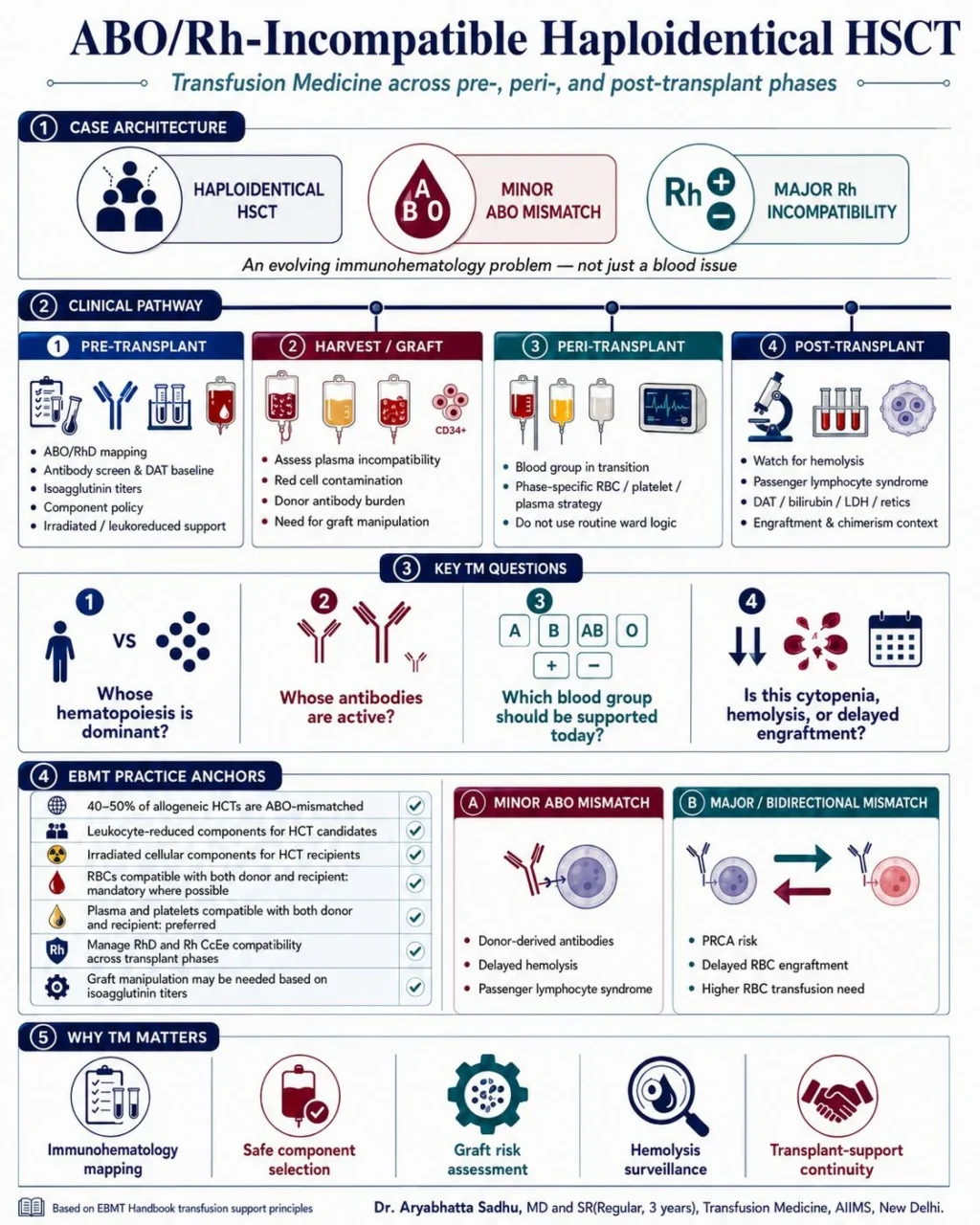
Other posts featuring Aryabhatta Sadhu with Hemostasis Today.
-
Sep 29, 2026, 17:13Nicholas Lang։ A Meaningful Case of Immune Thrombocytopenia
-
Sep 29, 2026, 16:55Ayatullah Gamal Wahab: When the CBC Lies
-
Sep 29, 2026, 16:35Jonathan Douxfils: Navigating the VTE Risk Continuum in Reproductive Medicine
-
Sep 29, 2026, 16:35Chaima Rajeh: Types of Anemia and Their Laboratory Features
-
Sep 29, 2026, 16:27Scott Isaacs: How GLP-1 RAs Target Systemic Inflammation to Drive Cardio, Autoimmune, and Gut Health
-
Sep 29, 2026, 16:21Yitshak Kreiss: From Treating Patients to Defining the Standard of Knowledge
-
Sep 29, 2026, 16:18Edward Lee Carter: Why Periprocedural DOAC Guidance Needs a Common Output Standard
-
Sep 29, 2026, 16:07Yasmine Laraba: Deep Vein Thrombosis Causes, Signs and Management
-
Sep 29, 2026, 16:01Stephen Cornelissen: How Joining the Stem Cell Registry Can Save Patients with Blood Cancers