


Ifeanyichukwu Ifechidere: We’ve Trained an Entire Generation of Clinicians to Fear The Wrong Thing About HIT
Ifeanyichukwu Ifechidere, Specialist Biomedical Scientist at Sheffield Teaching Hospitals NHS Foundation Trust, shared a post on LinkedIn:
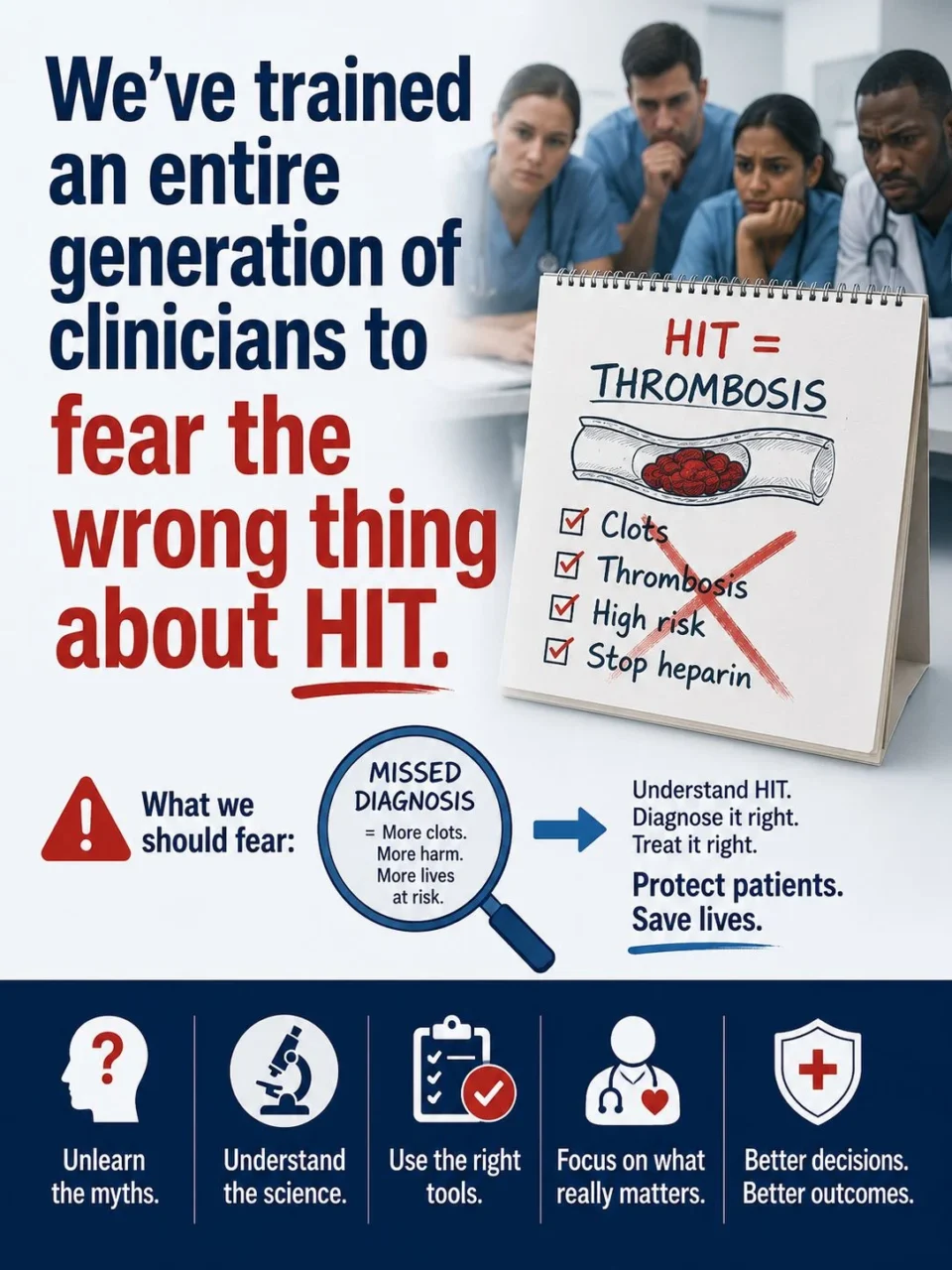
“We’ve trained an entire generation of clinicians to fear the wrong thing about HIT.
A falling platelet count makes everyone think ‘bleeding risk.’ Hold the heparin, watch for bruising, maybe transfuse platelets if it drops low enough.
That instinct, in Heparin-Induced Thrombocytopenia, can kill the patient.
Here’s the uncomfortable truth about HIT
The Paradox
HIT is not a bleeding disorder. It’s a prothrombotic disease that happens to present with a falling platelet count. The platelets aren’t dropping because the patient is bleeding — they’re dropping because they’re being consumed, forming clots.
Thrombosis, not haemorrhage, is what kills HIT patients. Transfusing platelets in classic HIT can actively fuel the fire.
The 4th Score— Your First Filter
Before any lab test, the 4Ts assess:
- Thrombocytopenia (degree of platelet fall)
- Timing (typically 5-10 days post-heparin exposure)
- Thrombosis (new clot, arterial or venous)
- Other causes excluded
A low 4T score has strong negative predictive value — it can rule HIT out before you even order an antibody test. This step gets skipped far too often, leading to unnecessary anxiety and unnecessary heparin cessation.
PF4/Heparin Antibodies
The immunoassay (ELISA) is sensitive but not specific. A positive result tells you antibodies are present — not that they’re clinically active.
This is where over-diagnosis creeps in: a positive PF4 antibody test alone, without clinical correlation, leads to patients being unnecessarily labelled as HIT-positive for life, closing the door on future heparin use when it might genuinely be needed.
Functional Assays — The True Confirmation
Serotonin release assay or heparin-induced platelet aggregation tests whether those antibodies actually activate platelets.
This is the step that separates ‘antibodies present’ from ‘disease active.’ Skipping straight from a positive ELISA to a life-changing diagnosis, without functional confirmation, is where a lot of clinical harm quietly happens.
The Controversial Part
We over-test, over-diagnose, and under-think HIT. A falling platelet count triggers panic and an immediate antibody test, when a properly calculated 4T score would have ruled it out first.
And when HIT is confirmed, the instinct to ‘support the platelets’ is precisely backwards — the priority is alternative anticoagulation, not platelet transfusion.
Diagnosing HIT isn’t about chasing a number. It’s about understanding a paradox — and resisting the urge to treat the platelet count instead of the disease behind it.
This is the kind of nuanced diagnostic reasoning I unpack in Coagsimplified.”
Find more posts featuring Ifeanyichukwu Ifechidere on Hemostasis Today.
-
Jul 22, 2026, 10:16Ney Carter Borges: Understanding Pathophysiology as the Foundation of Precision Cardiovascular Care
-
Jul 22, 2026, 10:01George Cieutat: Strengthening Connections Across the Bleeding Disorders Community
-
Jul 22, 2026, 09:57Ming Y Lim: Demonstrating the Value of Upfront Emicizumab at ISTH 2026
-
Jul 22, 2026, 09:52Danny Hsu: Get to Do Some Fun Stuff at ISTH 2026
-
Jul 22, 2026, 09:48Nita Radhakrishnan: The People Behind the Science at ISTH 2026
-
Jul 22, 2026, 09:46Clinical Trial Recruitment for the HARP Mother–Baby Study – HARP
-
Jul 22, 2026, 09:41Shaymaa Alhabib: From My First PhD Poster to ISTH 2026
-
Jul 22, 2026, 09:35A Novel Peptide Strategy to Prevent Surface-Triggered Thrombosis – JTH
-
Jul 22, 2026, 09:29Alessandra Bosch: Presenting the Latest Evidence in Pediatric Anticoagulation at ISTH 2026