

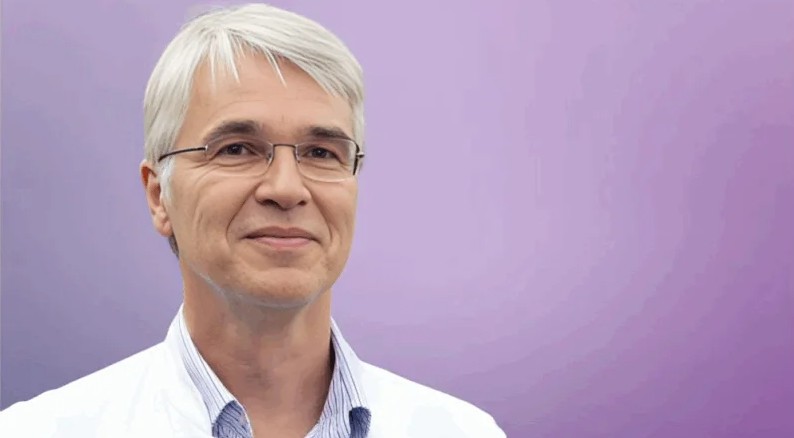
Wolfgang Miesbach on Lifelong Monitoring and Therapy Trends in Female Hemophilia Carriers
Wolfgang Miesbach, Professor of Medicine at Frankfurt University Hospital, shared a post on Linkedin:
“New Insights into Haemophilia Carriers Across the Lifespan. For too long, haemophilia has been viewed as a ‘male disorder,’ and female carriers neglected in research and clinical care.
A new study—just published in Research and Practice in Thrombosis and Haemostasis—is changing this narrative.
This multicenter retrospective cohort study utilized the robust American Thrombosis and Hemostasis Network (ATHN) dataset to analyze the largest U.S. cohort of documented haemophilia carriers to date:
The authors focused on the clinical phenotype of haemophilia carriers (HCs) throughout the entire lifespan—leveraging the ATHN dataset of 3,663 female carriers (2,728 HA-C, 935 HB-C) from 2010–2020. By grouping participants by age (children, reproductive years, and >50 years), they captured bleeding patterns beyond the traditionally studied reproductive window.
Main Findings
- Joint bleeding is prevalent at all ages—not just reproductive years—with increasing risk in older carriers. This highlights the need for vigilant, lifelong monitoring of musculoskeletal health
- Most carriers had factor levels near normal, but bleeding in haemophilia A was more frequent than haemophilia B, underscoring that “normal” levels may not guarantee mild phenotype
- Factor VIII levels increased with age in haemophilia A carriers — deserving further study to understand its impact on bleeding risk
- Utilization of both factor and non-factor therapies is rising, reflecting growing clinical awareness and improved management
- Medical alert device use remains unusually low (<12%), emphasizing the ongoing need to educate patients and clinicians that haemophilia carriership is a genuine bleeding disorder
Clinical Impact and What’s Next
Continuous, multidisciplinary monitoring in Haemophilia Treatment Centers (HTCs) is essential for carriers —across all ages—to ensure timely management and access to specialist care.
Age-specific guidelines should be developed to best address this often-overlooked population, as well as targeted research into the interplay between age, factor levels, and clinical outcomes.
Congratulations to Neeraja Swaminathan, Alison Currie, Jianzhong Hu, Ph.D., Roshni Kulkarni, Steve Pipe, Peter Kouides, M.D., and Anjali Sharathkumar RPTH Journal.”
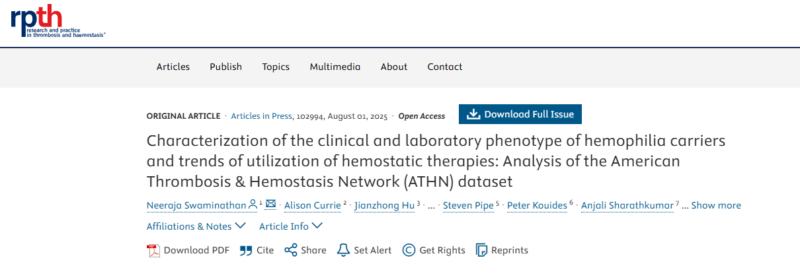
Title: Characterization of the clinical and laboratory phenotype of hemophilia carriers and trends of utilization of hemostatic therapies: Analysis of the American Thrombosis & Hemostasis Network (ATHN) dataset
Authors: Neeraja Swaminathan, Alison Currie, Jianzhong Hu, Roshni Kulkarni, Steven Pipe, Peter Kouides, Anjali Sharathkumar
Read the full article here.
Find similar posts on Hemostasis Today.
-
Oct 10, 2026, 17:58Archo Farzana Batool: Exploring Medical Writing Through an Article on Iron Deficiency Anemia
-
Oct 10, 2026, 17:53Assessing Frailty in Adults With Hemophilia – JTH
-
Oct 10, 2026, 17:52Fatma Sadeghi: Reducing Maternal Health Inequalities Through Nursing Advocacy
-
Oct 10, 2026, 17:50Grzegorz Hensler: How Apheresis Transformed Blood Cell Separation and Collection
-
Oct 10, 2026, 17:47Hemant K Sharma: Japan’s Universal Artificial Blood Research – A Potential Breakthrough in Transfusion Medicine
-
Oct 10, 2026, 17:40John Strouse: Learning About Bleeding Disorders and Sickle Cell Disease at FWGBD
-
Oct 10, 2026, 17:34Mae Caime: Speaking at the Annual Women’s Retreat for the Hemophilia Community in Florida
-
Oct 10, 2026, 17:30Chokri Ben Lamine: PNH beyond the Textbook Triad
-
Oct 10, 2026, 17:29Ruah Alyamany: Thrombosis and Anticoagulation in Hematological Malignancies at SOHO KSA 2026