

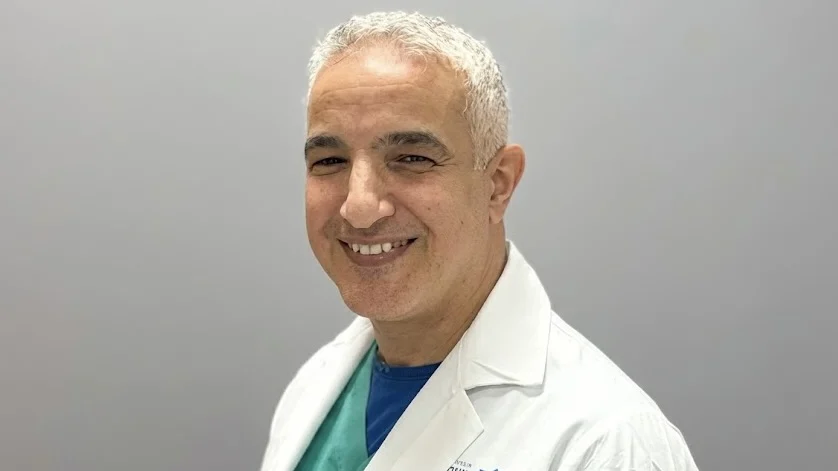
Elad Asher: How Do You Approach Antiplatelet Therapy After the DAPT Month in HBR Patients?
Elad Asher, Professor of Medicine at Shaare Zedek Medical Center, shared a post on LinkedIn about a recent article by Guillaume Marquis-Gravel, published in JACC: Cardiovascular Interventions, adding:
“In high-bleeding-risk (HBR) patients undergoing PCI, we increasingly shorten dual antiplatelet therapy to one month to limit bleeding.
But two questions matter for what we do next: when do events actually occur, and once DAPT stops, does bleeding or ischemia dominate?
A large patient-level pooled analysis in JACC: Cardiovascular Interventions offers a clear map.
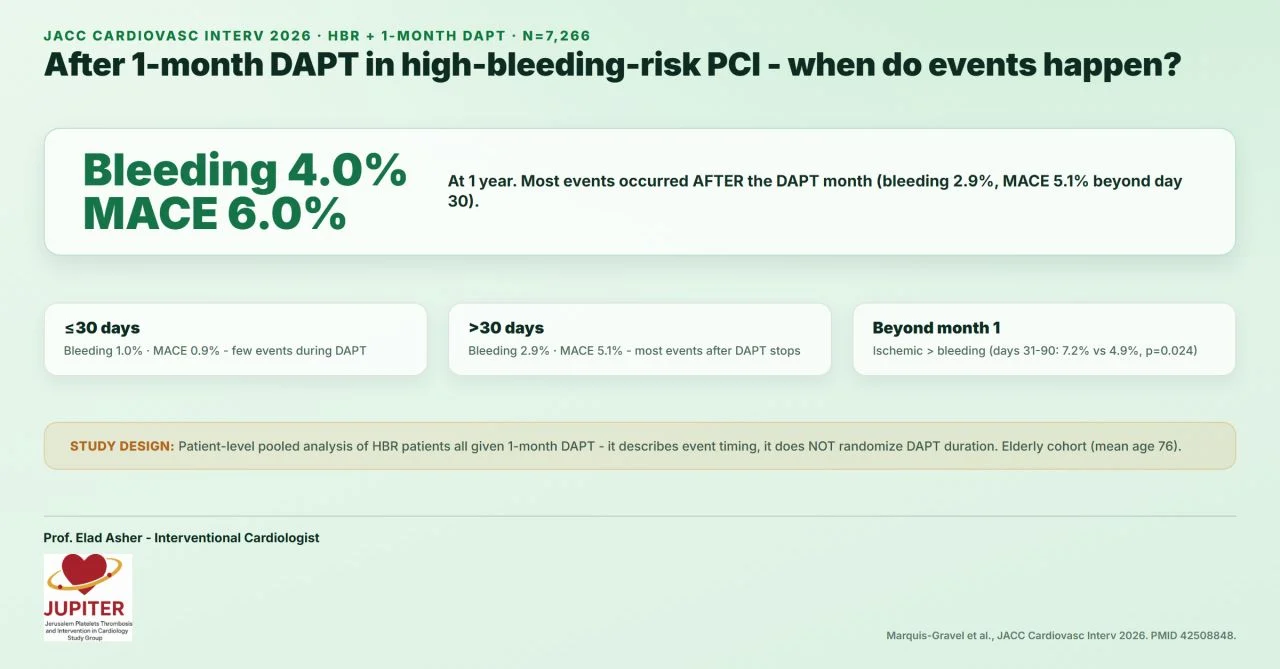
The authors pooled 7 prospective studies – 7,266 HBR patients (mean age 76, 31.5% women) treated with PCI and 1-month DAPT – and examined the timing of major bleeding (BARC 3-5) and ischemic events (MACE) over one year.
The findings: major bleeding occurred in 4.0% (only 1.0% within the first 30 days, 2.9% afterward), and MACE in 6.0% (0.9% within 30 days, 5.1% afterward). In other words, most events – bleeding and ischemic alike – accrued after the DAPT month. And the balance shifted over time: in days 31-90, ischemic events outpaced major bleeding (7.2% vs 4.9%, p=0.024), and in days 91-365 (5.3% vs 3.1%, p<0.001).
What this means in practice: after 1-month DAPT stops, residual ischemic risk in HBR patients is real and, beyond the first month, exceeds major-bleeding risk. It is a useful reminder that high-bleeding-risk patients are frequently high ischemic risk too, and that the antiplatelet strategy after the DAPT month deserves as much thought as the bleeding-avoidance decision that shortened it.
Limitations: this pools patients who all received 1-month DAPT, so it describes event timing rather than randomizing DAPT duration; the cohort is elderly.
It informs the tradeoff, it does not settle it.
For colleagues: how do you approach antiplatelet therapy after the DAPT month in your HBR patients?”
Title: Timing of Bleeding and Ischemic Events in High–Bleeding Risk Patients Treated With 1-Month DAPT
Authors: Guillaume Marquis-Gravel, Davide Cao, Dylan Taylor, Stuart J. Pocock, Angelo Oliva, Samantha Sartori, Giulio G. Stefanini, Philip Urban, Olivier Varenne, Stephan Windecker, Pieter C. Smits, Marco Valgimigli, Roxana Mehran, Mitchell W.

Stay updated on all scientific advances with Hemostasis Today.
-
Sep 19, 2026, 03:15Paulus Kirchhof: Europe’s Safe Hearts Plan to Reduce Cardiovascular Mortality
-
Sep 19, 2026, 03:10James Smith: Brain Training and Exercise for Cognitive Recovery After Stroke
-
Sep 19, 2026, 03:03Lesley Van Wyk: ASH Releases New Iron Deficiency Diagnosis Guidelines
-
Sep 19, 2026, 02:53Francisco Chacón-Lozsán: Acute Ischemic Stroke in 2026 – Expanding the Treatment Window
-
Sep 19, 2026, 01:53Thomas Dayspring: Understanding Genome and Lipid Interactions in Lipidology
-
Sep 19, 2026, 01:47Abdurrahman Tufan: Combination Targeted Therapy in Refractory Systemic Autoinflammatory Diseases
-
Sep 19, 2026, 01:44Patrick James Lynch: Mother of a Thousand Sons Premieres at BDC 2026
-
Sep 19, 2026, 01:41Genetic Fate Mapping Reveals Endothelial Cells During Venous Thrombus Resolution – RPTH Journal
-
Sep 19, 2026, 01:39Mostafa Hammam: Three Different Platelet Defects – One Common Symptom