


Sandeep De: Unraveling the Long-Term Impact of COVID-19 in Hemophilia
Sandeep De, Former Senior Manager at OpenText, shared on LinkedIn about a recent article by Chun Cao et al. published in BMC Infectious Diseases, adding:
“A multicenter study of 254 haemophilia patients in Southwest China finds that COVID-19 infection paradoxically curbed spontaneous bleeding while quietly stacking up mental health costs and long COVID symptoms over six months.
Researchers at hospitals across Chongqing tracked 254 people with haemophilia who contracted COVID-19, following them at 1, 2, 4, and 16 weeks and again at 6 months. The cohort spanned severe (167 patients), moderate (59), and mild (28) disease.
The team measured bleeding frequency, joint health scores, coagulation factor inhibitor formation, long COVID symptoms, and mental state throughout.
Spontaneous bleeding dropped significantly across nearly every body region during active COVID-19 infection, sparing only the gums. Bleeding rates then rose again after the infection cleared, a pattern consistent across all three severity groups.
Despite this fluctuation, joint function held steady over six months: Haemophilia Joint Health Scores measured 21.79 before infection versus 23.81 after, and HEAD-US ultrasound scores measured 20.33 versus 20.62, neither a statistically significant change.
Long COVID and mental health: Chronic cough affected 7.87% of patients and fatigue affected 5.12%, marking the most common lingering symptoms researchers classified as long COVID.
By the six-month mark, roughly 13.39% of patients showed anxiety, and the number reporting moderate or extremely severe depression rose significantly. One patient developed factor VIII inhibitors, a complication that can undermine standard clotting treatment, after the infection.
What it means:
The authors conclude COVID-19 does not appear to damage joint function in people with haemophilia, even as it temporarily suppresses bleeding episodes during active infection.
They call for closer monitoring of long COVID symptoms and mental health conditions in this patient population going forward. The study received no external funding and was published in BMC Infectious Diseases.”
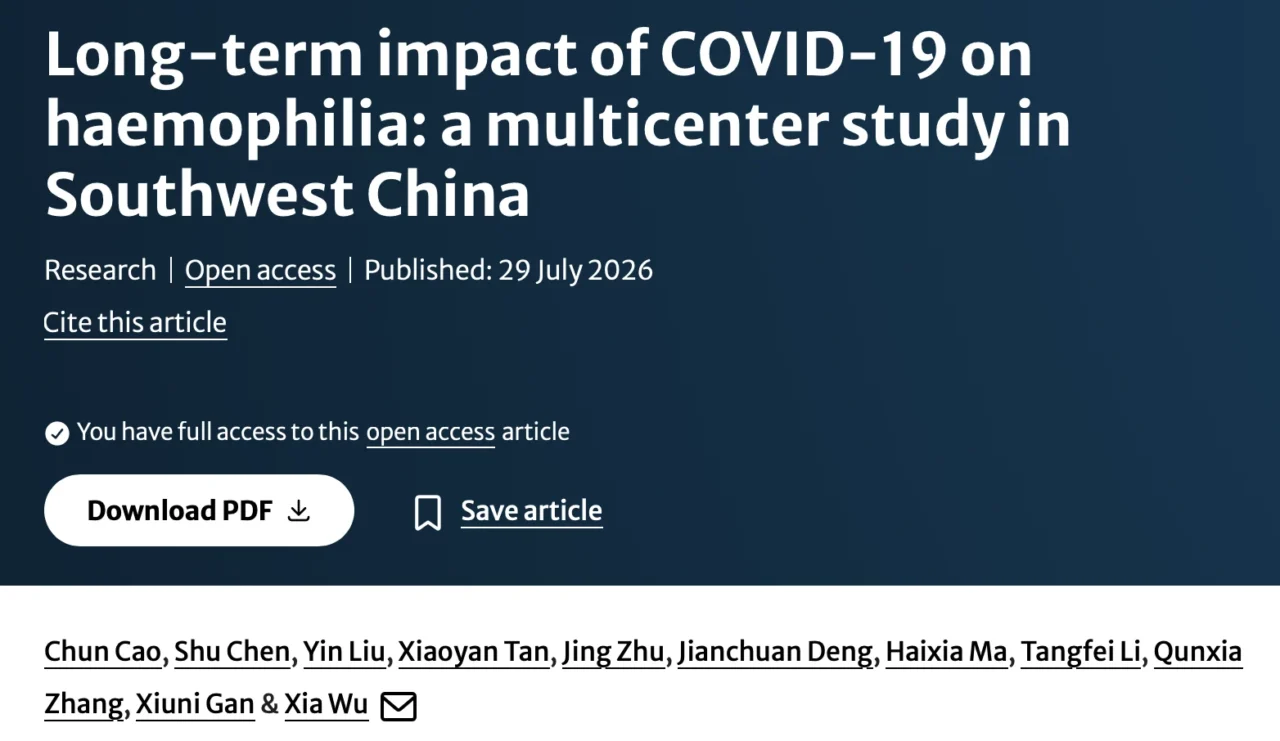
Title: Long-term impact of COVID-19 on haemophilia: a multicenter study in Southwest China
Authors: Chun Cao, Shu Chen, Yin Liu, Xiaoyan Tan, Jing Zhu, Jianchuan Deng, Haixia Ma, Tangfei Li, Qunxia Zhang, Xiuni Gan, Xia Wu
Stay updated on all scientific advances with Hemostasis Today.
-
Nov 9, 2026, 10:32Natalie Arnold: The Lp(a) Puzzle – Why Lower Levels May Not Tell the Whole Story
-
Nov 9, 2026, 10:22ISBT Opens Applications for the I TRY IT Programme 2027
-
Nov 9, 2026, 10:08Ibrahim Mansoor: Rare Tests, Common Diseases – Rethinking Autoimmune Diagnostics
-
Nov 9, 2026, 09:29Veronica Sanchez: A Framework for Woman’s Health
-
Nov 8, 2026, 19:31Anna Kajaste-Rudnitski: Presenting AAV-Induced p53 Signalling in Human CNS Cells at ESGCT 26
-
Nov 8, 2026, 19:29David McIntosh: Cybersecurity Matters, but Blood Availability Remains the Bigger Challenge
-
Nov 8, 2026, 19:26Wenxue Ma: An Integrative Framework for Macrophage-Mediated Therapeutic Resistance in Cancer
-
Nov 8, 2026, 19:25Yildiz Yigit: Presenting a Polycythemia Vera Case at the MPN Subcommittee Session
-
Nov 8, 2026, 18:56Denis Oduor: Strengthening the Regulation and Delivery of Blood Transfusion and Transplantation Services