


Alfonso J. Tafur: New Biomarkers Transform Pulmonary Embolism Risk Prediction
Alfonso J. Tafur, Board Member VAS European Independent Foundation in Angiology and Vasculearn Network, shared RPTH Journal’s post on LinedIn about a recent article he and his colleagues co-authored, adding:
“Proud to be a co-author on this important publication led by Fakiha Siddiqui Congratulations
This study moves beyond traditional clinical risk scores by showing that thromboin flammation and hemostatic activation are major drivers of early mortality in acute PE. Among the most clinically relevant findings:
- Neutrophil-to-lymphocyte ratio (NLR) above 7 emerged as one of the strongest and most accessible predictors of 30-day mortality.
- Combining NLR, PAI-1, and TNF-α identified a subgroup with markedly higher mortality, highlighting the value of integrated biomarker assessment.
- The work supports incorporating biologic markers of inflammation, endothelial injury, coagulation, and fibrinolysis into future PE risk stratification models. Precision Medicine
Excited to see how these findings help shape the next generation of personalized pulmonary embolism care.”
RPTH Journal shared a post on LinkedIn:
“Pulmonary embolism mortality: can thromboinflammation biomarkers do better than current scoring systems?
Despite advances in diagnosis and treatment, pulmonary embolism (PE) still carries significant mortality, and current prognostic models remain poorly predictive of who will deteriorate. A new study in RPTH Journal takes a comprehensive biomarker approach to address this gap.
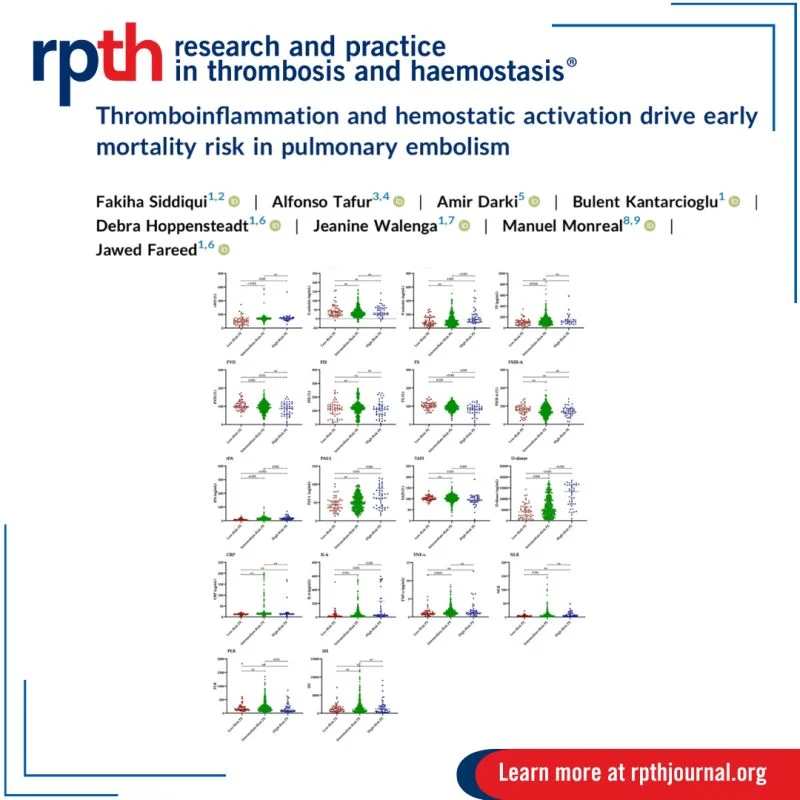
Key findings from 500 patients with PE (9.7% died within 30 days):
- Levels of vWF, P-selectin, tissue factor, tPA, PAI-1, D-dimer, CRP, IL-6, TNF-α, NLR, PLR, and SII were significantly higher in 30-day non-survivors
- FVII, FX, FXIIIA, and TAFI levels were significantly lower in non-survivors
- Multivariable analysis confirmed independent associations between these markers and 30-day mortality
- CHAID recursive partitioning identified NLR, PAI-1, and TNF-α as the key mortality predictors, with quantifiable thresholds established for each.”
Title: Thromboinflammation and hemostatic activation drive early mortality risk in pulmonary embolism
Authors: Fakiha Siddiqui, Alfonso Tafur, Amir Darki, Bulent Kantarcioglu, Debra Hoppensteadt, Jeanine Walenga, Manuel Monreal, Jawed Fareed
Stay updated on all scientific advances with Hemostasis Today.
-
Sep 20, 2026, 09:51Ceasovschih Alexandr: A Closer Look at Lipid Disorders in CKM Syndrome
-
Sep 20, 2026, 09:05World Stroke Academy: Can Adjunct IAT Improve Tissue Reperfusion?
-
Sep 20, 2026, 06:46Neeraj Songara: From Donated Blood to Engineered Therapeutics
-
Sep 20, 2026, 06:24Louise St. Germain Bannon: Improving Awareness and Care for Women Across the Lifespan
-
Sep 20, 2026, 05:17Maxime Dely: When ABO Compatibility Isn’t Enough for Safe Transfusion
-
Sep 20, 2026, 04:54William Aird: What Does a Complete History and Physical Really Mean?
-
Sep 20, 2026, 04:34Hons Saurabh Kaushik: Why Uncontrolled LDL Can Be Harmful
-
Sep 20, 2026, 03:58Salih Ehsan: The Complexities of HbF and HbA2
-
Sep 20, 2026, 03:22The Voices of People Living With Bleeding Disorders – EHC