

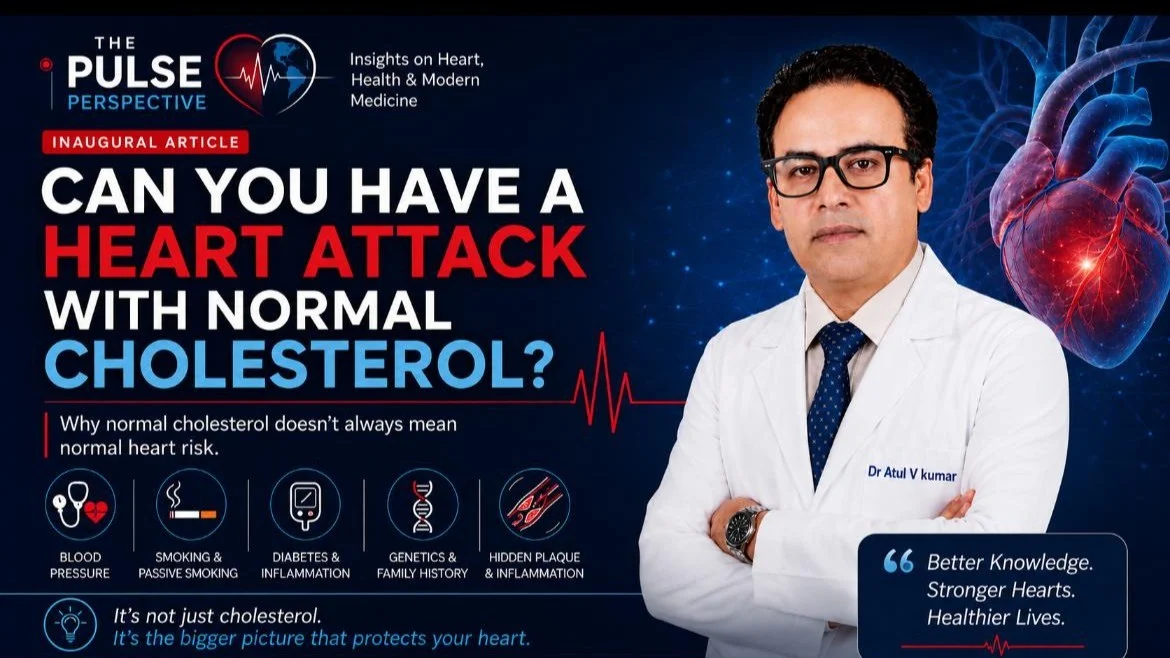
Atul V Kumar: Why Normal Cholesterol Does Not Guarantee Heart Health
Atul V Kumar, Senior Consultant at Max heart and vascular Institute,saket, New Delhi, shared a post on LinkedIn:
“Yes. And this is one of the most important misconceptions in heart health.
You can have a heart attack even when your routine cholesterol report looks completely ‘normal.’
A normal lipid panel is reassuring – but it is not a certificate of immunity from heart disease.
Your heart attack risk is determined by much more than a single LDL or total-cholesterol number.
Blood pressure, diabetes, smoking, family history, inflammation, genetics, metabolic health, lifestyle – and the actual condition of your coronary arteries – all matter.
Current cardiovascular guidance also recognizes markers such as Lp(a), ApoB, hs-CRP and triglycerides as factors that can refine cardiovascular risk assessment․
The cholesterol number is only one piece of the puzzle
Think of your standard lipid profile as a snapshot.
It tells us about cholesterol and triglycerides circulating in your blood at that moment.
But it doesn’t directly tell us:
- How much plaque is already inside your arteries.
- How many atherogenic particles are circulating.
- Whether you have genetically elevated Lp(a).
- Whether your arteries are being damaged by smoking or hypertension.
- Whether metabolic disease is accelerating atherosclerosis.
So two people can have the same LDL cholesterol—and very different cardiovascular risk.
What else can trigger a heart attack?
A heart attack usually occurs when blood flow through a coronary artery becomes suddenly blocked, often after an atherosclerotic plaque ruptures or erodes and a blood clot forms.
Cholesterol participates in plaque formation, but the story doesn’t end there.
1.High blood pressure
Years of uncontrolled hypertension place continuous mechanical stress on the artery wall and contribute to atherosclerosis.
You may feel perfectly well while this damage is occurring.
That’s why hypertension is often called a silent risk factor.
2.Smoking
Smoking damages the lining of blood vessels, promotes inflammation and makes the blood more prone to clotting.
And importantly:
You don’t need high cholesterol for smoking to increase your heart-attack risk.
Even people who smoke only a few cigarettes a day can develop early cardiovascular changes.
3.Passive smoking
You don’t have to be the smoker.
Secondhand smoke is also harmful to cardiovascular health, and there is no established risk-free level of exposure.
Even brief exposure can produce harmful cardiovascular effects.
So:
‘I don’t smoke’ doesn’t necessarily mean ‘I don’t get exposed to tobacco smoke.’
4.Diabetes and insulin resistance
Persistently elevated blood glucose contributes to vascular dysfunction and accelerates atherosclerotic cardiovascular disease.
This is one reason a person with a ՛normal՛ cholesterol number can still have substantial cardiovascular risk.
5.Genetics
Some people inherit cardiovascular risk that isn’t obvious on a routine lipid report.
Family history of premature cardiovascular disease is an important clue.
And then there is a particularly interesting particle:
Lipoprotein(a) — Lp(a)
Lp(a) is largely genetically determined and can increase cardiovascular risk even when conventional cholesterol levels look acceptable.
Most people don’t know their Lp(a) level because it isn’t routinely included in a standard lipid panel.
European guidance recommends considering Lp(a) measurement at least once in every adult’s lifetime, particularly to identify people with markedly elevated inherited levels.
What about ApoB?
Here’s another concept worth knowing.
LDL-C tells you how much cholesterol is being carried.
ApoB helps tell you how many atherogenic particles are carrying it.
That distinction can matter.
A person can sometimes have an LDL-C level that doesn’t look particularly alarming while having a relatively high number of atherogenic particles.
Current guidelines recognize ApoB as a useful risk-refining marker in selected individuals.
And then there is inflammation
Atherosclerosis isn’t simply a problem of ‘fat inside the artery.’
It is a complex inflammatory disease of the arterial wall.
When an atherosclerotic plaque becomes unstable, it can rupture or erode and trigger clot formation -potentially blocking coronary blood flow.
hs-CRP
High-sensitivity C-reactive protein (hs-CRP) can provide information about systemic inflammation and may help refine cardiovascular risk in appropriate patients.
But an important distinction:
- hs-CRP does not tell us that a particular plaque is about to rupture.
It is a risk marker, not a crystal ball.
Smoking plus inflammation plus plaque equals a dangerous combination.
This is why tobacco deserves special attention.
Smoking can promote:
Vascular injury – inflammation – endothelial dysfunction – atherosclerosis – thrombosis
And the same cardiovascular concern applies to secondhand smoke.
Electronic cigarettes are not harmless either.
Although their long-term cardiovascular effects are still being studied, e-cigarette exposure can affect vascular function and cardiovascular physiology, and current AHA/ACC guidance does not recommend e-cigarettes as first-line smoking-cessation therapy.
So should everyone get ՛advanced՛ cardiac tests?
Not necessarily.
This is where medical advice needs to be individualized.
An extended lipid profile, ApoB, Lp(a), hs-CRP, coronary calcium scoring, CT coronary angiography or other testing may be useful in selected people, particularly when the overall cardiovascular risk is uncertain or additional information could change management.
More testing is not automatically better testing.
The right question is:
‘Will this test change what we do for this particular person?’
The bigger picture
Imagine cardiovascular risk as a puzzle.
LDL cholesterol is one piece.
But other pieces include:
- Blood pressure
- Diabetes / metabolic health
- Tobacco exposure
- Genetics and family history
- Inflammation
- Body composition
- Physical activity
- Sleep
- Chronic stress
- Existing plaque burden
- Lp(a) and ApoB in selected individuals
You need to see the whole puzzle, not just one piece.
The most important message
‘Normal cholesterol’ does not mean ‘zero heart-attack risk.’
It means that one part of your risk assessment looks reassuring.
That is very different.
Your cardiovascular health is determined by the interaction of lipids, blood pressure, glucose, tobacco exposure, genetics, lifestyle, inflammation and the biology of your arteries.
And sometimes the first warning that something was wrong is a heart attack itself.
The goal of prevention is to identify risk before that happens.
The pulse perspective
Don’t ask only: ‘What is my cholesterol?’
Ask:
‘What is my overall cardiovascular risk?’
That is a much better question.
Better Knowledge. Stronger Hearts. Healthier Lives.
This article is for knowledge sharing and general education, not a substitute for individualized medical advice.”
Stay updated with Hemostasis Today.
-
Sep 26, 2026, 18:01Kalyan Roy: Blood Group Chimerism as a Rare Cause of ABO Discrepancy
-
Sep 26, 2026, 17:34Arwa Z. Al-Riyami: Join ISBT and Advance Your Career
-
Sep 26, 2026, 16:58Paul Whiteley: Iron Deficiency and Behavioral Problems in Children With Autism
-
Sep 26, 2026, 16:41Matthew Smeds: Management of Thoracic Endograft Thrombosis and Mesenteric Embolization
-
Sep 26, 2026, 16:04Isabelle Feldhaus: What the New ASH Iron Deficiency Guidance Means for Care
-
Sep 26, 2026, 15:55Francesca Palandri: The R-NAT Score Developed in Ruxolitinib-Treated MF Patients
-
Sep 26, 2026, 15:49Alex Ehsan: Antiphospholipid Syndrome – A Practical Guide
-
Sep 26, 2026, 15:42Michael Tadao Inouye: The Next Frontier in Genomic Population Health
-
Sep 26, 2026, 15:32Katariina Öörni: Familial Hypercholesterolaemia in Children Why Early Diagnosis Matters