


Edward Lee Carter: Why ‘Never Again’ Might Be the Wrong Instinct After Intracerebral Hemorrhage
Edward Lee Carter, Clinical Pharmacist Practitioner at U.S. Department of Veterans Affairs, shared a post on LinkedIn:
“After intracerebral hemorrhage in a patient with AF, is stopping anticoagulation actually the safer choice?
Few decisions in anticoagulation feel more uncomfortable than this one.
The patient has already lived through the complication we fear most.
The instinct to stop for good and never look back is completely understandable.
But the randomized evidence says the calculus is more complicated than that instinct suggests.
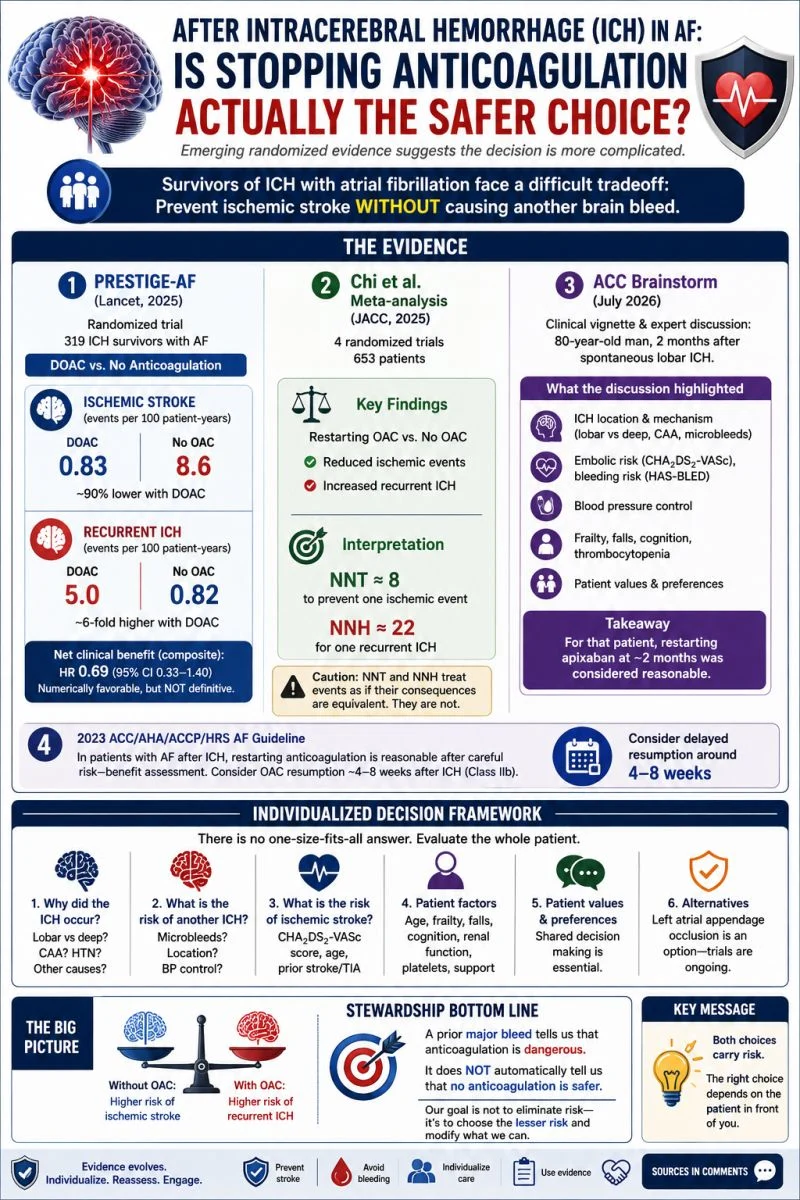
PRESTIGE-AF (Lancet, 2025) randomized 319 ICH survivors with AF to a DOAC or no anticoagulation.
The trade-off was stark: ischemic stroke occurred at 0.83 per 100 patient-years on a DOAC versus 8.6 with no anticoagulation.
Recurrent ICH ran the opposite direction — 5.0 versus 0.82. Anticoagulation dramatically cut ischemic events while raising the risk of the exact complication everyone is trying to avoid.
A pooled meta-analysis of four RCTs (JACC, 2025; n=653) added NNT and NNH to the picture — roughly 8 to prevent one ischemic event, 22 to cause one recurrent ICH.
Those numbers sound reassuring on their face, but they come with a real caveat: NNT and NNH treat every event as equally severe, and a recurrent lobar ICH doesn’t carry the same odds of death or lasting disability as an ischemic stroke.
Averaging them together flattens a distinction that matters enormously to the patient in front of you.
That’s what makes ACC’s discussion of this case useful — it isn’t really ‘restart, yes or no.’
It’s what caused the original bleed, lobar or deep, evidence of amyloid angiopathy or microbleeds, blood pressure control, embolic risk, and the geriatric layer trials don’t capture well — frailty, falls, cognition, thrombocytopenia, and what the patient actually values.
Worth remembering too that ICH isn’t the only bleeding risk in this conversation — COMBINE-AF recently flagged how common extracranial bleeding is with OAC use in AFib more broadly.
There’s also a third pathway.
A3ICH, STROKECLOSE, and CLEARANCE are all enrolling now to compare left atrial appendage occlusion against DOAC therapy and against no anticoagulation in this exact population.
The real stewardship lesson: a major bleed tells us anticoagulation is dangerous.
It doesn’t automatically tell us that no anticoagulation is safer.
After ICH, both paths carry risk. The job isn’t to eliminate it — it’s to figure out which risk is greater for this particular patient, and which of those risks we can actually modify.”
Stay updated with Hemostasis Today.
-
Oct 2, 2026, 06:00Susan Wickersham: Gradual Shift towards Autologous Blood Transfusion is a Current Trend
-
Oct 2, 2026, 05:54Shamee Shastry: When Every Cell Reacts – The Hunt for Rare Blood
-
Oct 2, 2026, 05:49David Mclntosh: Expanding Plasma Protein Therapies in Underserved Regions
-
Oct 2, 2026, 05:38Dianne E. van der Wal: C-Terminal Endings Impact PAR1/PAR4 Peptide Potency in In Vitro Platelet Assays
-
Oct 2, 2026, 05:29Mohammed Alo: Your LDL Isn’t a Snapshot – It’s a Smoking Habit Measured in Years
-
Oct 2, 2026, 00:33Marwa Mostafa: Hemoglobinopathies – When Globin Genes Go Wrong
-
Oct 1, 2026, 23:46Behnood Bikdeli: Global Burden of Venous Thromboembolism
-
Oct 1, 2026, 23:46Sthanu Subramanian: Clinical Presentation, Risk Factors, Diagnosis, and Neuroimaging Findings in CVT
-
Oct 1, 2026, 23:45Martha Gulati: Oral MHT Is Associated With Increased Thrombotic Risk