


Marwa Mostafa: Hemoglobinopathies – When Globin Genes Go Wrong
Marwa Mostafa, Clinical Pathologist at Al-Esraa Medical Center, shared a post on LinkedIn:
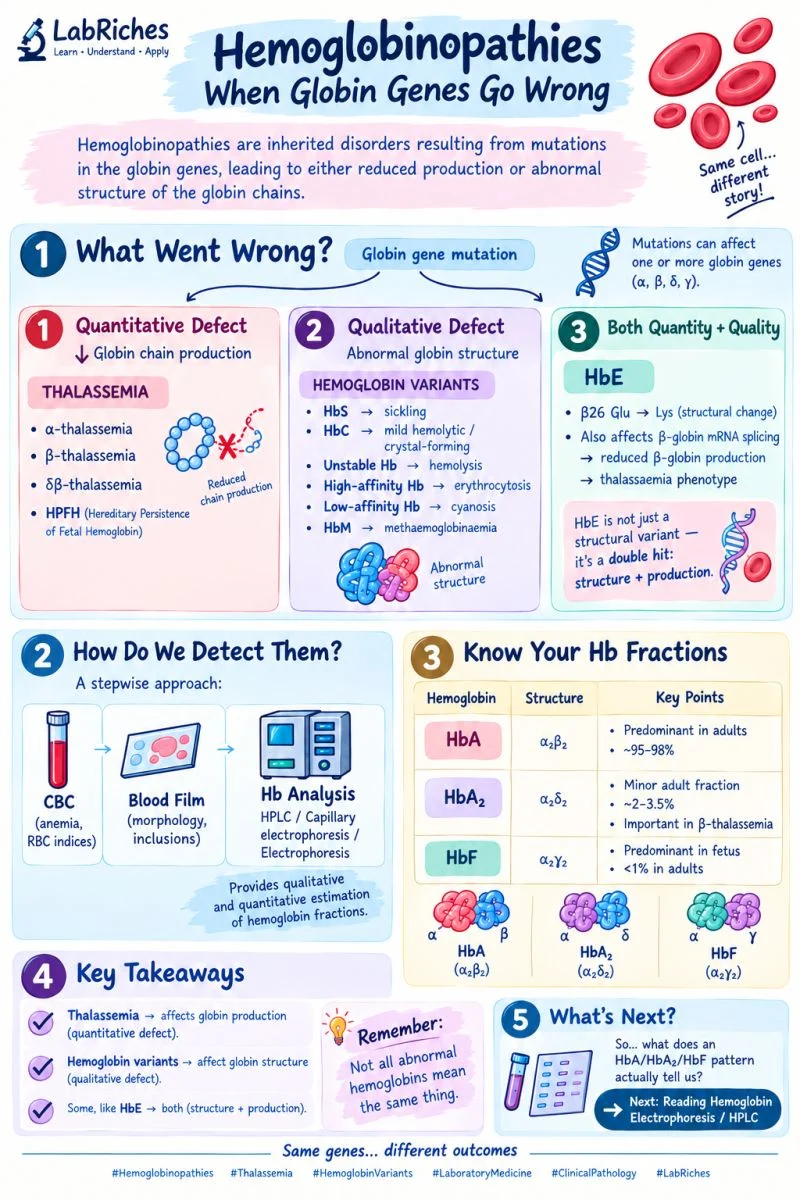
“Hemoglobinopathies: When Globin Genes Go Wrong
When we hear ‘hemoglobinopathy,’ we often think immediately of sickle cell disease or thalassemia.
But hemoglobinopathies are a much broader group of inherited disorders – and understanding what goes wrong at the globin-gene level is the key to understanding their laboratory patterns.
There are two major mechanisms:
1. Quantitative defects – ‘How much globin is produced?’
The globin chain itself may be structurally normal, but its production is reduced or absent.
This is the basic mechanism of thalassemia.
- α-thalassemia – reduced α-globin production
- β-thalassemia – reduced β-globin production
The resulting imbalance between globin chains affects hemoglobin synthesis and produces the characteristic hematological findings of thalassemia.
2. Qualitative defects – ‘What does the globin look like?’
Here, the amount of globin may be produced, but a mutation changes the structure or function of the globin chain.
Examples include:
- HbS – abnormal hemoglobin associated with sickling
- HbC – structural hemoglobin variant
- Other variants may result in unstable hemoglobin, altered oxygen affinity, or other functional abnormalities.
3. Sometimes, it is BOTH
One interesting example is HbE.
HbE results from a β-globin mutation that causes an amino-acid substitution and also affects β-globin mRNA splicing.
So HbE behaves as both:
A structural hemoglobin variant and a β-thalassemia-like production defect.
This is a great example of why classifying hemoglobinopathies isn’t always as simple as putting every disorder into one box.
So how do we investigate them?
The laboratory evaluation usually starts with:
CBC – Blood film – Hemoglobin analysis
Hemoglobin analysis by HPLC, capillary electrophoresis, or electrophoresis can help identify and quantify different hemoglobin fractions.
And this brings us to three very important fractions:
- HbA
- HbA₂
- HbF
Understanding what these fractions represent – and how their proportions change in different disorders – is essential for interpreting hemoglobin analysis.
Clinical Pearl
Don’t just ask ‘Which hemoglobin is abnormal?’
Ask ‘What happened to the globin gene – production, structure, or both?’
That question can completely change how we interpret the laboratory pattern.”
Stay updated with Hemostasis Today.
-
Oct 1, 2026, 23:46Behnood Bikdeli: Global Burden of Venous Thromboembolism
-
Oct 1, 2026, 23:46Sthanu Subramanian: Clinical Presentation, Risk Factors, Diagnosis, and Neuroimaging Findings in CVT
-
Oct 1, 2026, 23:45Martha Gulati: Oral MHT Is Associated With Increased Thrombotic Risk
-
Oct 1, 2026, 23:44Priya Sriskandarajah: HEMA-MED Trial Exploring Roginolisib Plus JAK Inhibitors in Myelofibrosis
-
Oct 1, 2026, 23:44Inge Vanhomwegen: Join Our Upcoming Webinar on D-dimer Testing
-
Oct 1, 2026, 23:43Bianca Rocca: Beyond API-CAT – Who Should Continue Anticoagulation, And for How Long?
-
Oct 1, 2026, 23:26Sara Gaafar Ibnauf Suliman: The Changing Role of Bariatric Surgery in the GLP-1 Era
-
Oct 1, 2026, 23:16Ahmed Reda: New Ferritin Cutoffs For Iron Deficiency – Ash 2026
-
Oct 1, 2026, 23:04Mario Ottiglio: Launching New Initiative During UNGA81 Week through WCSCD