


Zeeshan Ahmed Khattak: Anticoagulants in Hematology – Know the Drug, Dose, Route and Difference
Zeeshan Ahmed Khattak, Pharmacist (IP/Oncology) at Abu Dhabi Stem Cells Center, shared a post on LinkedIn:
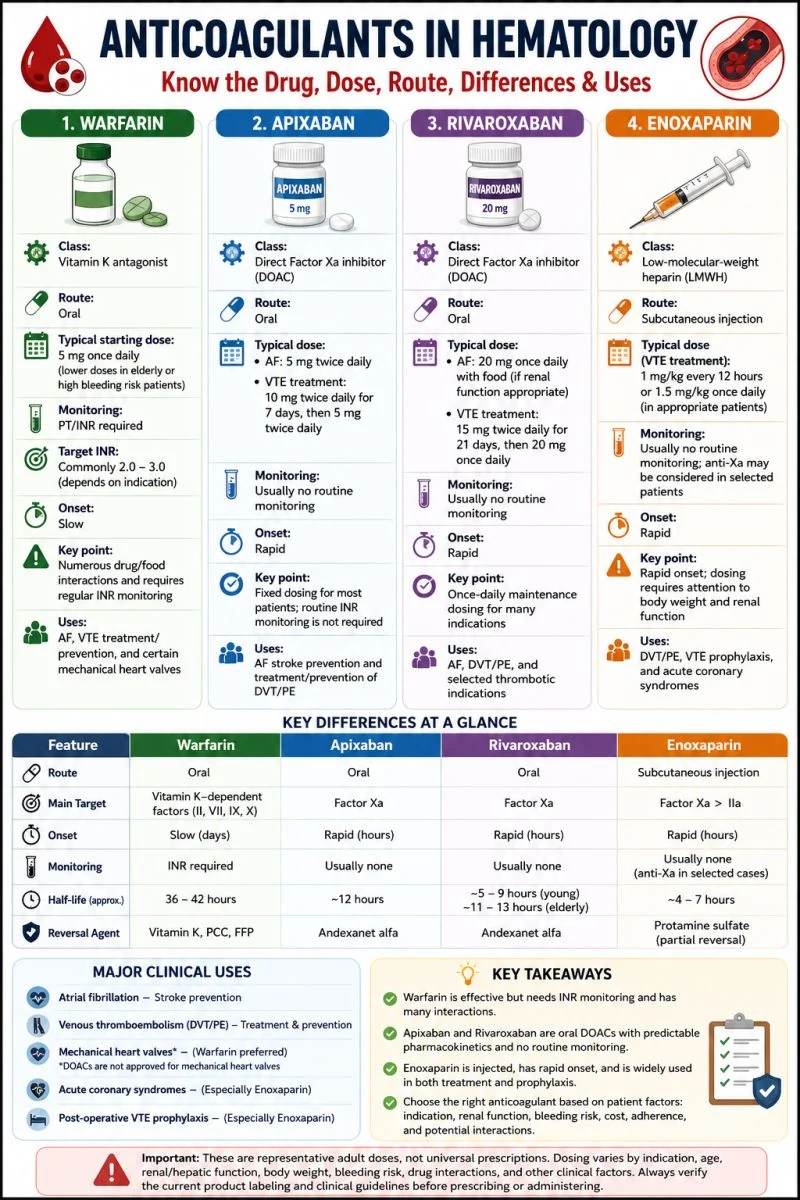
“Anticoagulants in Hematology: Know the Drug, Dose, Route and Difference
Anticoagulants are widely used for prevention and treatment of venous thromboembolism (VTE), atrial fibrillation, acute coronary syndromes, and other thrombotic conditions.
But not all anticoagulants work the same way – and understanding their mechanism, route, dosing, onset, monitoring, and clinical use is essential.
Here’s a quick comparison
1.Warfarin
- Class: Vitamin K antagonist
- Route: Oral
- Typical starting dose: 5 mg once daily in many adults; lower starting doses may be appropriate in older adults or patients at higher bleeding risk
- Monitoring: PT/INR required
- Target INR: Commonly 2.0–3.0, depending on indication
- Onset: Slow
- Key point: Numerous drug/food interactions and requires regular INR monitoring
- Uses: AF, VTE treatment/prevention, and certain mechanical heart valves
2.Apixaban
- Class: Direct Factor Xa inhibitor (DOAC)
- Route: Oral
- Typical AF dose: 5 mg twice daily
- VTE treatment: 10 mg twice daily for 7 days, followed by 5 mg twice daily
- Key point: Fixed dosing for most patients; routine INR monitoring is not required
- Uses: AF stroke prevention and treatment/prevention of DVT/PE
3.Rivaroxaban
- Class: Direct Factor Xa inhibitor (DOAC)
- Route: Oral
- Typical AF dose: 20 mg once daily with food in patients with appropriate renal function
- VTE treatment: 15 mg twice daily for 21 days, followed by 20 mg once daily
- Key point: Once-daily maintenance dosing for many indications
- Uses: AF, DVT/PE, and selected thrombotic indications
4.Enoxaparin
- Class: Low-molecular-weight heparin (LMWH)
- Route: Subcutaneous injection
- Typical VTE treatment dose: 1 mg/kg every 12 hours or 1.5 mg/kg once daily in appropriate patients
- Key point: Rapid onset; dosing requires attention to body weight and renal function
- Monitoring: Usually no routine coagulation monitoring; anti-Xa may be considered in selected patients
- Uses: DVT/PE, VTE prophylaxis, and acute coronary syndromes
Key Differences at a Glance
- Drug – Route – Main Target – Monitoring – Onset
- Warfarin – Oral – Vitamin K–dependent factors – INR – Slow
- Apixaban – Oral – Factor Xa – Usually none – Rapid
- Rivaroxaban – Oral – Factor Xa – Usually none – Rapid
- Enoxaparin – SC – Factor Xa more than IIa – Usually none – Rapid
Easy way to remember
- Warfarin – Vitamin K antagonist – INR
- Apixaban/Rivaroxaban – Direct Xa inhibitors – Oral DOACs
- Enoxaparin – LMWH – Subcutaneous injection
Important: These are representative adult doses, not universal prescriptions.
Dosing varies by indication, age, renal/hepatic function, body weight, bleeding risk, drug interactions, and other clinical factors.
Mechanical heart valves, pregnancy, severe renal impairment, and acute coronary syndromes require particular attention.
Always verify the current product labeling and clinical guidelines before prescribing or administering.”
Stay updated with Hemostasis Today.
-
Oct 13, 2026, 11:24Brandon Daniel D’Costa: Building Stronger Stakeholder Relationships Through Empathy and Open Communication
-
Oct 13, 2026, 11:08Renel Tique: 5th International Conference on Hemophilia and Rare Bleeding Disorders
-
Oct 13, 2026, 02:01Nour Al-Mozain: Is It Really Anti-D? – Unraveling Auto-Anti-LW in the Transfusion Laboratory
-
Oct 13, 2026, 01:51Berenice Villegas: The Role of Morphologic Evaluation in Body Fluid Differential Analysis
-
Oct 13, 2026, 01:44Debadrita Ray: Evaluating vWF and VITRO Score for Detecting CSPH in cACLD Patients
-
Oct 13, 2026, 01:34Nagesh Ramesh: Donating Blood for International Plasma Awareness Week
-
Oct 12, 2026, 21:51Sam Botchey: Orthobiologics Are Advancing but the Evidence Must Keep Pace
-
Oct 12, 2026, 21:50Serum Vitamin D, Platelet Function, and Bleeding in Primary ITP – Platelets Journal
-
Oct 12, 2026, 21:30Nika Samadzadeh Tabrizi: Looking Forward to the PACeS Trial on Anticoagulation for POAF