


Mehrdad Zarghami: Evaluating aPL Prevalence and Recurrence Risk in Ischemic Stroke
Mehrdad Zarghami, Internal Medicine Resident at Jamaica Medical Center Hospital, Postdoctoral Researcher of Harvard Medical School, shared a post on LinkedIn about a recent article by Nathan W. Watson et al., published in Stroke, adding:
“Excited to share our newly published systematic review and meta-analysis in Stroke
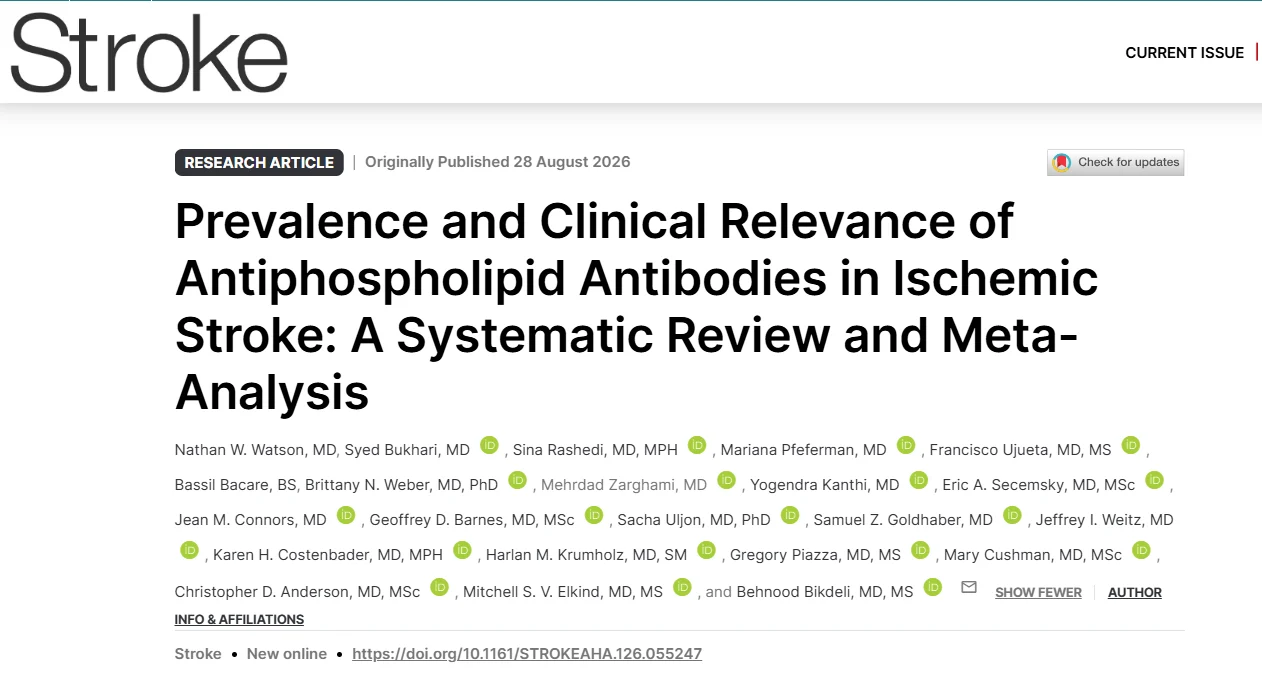
‘Prevalence and Clinical Relevance of Antiphospholipid Antibodies in Ischemic Stroke.’
In this analysis of 52 studies, we evaluated the prevalence of antiphospholipid antibodies (aPL) and their association with first and recurrent ischemic stroke.
Key findings included:
Nearly 1 in 5 patients with ischemic stroke were aPL-positive — pooled prevalence 19.1%.
aPL positivity was associated with almost 3-fold higher odds of first ischemic stroke (OR 2.93).
Lupus anticoagulant showed the strongest association, with OR 6.69.
Importantly, aPL positivity was not significantly associated with recurrent ischemic stroke in the available data (OR 1.20).
These findings highlight the potential importance of antiphospholipid antibodies in the evaluation and risk characterization of patients presenting with ischemic stroke, while also underscoring important questions regarding recurrence and long-term management.
Grateful to Nathan Watson, Syed Bukhari, Sina Rashedi, Behnood Bikdeli, and the entire multidisciplinary team for the opportunity to contribute to this collaborative work.”
Title: Prevalence and Clinical Relevance of Antiphospholipid Antibodies in Ischemic Stroke: A Systematic Review and Meta-Analysis
Authors: Nathan W. Watson, Syed Bukhari, Sina Rashedi, Mariana Pfeferman, Francisco Ujueta, Bassil Bacare, Brittany N. Weber, Mehrdad Zarghami, Yogendra Kanthi, Eric A. Secemsky, Jean M. Connors, Geoffrey D. Barnes, Sacha Uljon, Samuel Z. Goldhaber, Jeffrey I. Weitz, Karen H. Costenbader, Harlan M. Krumholz, Gregory Piazza, Mary Cushman, Christopher D. Anderson, Mitchell S. V. Elkind, Behnood Bikdeli
Stay updated on all scientific advances with Hemostasis Today.
-
Oct 16, 2026, 04:16Asmaa M. Gouda: Advancing Blood Bank Leadership at Alexandria University Hospitals
-
Oct 16, 2026, 03:52Saja Al-Zamili: Minimally Invasive Hematoma Evacuation in Intracerebral Hemorrhage
-
Oct 16, 2026, 03:13Bhumika Satija: Beyond the Diploma A Growing Passion for Blood Banking and Transfusion Medicine
-
Oct 16, 2026, 03:03Jamie Nash: Microfluidics in Transfusion Medicine Advancing Blood Component Quality Assessment
-
Oct 16, 2026, 02:53World Thrombosis Day 2026 Advancing Women’s Health Through Better Thrombosis Research and Care – World Thrombosis Day
-
Oct 16, 2026, 02:42Areej Wasi: Myocardial Infarction in Young Adults Advancing Cardiology Education and Medical Leadership
-
Oct 16, 2026, 02:33Mehak Trehan: ASH 2026 Myelofibrosis Guidelines 10 Practical Takeaways for Clinical Practice
-
Oct 15, 2026, 19:41Looking Beyond Platelet Counts to Quality of Life in ITP – American Society of Hematology
-
Oct 15, 2026, 19:32Markus Gregorio Barbosa: Hepatic VPS35 and Cholesterol Homeostasis