


W. Alberto Sifuentes Giraldo: Why Obstetric Cases Are Missed Under 2023 ACR/EULAR APS Criteria
W. Alberto Sifuentes Giraldo, Rheumatologist at Hospital Nuestra Señora de Sonsoles (Sacyl), shared a post on X about a recent article by Leyre Riancho-Zarrabeitia et al., published in Rheumatology, adding:
“A recent systematic review and meta-analysis tested how well the 2023 ACR/EULAR antiphospholipid syndrome classification criteria perform against expert diagnosis and/or the 2006 Sydney (revised Sapporo) criteria.
What was reviewed
- 24 studies (25 data sets) from August 2023 to May 2026. Thirteen studies included non-APS controls, which allowed joint estimation of sensitivity and specificity.
Overall performance
- Pooled specificity: 99% (95% CI 98–100%)
- Pooled sensitivity: 74% (95% CI 67–81%)
Specificity is nearly perfect: people without APS are almost never classified as APS. Sensitivity is only moderate, so about 1 in 4 APS cases fall below the classification threshold.
Performance depends on phenotype
Sensitivity is not uniform:
- Thrombotic APS: ~82%
- Obstetric APS: much lower — 20% in obstetric-only studies and 31% when obstetric subgroups from mixed studies were added
As the share of obstetric cases rises, overall sensitivity falls. That is the main ‘phenotype gap.’
Why patients miss classification
The usual reasons were:
- Isolated IgM anticardiolipin or anti-β2-glycoprotein I positivity
- Obstetric phenotypes that do not reach clinical-domain score thresholds (for example recurrent early miscarriage without placental complications)
- Entry-rule failures, including a clinical event and a positive lab test separated by more than 3 years
Take-home
The 2023 criteria do what they were built to do: create highly specific research cohorts.
They are not a clinical diagnostic tool. Patients who do not classify – especially obstetric APS and IgM-only profiles – can still have real risk of thrombosis or pregnancy loss, so treatment decisions should stay with expert clinical judgment.”
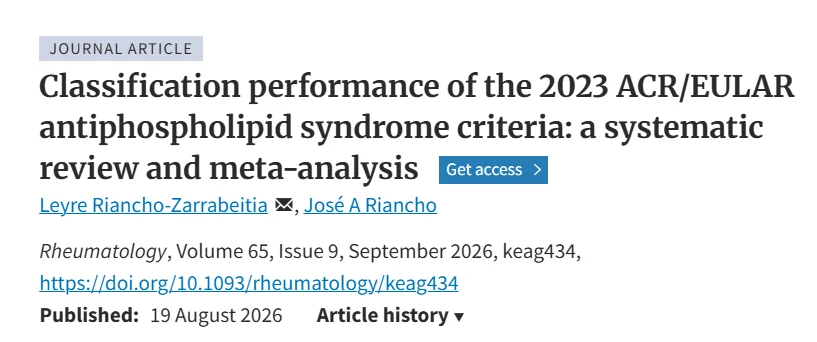
Title: Classification performance of the 2023 ACR/EULAR antiphospholipid syndrome criteria: a systematic review and meta-analysis
Authors: Leyre Riancho-Zarrabeitia, José A Riancho
Other posts featuring W. Alberto Sifuentes Giraldo on Hemostasis Today.
-
Oct 20, 2026, 21:22Intezar Mehdi: When Prolonged Bleeding May Indicate an Underlying Bleeding Disorder
-
Oct 20, 2026, 21:06Nandini Pethe: Sharing My Experience as a Caregiver in the HOPE Factor Resource Guide
-
Oct 20, 2026, 16:51Suzan Nakasendwa: A Growing Stroke Challenge in Uganda
-
Oct 20, 2026, 16:38Steve Moon: How Does Smoking Cessation Duration Affect Ischemic Stroke Risk
-
Oct 20, 2026, 16:25Cedrice Mentor: Reducing Platelet Wastage Through Cold Storage
-
Oct 20, 2026, 16:09Thirunavukkarasu Angappan: Can a Purified Fibrinogen Concentrate Replace Cryoprecipitate
-
Oct 20, 2026, 16:01Kalyan Roy: Platelet Conservation Through Evidence-Based Transfusion Practice
-
Oct 20, 2026, 15:28Stacy E. Croteau: 33 Countries, One Mission – Better Bleeding Disorder Care
-
Oct 20, 2026, 15:19Teresa Barnes: What Does a Pulmonary Embolism Mean for Jalen Hurts?