


Chaza Alaji: How Hemophilia Became a Disease of Precision Medicine
Chaza Alaji, Medical Laboratory Specialist and Supervisor at Privat university-private laboratory-general hospital, shared a post on LinkedIn:
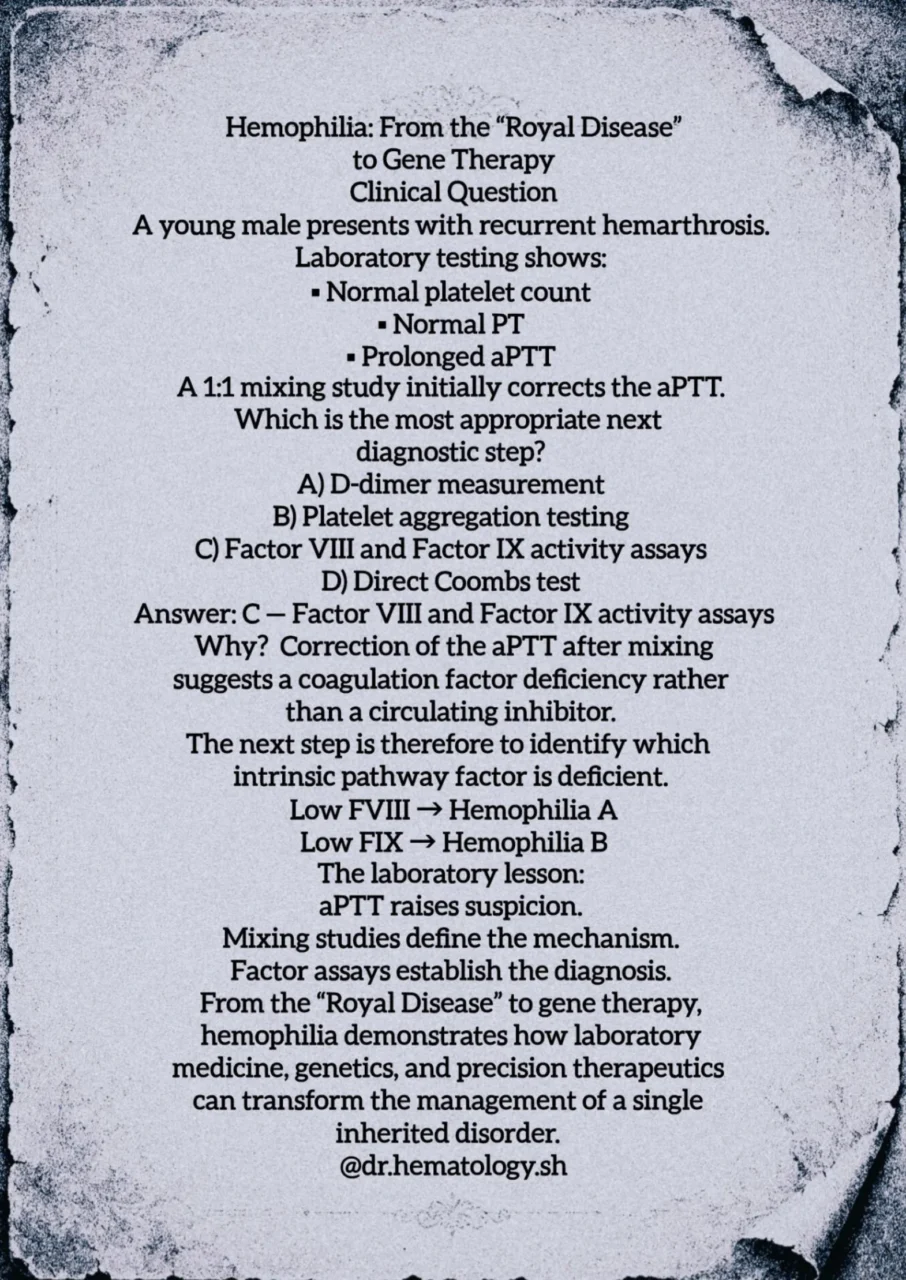
“Hemophilia: From a Royal Mystery to the Era of Precision Medicine or centuries, hemophilia was a medical mystery.
Historical descriptions of families in which boys suffered severe bleeding appeared long before coagulation was understood.
Later, it became known as the ‘Royal Disease.’
Today, however, hemophilia is far more than a bleeding disorder.
It represents the intersection of:
- Genetics
- Coagulation
- Laboratory medicine
- Immunology
- Precision therapy
- The Laboratory Journey
A patient with recurrent joint or muscle bleeding may present with:
- Normal platelet count
- Normal PT
- Prolonged aPTT
This pattern suggests a disorder involving the intrinsic coagulation pathway.
But prolonged aPTT alone does not diagnose hemophilia.
The critical question is:
Factor deficiency or an inhibitor?
Here, the Mixing Study becomes essential:
Correction means Factor deficiency is likely
Failure to correct means Consider an inhibitor
The diagnosis is then confirmed by:
- Factor VIII activity indicates Hemophilia A
- Factor IX activity indicates Hemophilia B
Severity depends on factor activity:
Severe: less than 1 percent
Moderate: 1–5 percent
Mild: more than 5 percent to less than 40 percent
Beyond Factor Levels
Hemophilia A and B are usually X-linked disorders involving:
- F8 causes Hemophilia A
- F9 causes Hemophilia B
Genetic testing can identify pathogenic variants, support family counseling, and evaluate at-risk females.
One of the most important complications is the development of inhibitors-antibodies that neutralize replacement factors.
At that point, hemophilia becomes more than a coagulation disorder.
It becomes an intersection between coagulation and immunology.
Beyond Factor Replacement
Treatment has evolved from simply replacing the missing factor.
Modern approaches include:
- Extended half-life factors
- Non-factor therapies
- Bispecific antibodies
- Antithrombin-lowering therapies
- Gene therapy for selected patients
The fundamental question has changed from:
‘How do we replace the missing factor?’ to:
‘How do we restore hemostatic balance?’
The Take-Home Message
From the ‘Royal Disease’ to molecular diagnostics, immune inhibitors, non-factor therapies, and gene therapy, hemophilia illustrates how modern medicine has transformed the understanding of a single inherited disorder.
Hemophilia is no longer simply a disease of missing factors-it is where genetics, immunity, laboratory medicine, and precision therapy meet.”
Stay updated with Hemostasis Today.
-
Oct 24, 2026, 16:57Pall T. Onundarson: Fiix Prothrombin Time Advancing Precision in Anticoagulation Management
-
Oct 24, 2026, 16:42Mark-Anthony Johnson: Blood Type Awareness and Emergency Transfusion
-
Oct 24, 2026, 16:27Pedro Perez: Florida’s Push to Strengthen VTE Prevention
-
Oct 24, 2026, 16:23Kathleen Freson: Human Cell Models Advance Research into Rare Platelet Disorders
-
Oct 24, 2026, 16:18Victor Daniel: Deep Learning for Automated Platelet Classification
-
Oct 24, 2026, 16:08Paula Alonso-Frías: Human Umbilical Cord Blood Platelet-Rich Plasma for Endometrial Regeneration
-
Oct 24, 2026, 16:00Fatma Ebeid: Ain Shams University Hosts TIF Experts for Collaborating Center Evaluation
-
Oct 24, 2026, 15:52Mazen A. Juratli: Platelet-Derived Extracellular Vesicles as Potential Predictors of Survival in Liver Cancer
-
Oct 24, 2026, 14:28Satyam Arora: Umbilical Cord Blood for Neonatal Transfusions