


Abdul Mannan: Evaluating Longitudinal Platelet Trends Beyond Standard Reference Intervals
Abdul Mannan, Consultant Haematologist, Director Haemophilia Centre, Haematology Lab Lead at Betsi Cadwaladr University Health Board, shared a post LinkedIn:
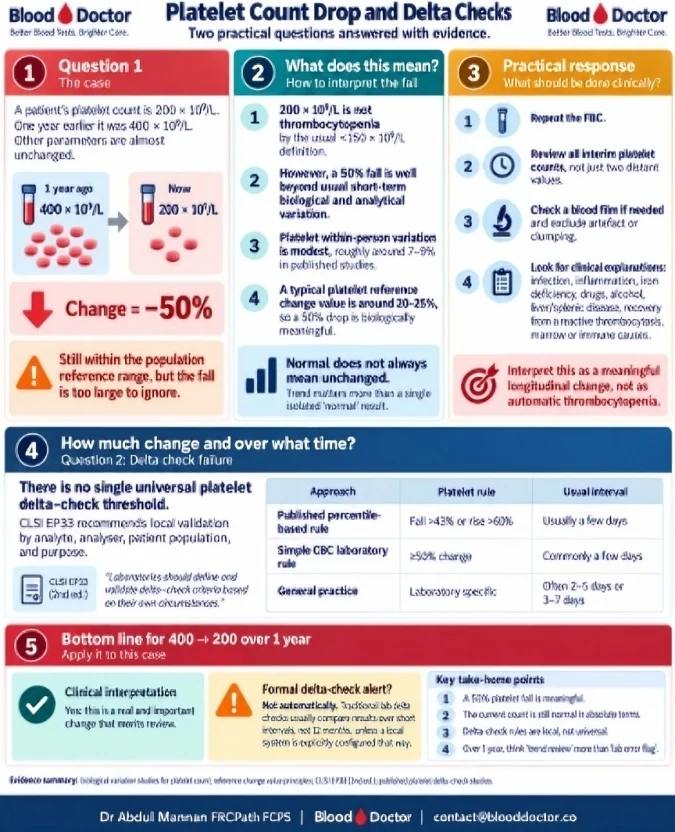
“A platelet count of 200 ×10⁹/L is within the usual reference range.
But what if it was 400 ×10⁹/L one year earlier?
That represents a 50 percent fall. The patient is not thrombocytopenic, but the change still deserves attention.
Platelet counts usually vary only modestly within an individual. Published studies report intra-individual biological variation of about 7–9 percent, with reference-change values generally much smaller than a 50 percent fall.
So the key question is not: ‘Is 200 within the reference range?’
It is: ‘Is 200 typical for this patient?’
The pattern over time matters. 400 to 370 to 320 to 260 to 200 suggests a sustained decline.
By contrast: 210 to 220 to 400 to 205 to 200 suggests that 400 may have been the abnormal result.
This is where the delta check becomes relevant.
There is no universal platelet delta-check threshold or time interval. CLSI EP33 recommends that laboratories validate their own criteria based on the analyte, analyser, patient population and intended use.
Published approaches have used thresholds such as:
- fall >43 percent
- rise >60 percent
- or a ≥50 percent change
However, these thresholds are generally designed for short intervals, often days, rather than changes measured over a year.
Therefore, a fall from 400 to 200 ×10⁹/L over 12 months is:
Clinically: worth reviewing.
As a formal laboratory delta-check failure: not necessarily.
I would review the intervening results, repeat the FBC if appropriate, examine a blood film when indicated, and consider possible clinical explanations.
A reference interval describes what is usual in a population.
A trend shows what is happening to the patient.”
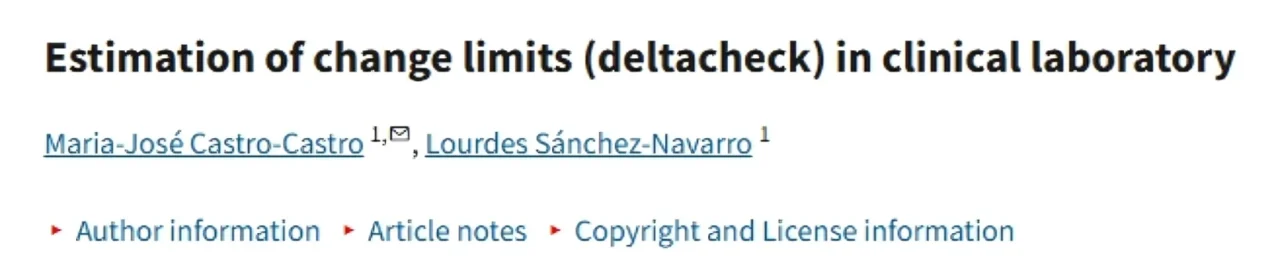
Title: Estimation of change limits (deltacheck) in clinical laboratory
Authors: Maria-José Castro-Castro, Lourdes Sánchez-Navarro
Read full article on National Library of Medicine.
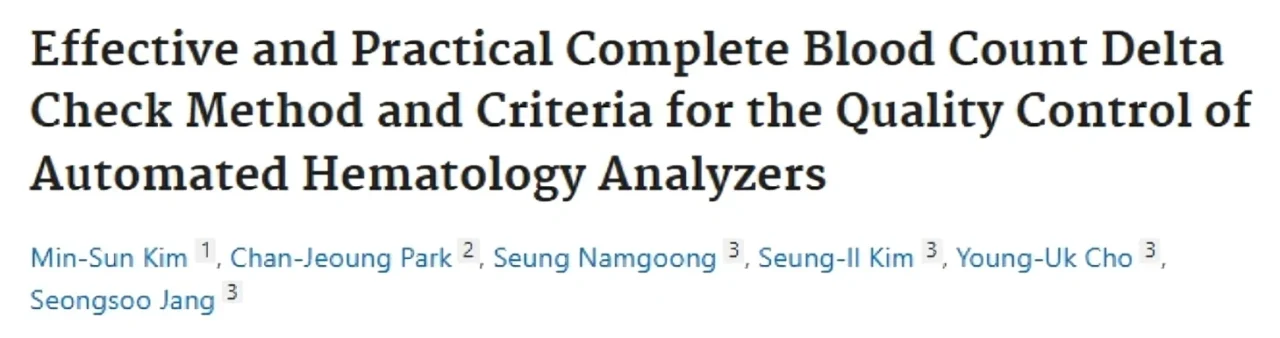
Title: Effective and Practical Complete Blood Count Delta Check Method and Criteria for the Quality Control of Automated Hematology Analyzers
Authors: Min-Sun Kim, Chan-Jeoung Park, Seung Namgoong, Seung-Il Kim, Young-Uk Cho, Seongsoo Jang
Read full article on National Library of Medicine.
Stay updated on all scientific advances with Hemostasis Today.
-
Sep 18, 2026, 17:32Hassan Kawtharany: New Ferritin Cutoffs for the Diagnosis of Iron Deficiency With or Without Anemia
-
Sep 18, 2026, 17:20Abhishek G P: GAVE as an Important Cause of Chronic Gastrointestinal Blood Loss
-
Sep 18, 2026, 17:08Irem Karaman Sebin: ASH 2026 Changes a Key Concept in Iron Deficiency
-
Sep 18, 2026, 16:51Adarsh Krishnan Sundara Rajan: Is VTE the Most Underdiagnosed Critical Threat in Modern Healthcare?
-
Sep 18, 2026, 16:19CRISPR and Hemophilia: The Next Frontier of In Vivo Gene Editing
-
Sep 18, 2026, 16:13Christian Irsara: PF4 Immunothrombosis Following Natural Adenovirus Infection
-
Sep 18, 2026, 16:10Leo Nicolai։ The Spleen Emerges as a Key Regulator of Thromboinflammation
-
Sep 18, 2026, 16:05Targeting Factor XI to Reduce Thrombosis Without Compromising Hemostasis – ISTH
-
Sep 18, 2026, 15:54Swapnil Pawar: Why Aren’t We Using Cryopreserved Platelets Everywhere Yet?