


Neeraj Songara: From Donated Blood to Engineered Therapeutics
Neeraj Songara, Resident Doctor at Dr S.N. Medical College Jodhpur, shared a post on LinkedIn:
“From Donation to Innovation: The Evolving Landscape of Blood-Derived Products
For decades, transfusion medicine followed a simple paradigm:
Donate – Process – Separate – Transfuse
Today, this paradigm is expanding.
A 2026 review by Wendland, Selleng and Aurich highlights how blood and blood-derived materials are increasingly being explored as starting materials for engineered, modified and downstream therapeutic products.
These approaches range from established applications to emerging and investigational technologies.
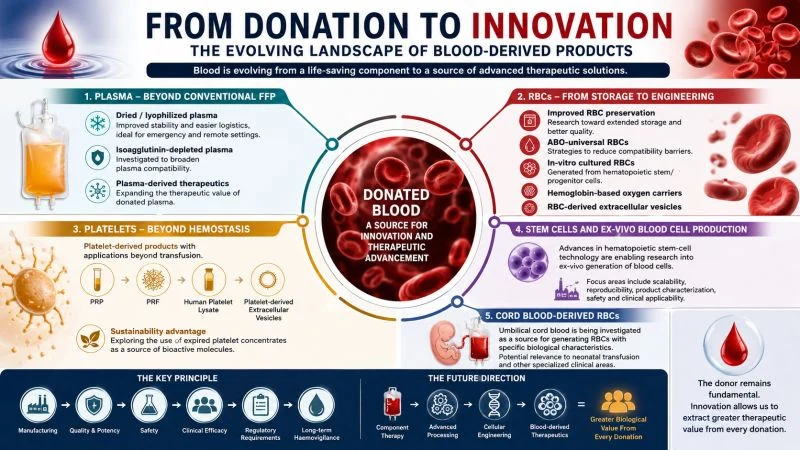
1. Plasma – beyond conventional FFP
Emerging approaches include dried or lyophilized plasma for improved storage and logistics, particularly in emergency and austere settings; isoagglutinin-depleted plasma to potentially broaden plasma compatibility; and plasma-derived therapeutics that extend the clinical value of donated plasma beyond direct transfusion.
2. RBCs – from storage to engineering
RBC innovation is moving beyond conventional storage improvement.
Research includes advanced preservation strategies, toward ABO-universal RBCs, in-vitro cultured RBCs from hematopoietic stem or progenitor cells, hemoglobin-based oxygen carriers and RBC-derived extracellular vesicles.
The goal is to develop products with defined and potentially tailored biological characteristics.
3. Platelets – beyond hemostasis
Platelet-derived products are being investigated beyond transfusion:
PRP – PRF – Human platelet lysate – Platelet-derived extracellular vesicles
Potential applications include tissue repair, regenerative medicine, immunomodulation and drug delivery.
Another emerging concept is using expired platelet concentrates as a source of bioactive molecules, potentially adding value to material otherwise discarded after its transfusion shelf life.
4. Stem cells and ex-vivo blood cell production
Hematopoietic stem-cell technology is enabling research into ex-vivo generation of blood cells.
This represents a shift from collecting mature donor cells toward cellular manufacturing, but challenges remain in scalability, reproducibility, characterization, safety, cost and clinical applicability.
5. Cord blood-derived RBCs
Umbilical cord blood is also being investigated as a source for generating RBCs with specific biological characteristics, including potential applications in neonatal transfusion.
The key scientific principle:
Novel blood-derived products require evaluation across:
Manufacturing – Quality and potency – Safety – Clinical efficacy – Regulatory requirements – Long-term haemovigilance
Translation into clinical practice ultimately depends on reproducible manufacturing, defined quality attributes, robust clinical evidence and demonstrated clinical value.
The field is therefore expanding from:
Component therapy toward advanced processing – Cellular engineering – Blood-derived therapeutics.”
Stay updated on Hemostasis Today.
-
Sep 20, 2026, 06:24Louise St. Germain Bannon: Improving Awareness and Care for Women Across the Lifespan
-
Sep 20, 2026, 05:17Maxime Dely: When ABO Compatibility Isn’t Enough for Safe Transfusion
-
Sep 20, 2026, 04:54William Aird: What Does a Complete History and Physical Really Mean?
-
Sep 20, 2026, 04:34Hons Saurabh Kaushik: Why Uncontrolled LDL Can Be Harmful
-
Sep 20, 2026, 03:58Salih Ehsan: The Complexities of HbF and HbA2
-
Sep 20, 2026, 03:22The Voices of People Living With Bleeding Disorders – EHC
-
Sep 20, 2026, 01:18Sebastian Mafeld: Has 2026 Changed How We Treat Pulmonary Embolism?
-
Sep 20, 2026, 01:16Pall T. Onundarson: DOACs – Monitoring, Tailoring Dose and Identifying Problems
-
Sep 20, 2026, 01:15Thierry Fumeaux: From Efficacy to Effectiveness – The Value of Real-World Evidence