

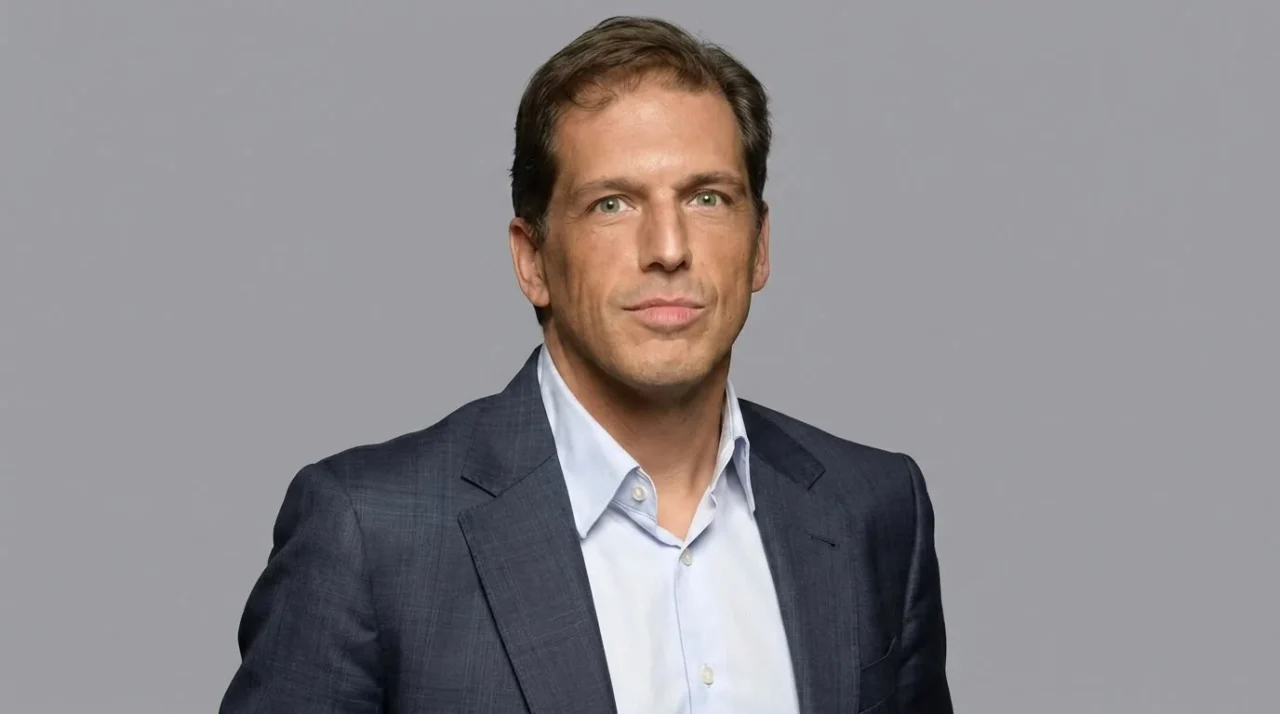
Gerardo Moscatelli: The Spike Protein Cascade – From Endothelial Binding to Vascular Collapse
Gerardo Moscatelli, Global Grains, Oilseeds and Meals Brokerage at Med Commodities, shared a post on LinkedIn:
“The Spike Protein Cascade: From Endothelial Binding to Vascular Collapse.
1.Spike coats the artery walls.
The SARS-CoV-2 Spike S1 subunit binds to the endothelial wall downregulating ACE2, damaging mitochondria, and disrupting VE-cadherin junctions between endothelial cells.
The interior lining of arteries gets stripped bare in microscopic patches. Basement membrane exposed. This is the initiating wound.
2. Fibrinogen-to-fibrin conversion activates, then goes off the rails.
Tissue factor – thrombin burst – fibrinopeptides cleaved – fibrin monomers ready to polymerize. Host proteases (furin, TMPRSS2, neutrophil elastase, plasmin itself) cleave Spike into fragments that expose prion-like amyloidogenic motifs that act as nucleation seeds for fibrinogen.
They template an α-helix – β-sheet conformational transformation. Hydrophobic side chains stack into steric zippers, the identical cross-β structure found in Alzheimer’s plaques and prion disease.
3․ Indestructible amyloid fibrin microclots form.
They’re hyper-condensed, β-sheet-rich, Thioflavin T-positive amyloid. Plasmin cannot digest them because cleavage sites are buried in the hydrophobic core. They resist fibrinolysis.
4․ NETosis amplifies the catastrophe.
Spike directly triggers neutrophil extracellular trap formation. NETs become entangled with the amyloid fibrin. DNase can’t reach the DNA. Plasmin can’t reach the fibrin. It’s a molecular fortress.
5․ White fibrous casts line the vascular system.
These amyloid-NET microclots adhere to and coat the endothelial surface diffusely. This is not atherosclerosis.
It’s a distinct amyloid angiopathy a continuous fibrous sheath narrowing effective luminal diameter throughout the arterial tree.
6․ Hemodynamics collapse.
Organs suffer hypoperfusion. Cells switch to anaerobic metabolism, reduction in ATP yield. Chronic energy failure.
7․ The heart fights a losing battle.
Massively increased systemic vascular resistance. Resting tachycardia. Coronary arteries are lined with the same casts. The heart demands more oxygen while receiving less.
Myocardium remodels: fibrosis replaces functional muscle, ejection fraction declines, wall stress climbs.
8․ Terminal event.
At any point: coronary thrombosis – MI. Cerebral thrombosis – stroke.
Or ventricular free wall rupture when pressure exceeds the tensile strength of damaged, fibrotic, hypoxic muscle. Cardiac tamponade.
Death.
β-sheet amyloid is at thermodynamic free energy minimum. It will not spontaneously revert.
Plasmin cannot access cleavage sites.
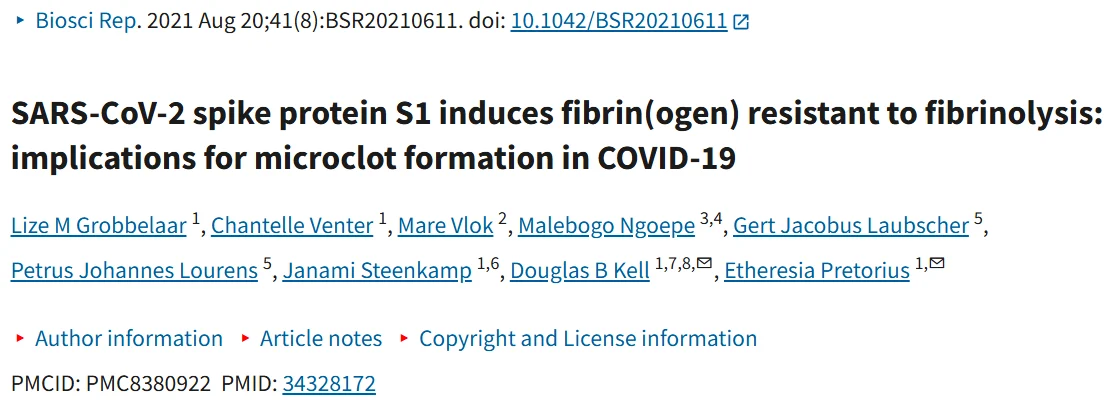
- Grobbelaar et al. (2021): Isolated Spike S1 and healthy fibrinogen leads to amyloid microclots.
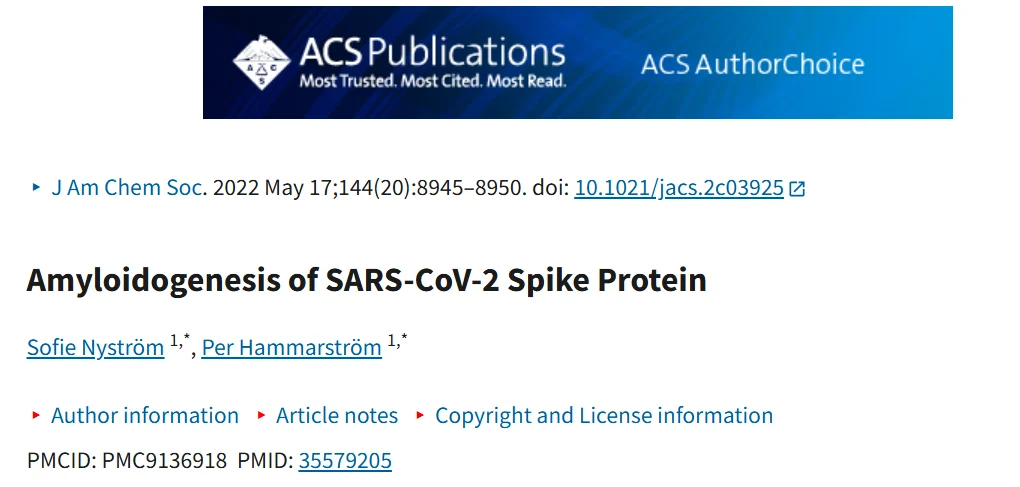
- Nyström and Hammarström (2022): S1 domain contains multiple amyloidogenic sequences forming amyloid fibrils in vitro.
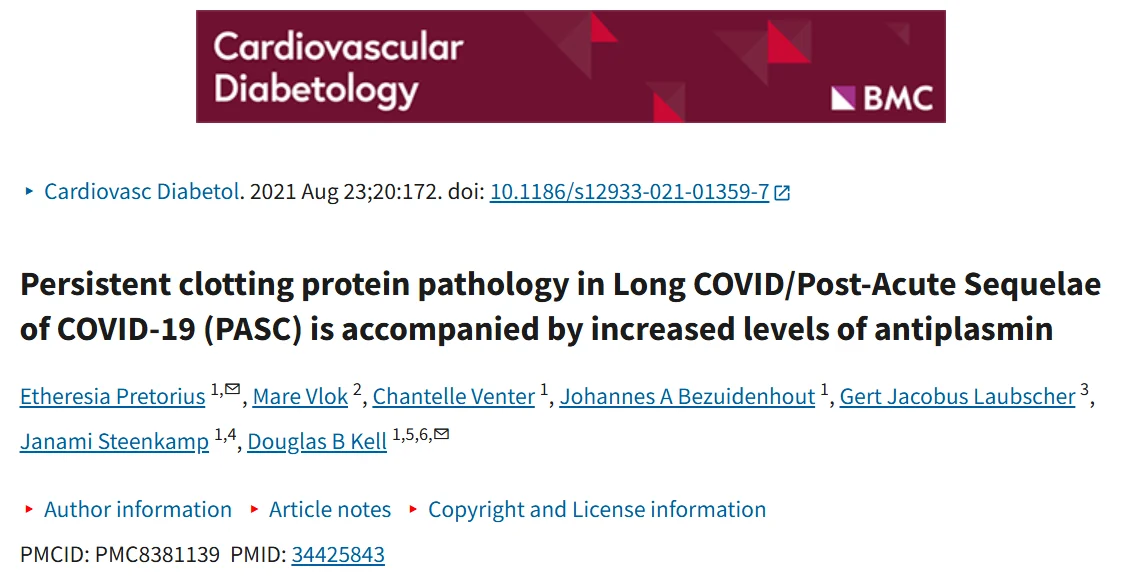
- Pretorius et al. (2020, 2021): Amyloid microclots identified in patient plasma. ThT-positive and protease-resistant. Persist for months.
- Veras et al. (2020): Spike directly triggers NETosis via TLR4. No virus needed.”
Title: SARS-CoV-2 spike protein S1 induces fibrin(ogen) resistant to fibrinolysis: implications for microclot formation in COVID-19
Authors: Lize M Grobbelaar, Chantelle Venter, Mare Vlok, Malebogo Ngoepe, Gert Jacobus Laubscher, Petrus Johannes Lourens, Janami Steenkamp, Douglas B Kell, Etheresia Pretorius
Title: Amyloidogenesis of SARS-CoV-2 Spike Protein
Authors: Sofie Nyström, Per Hammarström
Title: Persistent clotting protein pathology in Long COVID/Post-Acute Sequelae of COVID-19 (PASC) is accompanied by increased levels of antiplasmin
Authors: Etheresia Pretorius, Mare Vlok, Chantelle Venter, Johannes A Bezuidenhout, Gert Jacobus Laubscher, Janami Steenkamp, Douglas B Kell
Title: SARS-CoV-2-triggered neutrophil extracellular traps mediate COVID-19 pathology
Authors: Flavio Protasio Veras, Marjorie Cornejo Pontelli, Camila Meirelles Silva, Juliana E Toller-Kawahisa, Mikhael de Lima, Daniele Carvalho Nascimento, Ayda Henriques Schneider, Diego Caetité, Lucas Alves Tavares, Isadora M Paiva, Roberta Rosales, David Colón, Ronaldo Martins, Italo Araujo Castro, Glaucia M Almeida, Maria Isabel Fernandes Lopes, Maíra Nilson Benatti, Letícia Pastorelli Bonjorno, Marcela Cavichioli Giannini, Rodrigo Luppino-Assad, Sérgio Luna Almeida, Fernando Vilar, Rodrigo Santana, Valdes R Bollela, Maria Auxiliadora-Martins, Marcos Borges, Carlos Henrique Miranda, Antônio Pazin-Filho, Luis Lamberti P da Silva, Larissa Dias Cunha, Dario S Zamboni, Felipe Dal-Pizzol, Luiz O Leiria, Li Siyuan, Sabrina Batah, Alexandre Fabro, Thais Mauad, Marisa Dolhnikoff, Amaro Duarte-Neto, Paulo Saldiva, Thiago Mattar Cunha, José Carlos Alves-Filho, Eurico Arruda, Paulo Louzada-Junior, Renê Donizeti Oliveira, Fernando Queiroz Cunha
Stay updated with Hemostasis Today.
-
Nov 13, 2026, 03:21Abdul Muqtadir Abbasi: Iron Deficiency Beyond Anemia and the Importance of Finding the Cause
-
Nov 13, 2026, 03:05Marc Carrier: Aspirin vs Anticoagulants for VTE Prevention After Joint Replacement
-
Nov 13, 2026, 02:28Julia Sjöberg: ROCK1 Inhibition and Red Blood Cell Recovery After Chemotherapy
-
Nov 13, 2026, 02:07Tonie Reincke: Understanding Deep Vein Thrombosis and Vascular Health
-
Nov 13, 2026, 01:52Akshita Singh: The Remarkable Process of Blood Clotting
-
Nov 12, 2026, 22:52Milka Koupenova: The Role of Platelet RIG-I in Regulating Thrombotic Responses
-
Nov 12, 2026, 22:50Arun V J: Why Has India Still Not Achieved 100% Voluntary Blood Donation?
-
Nov 12, 2026, 22:49Sickle Cell Disease Deserves to Be Prioritised in Ghana – ISCC
-
Nov 12, 2026, 22:47Samir Kumar Beura: Delighted to Serve as a Topic Editor for a Research Topic in Frontiers in Neuroscience