


Francisco Chacón-Lozsán: Rethinking PE Risk in 2026
Francisco Chacón-Lozsán, Fellow at World Extreme Medicine, Member of European Society of Intensive Care Medicine (ESICM) and American College of Cardiology, shared a post on X:
“Pulmonary embolism in 2026: are our traditional risk categories becoming too static?
A new 2026 consensus from the Interamerican Society of Cardiology is particularly interesting when read alongside the 2026 AHA/ACC guideline and the still-current 2019 ESC/ERS guideline.
Three frameworks, one important evolution.
The 2019 ESC/ERS model established the familiar low, intermediate-low, intermediate-high and high-risk categories.
In normotensive patients, the combination of clinical risk, RV dysfunction and troponin identifies intermediate-high risk patients who require close monitoring and rescue reperfusion if deterioration occurs.
The 2026 AHA/ACC guideline goes further, replacing the older massive/submassive terminology with categories A through E. Importantly, it explicitly recognizes incipient cardiopulmonary failure in Category D, including patients developing hypoperfusion before persistent hypotension, and incorporates a respiratory modifier.
New Sistema Integrado de Afectación Cardiorrespiratoria, SIAC, integrates hemodynamics, RV dysfunction, gas exchange, biomarkers and clinical evolution, with serial reassessment intended to detect progression before overt deterioration. The RV can progressively fail.
Oxygen requirements can increase. Lactate can rise. Perfusion can deteriorate while arterial pressure is still apparently preserved…Blood pressure is a late variable in obstructive shock.
This is where the 2026 American and Interamerican approaches appear conceptually closer than their terminology suggests.
Both move toward recognizing a dynamic transition from RV stress – impaired cardiopulmonary reserve – hypoperfusion – overt shock, rather than waiting for sustained hypotension to redefine severity.
The ESC framework already requires monitoring for deterioration, but its formal risk categories remain the 2019 structure.
The ESC currently lists a new PE guideline in development.
There is also substantial agreement elsewhere: pretest probability remains fundamental, Wells/Geneva, PERC and YEARS remain useful diagnostic tools, PESI/sPESI and Hestia remain important for disposition, DOACs dominate eligible oral anticoagulation, PERT models are increasingly emphasized, and reperfusion is clearly indicated for the unstable patient while selection of advanced therapy in patients at risk of deterioration remains more nuanced.”
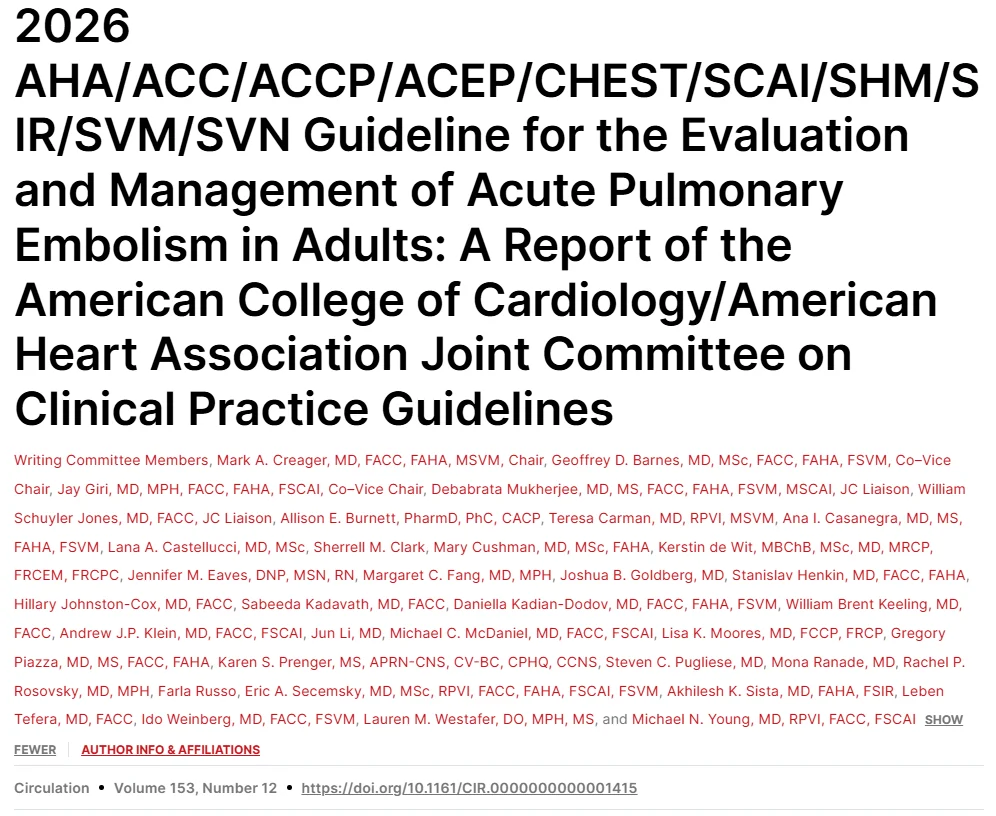
Title: 2019 ESC Guidelines for the diagnosis and management of acute pulmonary embolism developed in collaboration with the European Respiratory Society (ERS): The Task Force for the diagnosis and management of acute pulmonary embolism of the European Society of Cardiology (ESC)
Authors: Stavros V Konstantinides, Guy Meyer, Cecilia Becattini, Héctor Bueno, Geert-Jan Geersing, Veli-Pekka Harjola, Menno V Huisman, Marc Humbert, Catriona Sian Jennings, David Jiménez, Nils Kucher, Irene Marthe Lang, Mareike Lankeit, Roberto Lorusso, Lucia Mazzolai, Nicolas Meneveau, Fionnuala Ní Áinle, Paolo Prandoni, Piotr Pruszczyk, Marc Righini, Adam Torbicki, Eric Van Belle, José Luis Zamorano
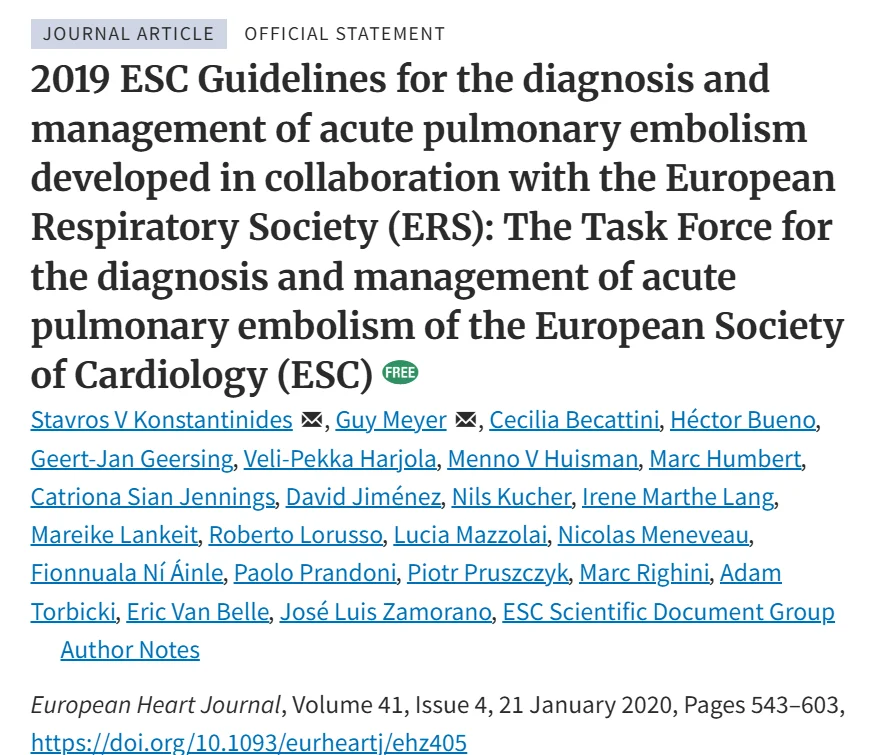
Title: Pulmonary embolism consensus
Authors: Miguel A. Quintana, Joaquín Perea, Arnaldo López-Ruiz, Mauricio Soto, Marildes Castro, Rafael Silva-Cortés, Alexandra Arias, Alex Rivera, Manuel Álvarez, Patricio Sanhueza, Yaqueline Quispe, Roger Tenezaca, Juan P. Costabel, Iván Saavedra, Roberto Colque, Ismenia Diez-Pérez, Gonzalo Pérez, Paola Morejón, Karina Gan-Fernández, Adriana Mogollón, Marcelo Cardona, Dahiana Ibarrola, Ricardo Villarreal
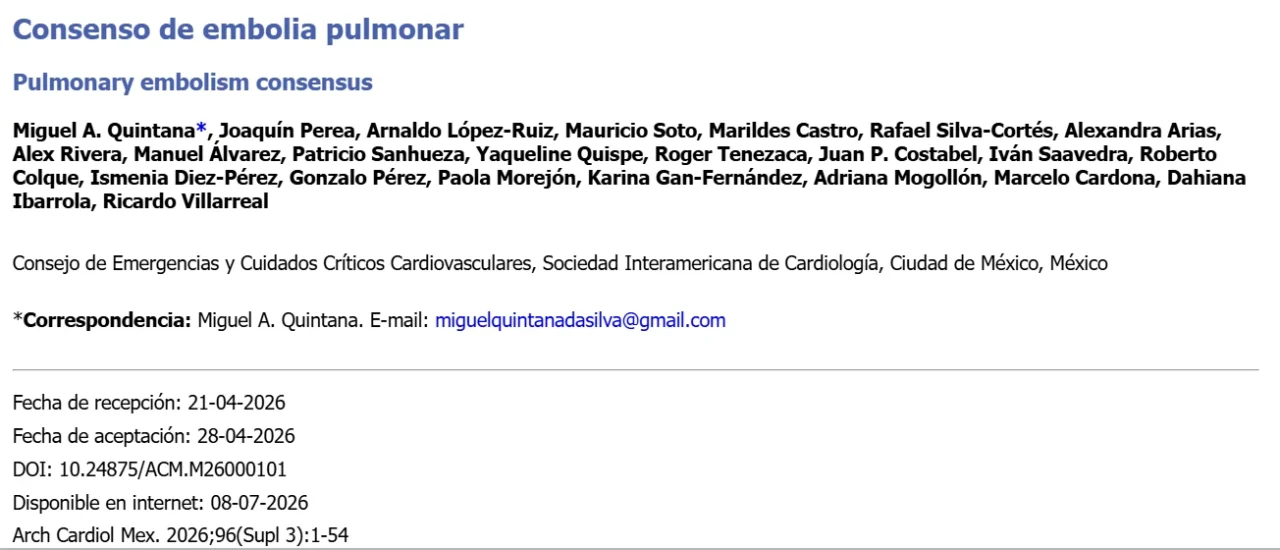
Title: 2026 AHA/ACC/ACCP/ACEP/CHEST/SCAI/SHM/SIR/SVM/SVN Guideline for the Evaluation and Management of Acute Pulmonary Embolism in Adults: A Report of the American College of Cardiology/American Heart Association Joint Committee on Clinical Practice Guidelines
Authors: Mark A. Creager, Geoffrey D. Barnes, Jay Giri, Debabrata Mukherjee, William Schuyler Jones, Allison E. Burnett, Teresa Carman, Ana I. Casanegra, Lana A. Castellucci, Sherrell M. Clark, Mary Cushman, Kerstin de Wit, Jennifer M. Eaves, Margaret C. Fang, Joshua B. Goldberg, Stanislav Henkin, Hillary Johnston-Cox, Sabeeda Kadavath, Daniella Kadian-Dodov, William Brent Keeling, Andrew J.P. Klein, Jun Li, Michael C. McDaniel, Lisa K. Moores, Gregory Piazza, Karen S. Prenger, Steven C. Pugliese, Mona Ranade, Rachel P. Rosovsky, Farla Russo, Eric A. Secemsky, Akhilesh K. Sista, Leben Tefera, Ido Weinberg, Lauren M. Westafer, Michael N. Young
Find more posts featuring Francisco Chacón-Lozsán on Hemostasis Today.
-
Sep 23, 2026, 13:16Beverley Hunt: Advances in Haemostatic Management of Postpartum Haemorrhage
-
Sep 23, 2026, 13:13Ioanna Mela: Recruiting a Research Associate on DNA nanotechnology
-
Sep 23, 2026, 13:04Ben Samelson-Jones: Do Gene Variants Drive PK Differences in FIX-Fusion and N9-GP Therapies?
-
Sep 23, 2026, 12:57Shelly Reed: Advocating for HTCs and CDC Funding with the Hemophilia Federation of America
-
Sep 23, 2026, 12:51Domenico Girelli: How Verona Hospital Transformed ED Anemia Care with Patient Blood Management
-
Sep 23, 2026, 12:45Lina Camacho-Arteaga: ENTIS Study Uncovers Safety Data on Early Pregnancy Exposure to Direct Oral Anticoagulants
-
Sep 23, 2026, 12:34Hiteshi K.C. Chauhan: Why Mechanical Valve Thrombosis Is a Systems Failure, Not Just an Anticoagulation Error
-
Sep 23, 2026, 12:33World Thrombosis Day 2026 Puts Women’s Health in Focus – JTH
-
Sep 23, 2026, 12:30Zain Khalpey: How a Sudden Blockage Causes Myocardial Infarction