


Alefiya B.: Imagine Treating a Genetic Disorder by Giving Cells the Instructions They are Missing
Alefiya B., Medical Officer at EPIC Multispecialty Hospital, Ahmedabad, shared a post on LinkedIn:
“Imagine treating a genetic disorder by giving cells the instructions they are missing.
That’s the basic idea behind gene therapy.
And a recent Nature Medicine study gives us another interesting example.
Let’s start with hemophilia B.
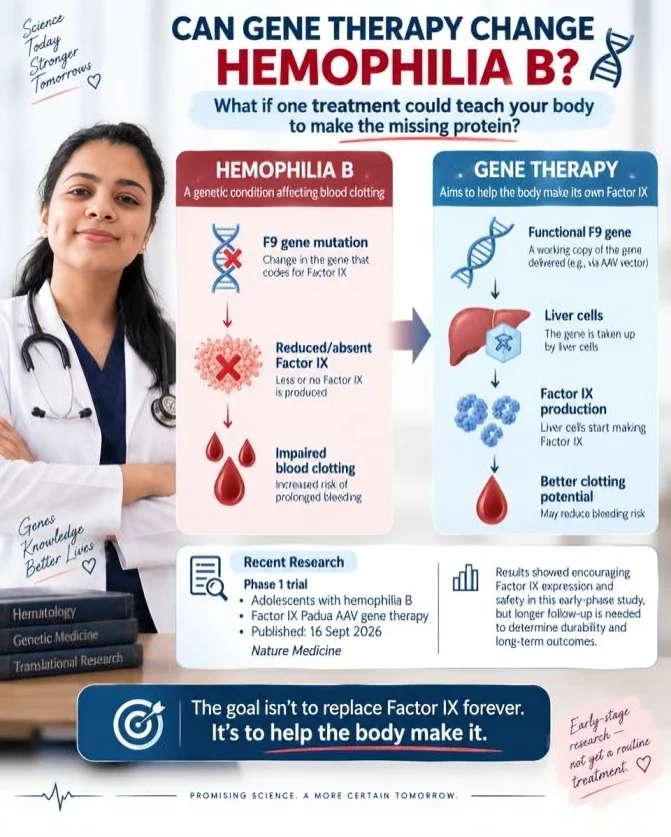
Hemophilia B is caused by pathogenic variants affecting the F9 gene, which is needed to produce coagulation factor IX.
When factor IX is deficient, the normal clotting process is impaired.
That’s why people with hemophilia B can experience prolonged or spontaneous bleeding.
Traditionally, treatment has involved replacing the missing clotting factor.
But gene therapy asks a different question:
What if we could give the patient’s cells a functional copy of the gene?
In the recent Phase 1 study, researchers investigated an AAV-based gene therapy carrying the Factor IX Padua variant in adolescents with hemophilia B.
The concept is fascinating:
Deliver genetic instructions → target liver cells → enable production of Factor IX
Instead of repeatedly supplying the missing protein from outside, the aim is to help the patient’s own cells produce it.
But here’s the important part about reading early research:
This was a Phase 1 clinical trial.
That means we’re looking at an early stage of clinical development, where safety, tolerability, dosing and biological activity are important considerations.
So this isn’t: ‘Hemophilia has been cured.’
It’s: ‘Researchers are testing whether a single gene-delivery approach can produce a clinically meaningful source of Factor IX.’
That’s a very different statement.
And that’s something I think we should all get better at when reading medical news:
Interesting is not equal to proven.
Promising is not equal to established.
Phase 1 is not equal to standard treatment.
But every established therapy once began as an experiment.
And that’s what makes following clinical research so fascinating.
One day, a concept exists mainly in molecular biology.
Then researchers test it in cells.
Then animals.
Then carefully selected human participants.
Then larger clinical trials.
And, if the evidence continues to support it, eventually clinical practice.
That’s how today’s “experimental” medicine can become tomorrow’s standard of care.
A question for my medical colleagues:
Which emerging area of medicine fascinates you most?
Gene therapy?
mRNA therapeutics?
CRISPR?
AI in diagnostics?
Personalized medicine?”
Stay updated with Hemostasis Today.
-
Nov 13, 2026, 03:21Abdul Muqtadir Abbasi: Iron Deficiency Beyond Anemia and the Importance of Finding the Cause
-
Nov 13, 2026, 03:05Marc Carrier: Aspirin vs Anticoagulants for VTE Prevention After Joint Replacement
-
Nov 13, 2026, 02:28Julia Sjöberg: ROCK1 Inhibition and Red Blood Cell Recovery After Chemotherapy
-
Nov 13, 2026, 02:07Tonie Reincke: Understanding Deep Vein Thrombosis and Vascular Health
-
Nov 13, 2026, 01:52Akshita Singh: The Remarkable Process of Blood Clotting
-
Nov 12, 2026, 22:52Milka Koupenova: The Role of Platelet RIG-I in Regulating Thrombotic Responses
-
Nov 12, 2026, 22:50Arun V J: Why Has India Still Not Achieved 100% Voluntary Blood Donation?
-
Nov 12, 2026, 22:49Sickle Cell Disease Deserves to Be Prioritised in Ghana – ISCC
-
Nov 12, 2026, 22:47Samir Kumar Beura: Delighted to Serve as a Topic Editor for a Research Topic in Frontiers in Neuroscience