

Why Does Plasma Form Such Robust Fibrin Clots – RPTH Journal
RPTH Journal shared a post on LinkedIn about a recent article by François Caton et al, adding:
“Why does plasma form such robust fibrin clots?
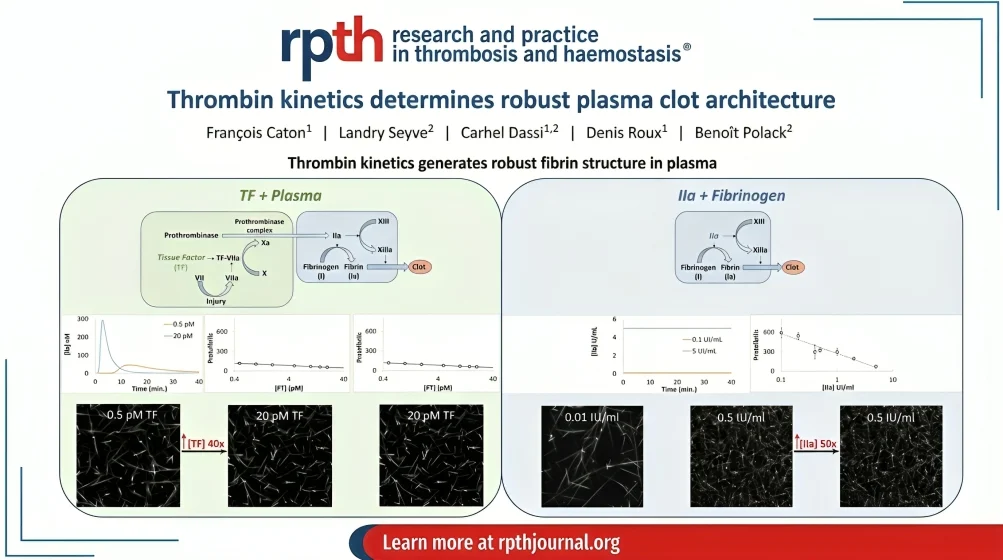
Fibrin clot architecture is a recognised signature of cardiovascular disease, but the fundamental mechanisms linking clot-forming chemistry to clot structure in plasma remain poorly understood. A new study in RPTH Journal takes a rigorous quantitative approach to answer this question.
Key findings comparing plasma clots with purified fibrinogen/thrombin systems:
In purified systems, a 100-fold increase in thrombin concentration caused a 30-fold decrease in protofibril number and a 5-fold change in pore size, highly sensitive to trigger concentration
In contrast, plasma clots showed remarkable robustness: a 40-fold increase in tissue factor concentration resulted in only a 2-fold change in protofibril number, with minimal pore size evolution
Purified and plasma clots appeared morphologically identical, their ultrastructural parameters behaved fundamentally differently
Key driver: it is the characteristic shape of the thrombin burst over time, not the total amount of thrombin produced, that governs plasma fibrin architecture
This inherent robustness of plasma clot formation may explain the existence of a ‘normal’ clot structure, and positions fibrinography as a promising structural biomarker for detecting deviations from this norm in cardiovascular disease.”
Title: Thrombin kinetics determines robust plasma clot architecture
Authors: François Caton, Landry Seyve, Carhel Dassi, Denis Roux, Benoît Polack
Stay updated on all scientific advances with Hemostasis Today.
-
Sep 27, 2026, 15:49Rana Al-Hrout: Iron Deficency – Is Ferritin 15ng/mL or Less Still the Cutoff?
-
Sep 27, 2026, 15:49Ayushi Sharma: What I Thought Transfusion Medicine Would Be vs What It Actually Is
-
Sep 27, 2026, 15:48William Wallace: How Much Human Research Is Behind the Supplements We Take?
-
Sep 27, 2026, 15:46Franck Perraudin: Lp(a) Lowering Alone May Not Be Enough
-
Sep 27, 2026, 15:41Ahmed Hamandi: Sharing Real-World HSCT Experience at the Iraqi Society of Haematology Conference
-
Sep 27, 2026, 15:39Co-creating Digital Support With Young Stroke Survivors – European Stroke Organisation
-
Sep 27, 2026, 15:39Eleri Schiavone: Celebrating 80 Years of the Welsh Blood Service
-
Sep 27, 2026, 15:38Jessica Garcia: Standing Where VWD Was First Recognized 100 Years Later
-
Sep 27, 2026, 15:37Heghine Khachatryan: A Meaningful Step Forward for Inherited Blood Disorders in Africa