

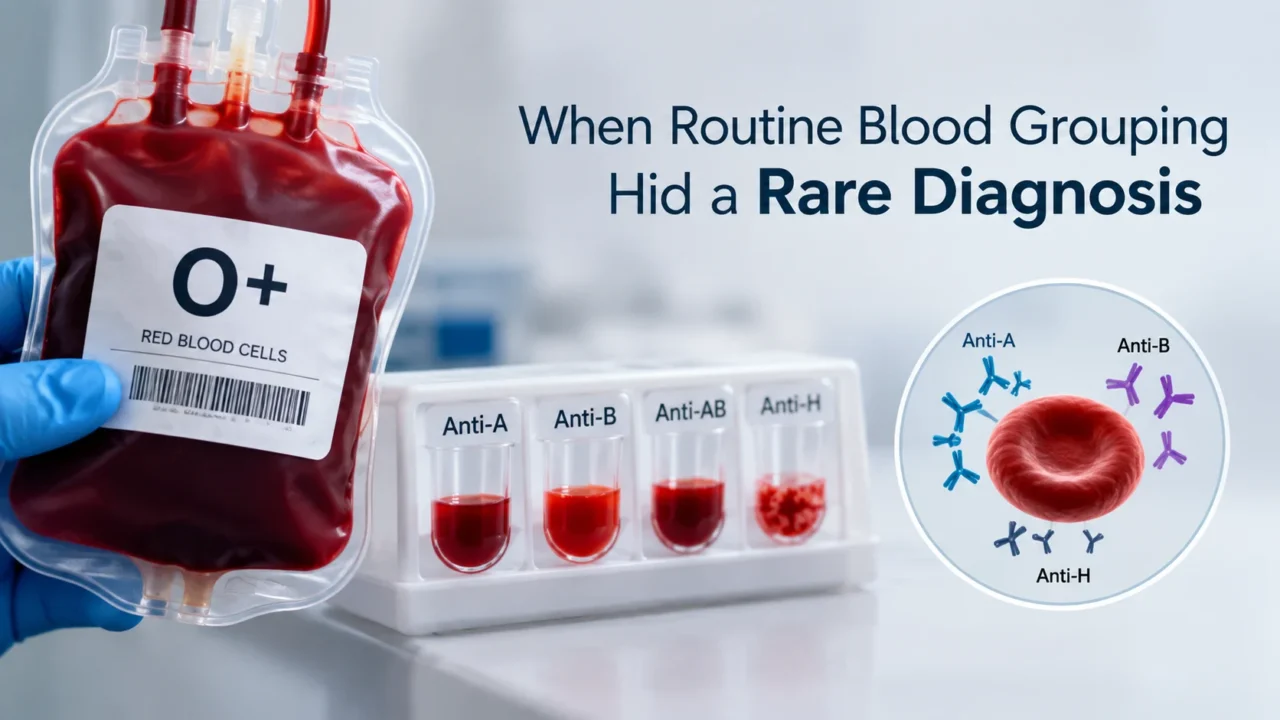
Subham Banerjee: When Routine Blood Grouping Hid a Rare Diagnosis
Subham Banerjee, General Practitioner at Nightingale Nursing Home, Junior Resident of Medicine Department at COMJNMH, shared a post on LinkedIn:
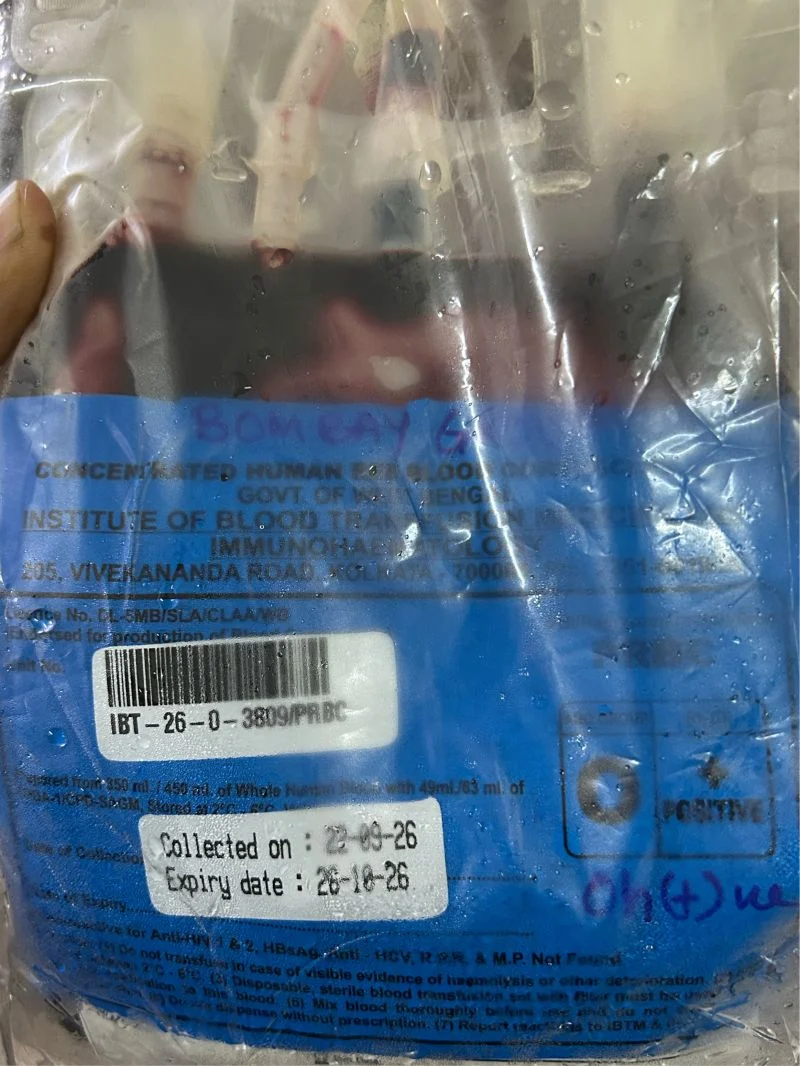
“When ‘O positive’ wasn’t actually O positive – a rare transfusion challenge
A patient with severe anemia (Hb approximately 6 g/dL) required blood transfusion.
What initially seemed like a routine transfusion soon turned into an unusual diagnostic challenge.
Multiple blood samples were tested, but none of the available blood units were compatible on crossmatching.
The pattern raised suspicion that this was not a routine ABO grouping problem.
Further evaluation revealed something extremely rare – the patient had the Bombay blood group phenotype (Oh/hh).
The Bombay phenotype is fascinating because it is different from the usual ABO blood groups at a fundamental level.
In a normal individual, the H antigen acts as the precursor on which A or B antigens are formed.
In group O individuals, H antigen is still present – in fact, it is present in relatively high amounts.
In the Bombay phenotype, however, the H antigen is absent because of a defect affecting its formation.
Consequently, A and B antigens also cannot be expressed on the red cells, making the patient’s cells appear like group O on routine forward grouping.
The important difference is in the plasma: Bombay phenotype individuals generally have anti-A, anti-B and anti-H antibodies.
That means ordinary O blood is NOT compatible, because even O red cells carry H antigen.
Transfusion with ordinary ABO blood can therefore cause a severe hemolytic transfusion reaction.
And this is where the case became a team effort.
With no compatible blood readily available, NGO or rare-donor networks were contacted to search for a Bombay-phenotype donor.
A compatible Bombay blood unit was eventually identified at Apollo Hospitals, Vellore, and a cold-chain transport pathway was arranged to bring the unit to JNM Hospital.
After the long search, coordination and transportation, the rare blood unit finally reached our hospital and was successfully transfused to the patient.
The Bombay phenotype was first described in Mumbai in 1952, and its estimated frequency in India is around 1 in 7,600-10,000 people, although prevalence varies considerably between populations.
What makes this case particularly memorable is that it wasn’t simply about finding ‘O negative’ or ‘O positive’ blood.”
Stay updated with Hemostasis Today.
-
Nov 13, 2026, 03:21Abdul Muqtadir Abbasi: Iron Deficiency Beyond Anemia and the Importance of Finding the Cause
-
Nov 13, 2026, 03:05Marc Carrier: Aspirin vs Anticoagulants for VTE Prevention After Joint Replacement
-
Nov 13, 2026, 02:28Julia Sjöberg: ROCK1 Inhibition and Red Blood Cell Recovery After Chemotherapy
-
Nov 13, 2026, 02:07Tonie Reincke: Understanding Deep Vein Thrombosis and Vascular Health
-
Nov 13, 2026, 01:52Akshita Singh: The Remarkable Process of Blood Clotting
-
Nov 12, 2026, 22:52Milka Koupenova: The Role of Platelet RIG-I in Regulating Thrombotic Responses
-
Nov 12, 2026, 22:50Arun V J: Why Has India Still Not Achieved 100% Voluntary Blood Donation?
-
Nov 12, 2026, 22:49Sickle Cell Disease Deserves to Be Prioritised in Ghana – ISCC
-
Nov 12, 2026, 22:47Samir Kumar Beura: Delighted to Serve as a Topic Editor for a Research Topic in Frontiers in Neuroscience