

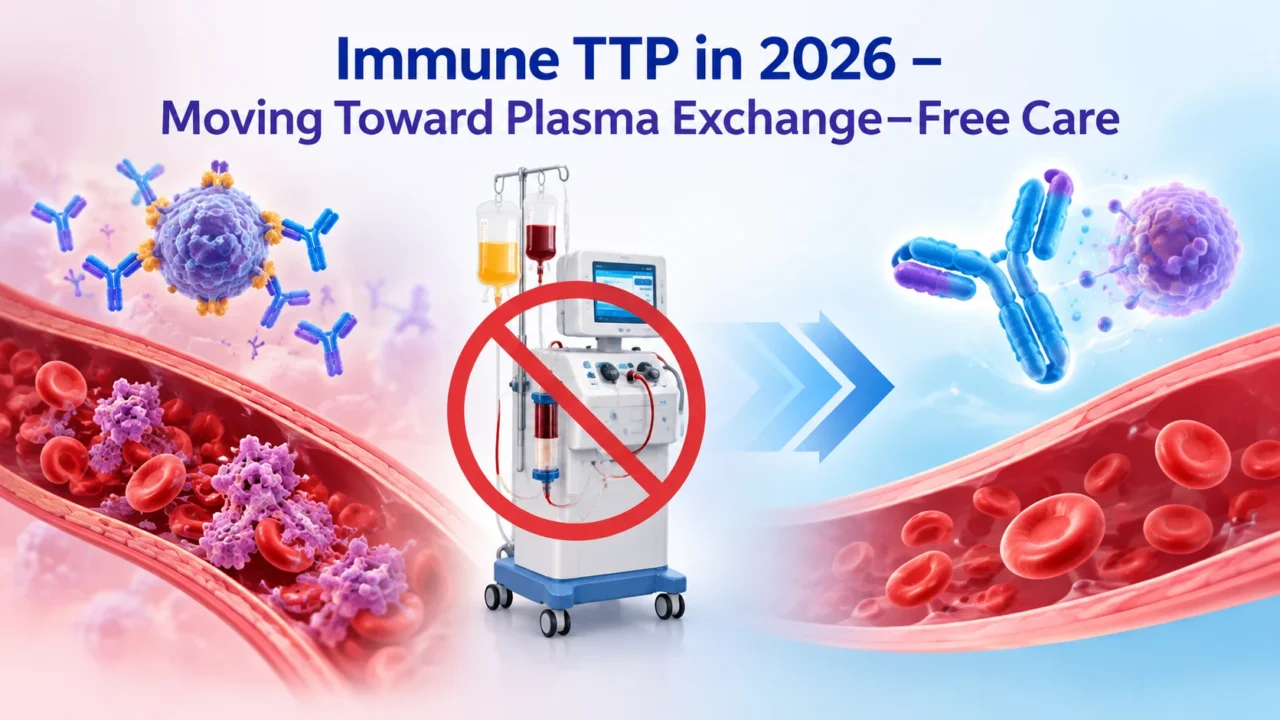
Andra Tocarciuc: Immune TTP in 2026 – Moving Toward Plasma Exchange–Free Care
Andra Tocarciuc, Intelligence Liaison Officer at JMED MCM CBRN, shared a post on LinkedIn:
“Immune TTP in 2026: moving toward plasma exchange–free care
Immune thrombotic thrombocytopenic purpura (iTTP) is a life-threatening thrombotic microangiopathy. Autoantibodies inhibit or clear ADAMTS13, the enzyme that cleaves von Willebrand factor (VWF).
Ultra-large VWF then drives platelet microthrombi and organ damage. Without treatment it is usually fatal, and historically about a third of patients relapse within 10 years.
Current treatment
- Therapeutic plasma exchange (TPE): removes autoantibodies and replenishes functional ADAMTS13.
- Corticosteroids and rituximab: suppress autoantibody production. Rituximab (anti-CD20) depletes the B cells behind it and lowers relapse risk.
- Caplacizumab: a nanobody against the VWF A1 domain that blocks platelet binding. In HERCULES it shortened time to platelet response and reduced death, recurrence and major thromboembolic events.
- ADAMTS13-guided follow-up: giving rituximab preemptively when activity drops during remission cuts clinical relapse from up to 75% to about 15%.
Practice-changing now
- Caplacizumab and immunosuppression without first-line TPE: in the Phase 3 MAYARI trial in non-severe iTTP, 43 of 46 patients reached remission without plasma exchange. German-Austrian registry data showed no difference in outcomes vs TPE-based care. The US label still pairs caplacizumab with TPE, but practice is shifting.
In the pipeline
- Recombinant ADAMTS13 (apadamtase alfa): directly replaces the missing enzyme. It has been FDA-approved for congenital TTP since 2023, where it restored ADAMTS13 activity to about 100% of normal. It is now in a randomized Phase 2b trial in iTTP with minimal or no plasma exchange.
- Anti-CD38 (daratumumab): targets long-lived plasma cells that escape rituximab. In a Swiss series, 7 of 8 treatment courses rapidly restored ADAMTS13, though 4 of 5 patients later had an ADAMTS13 relapse. Autoantibody-evading ADAMTS13 muteins (e.g., GC1126A): engineered to avoid inhibitor binding across multiple epitopes; still preclinical.
- Next-generation anti-VWF aptamers (e.g., TAGX-0004): matched caplacizumab’s inhibition of thrombus formation in preclinical testing.
The direction is clear: address all three pillars – replace ADAMTS13, block VWF–platelet binding and switch off the autoimmune response – while sparing patients the burden of daily plasma exchange.”
Stay updated with Hemostasis Today.
-
Sep 28, 2026, 13:20Elif Susan Elcin։ PRP for Skin Rejuvenation – Is It Worth the Hype?
-
Sep 28, 2026, 13:07Alexandru Stieber: Looking Beyond MDS in VEXAS Syndrome
-
Sep 28, 2026, 12:53Shifa Maharani: Research Innovation and Recognition at JSMID 8th
-
Sep 28, 2026, 12:40Najmul Hasan Forhad: Platelets – The Unsung Heroes of Hemostasis
-
Sep 28, 2026, 12:29Turki Alqahtani: From Routine Testing to Specialized Hematology Diagnostics
-
Sep 28, 2026, 11:13Nathan Pennell: 3 Questions That Matter for the Next Multiple Myeloma Treatment
-
Sep 28, 2026, 11:00Oren Rom: Connecting Amino Acid and Lipid Metabolism in MASH
-
Sep 28, 2026, 10:38Dawn Rotellini: Advocating for Women and Girls With Bleeding Disorders
-
Sep 28, 2026, 10:18Neha Rastogi Panda: Empowering Young Women Through Health Awareness