


William Aird: Gulliver’s Atlas – Mapping the Evolution of the Vertebrate Red Cell
William Aird, Professor of Medicine at Harvard Medical School, shared a post on LinkedIn։
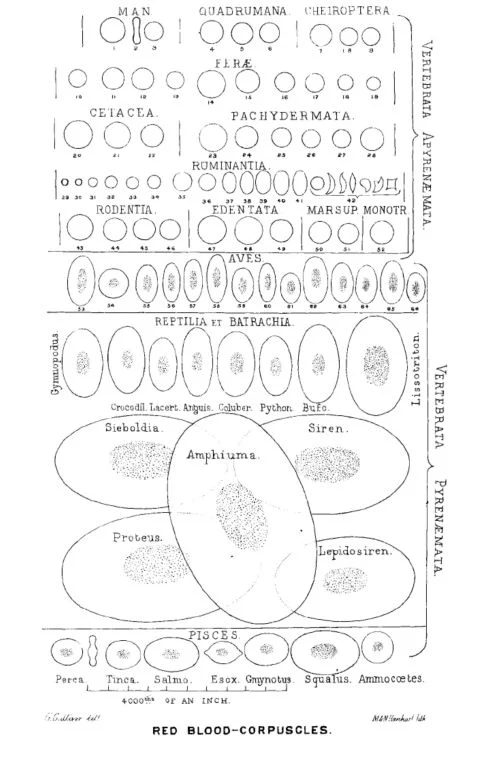
“Gulliver’s Atlas
This may be one of my favorite images in the history of hematology.
In the mid-19th century, British surgeon and microscopist George Gulliver measured red blood cells from an extraordinary range of vertebrates, then drew them side by side at the same scale.
Look closely.
Fish. Amphibians. Reptiles. Birds. Mammals.
Some cells are enormous, others tiny. Some are oval, others round.
Most vertebrate red cells contain a nucleus. Mammalian red cells do not.
What we casually call ‘the red blood cell’ is actually a family of different evolutionary solutions to the same problem: moving respiratory pigment through a circulation.
Gulliver was particularly interested in what he called the ‘vexed question of a nucleus.’
His atlas helps us see just how strange the mammalian solution really is.
We didn’t hide the nucleus.
We lost it.”
Other posts featuring William Aird on Hemostasis Today.
-
Sep 28, 2026, 15:52Kassa Tameru: Antithrombotic Management in GI Bleeding and Elective Endoscopy
-
Sep 28, 2026, 15:51Chengappa Kavadichanda: How Do aPLs Change Over Time in Early Lupus?
-
Sep 28, 2026, 15:18Linda Shore-Lesserson: Celebrating 25 Years of PBM at the SABM Meeting
-
Sep 28, 2026, 14:45Access Real-Time Bleeding Disorder Guidelines with the New WFH Resource Hub – WFH
-
Sep 28, 2026, 14:44Subham Banerjee: When Routine Blood Grouping Hid a Rare Diagnosis
-
Sep 28, 2026, 14:41Francois Roubille: Can Low-Dose Colchicine Prevent Atrial Fibrillation After CABG?
-
Sep 28, 2026, 14:30Rafael Zubiran: High Lp(a) Drives 1 in 15 Cases of Aortic Stenosis
-
Sep 28, 2026, 14:23Heghine Khachatryan: Measuring the Human Impact of Gene Therapy on the Hemophilia
-
Sep 28, 2026, 13:48Can the Immune System Be Reprogrammed to Treat Aplastic Anemia?