

Platelets Without Donors: Can Freeze-Dried Artificial Platelets Transform Trauma Care?
Severe bleeding is one of the leading preventable causes of death after major trauma. In many cases, the problem is not that effective treatment does not exist. The problem is that blood products may not be available during the first critical minutes after injury.
Platelets are an important part of bleeding control. They attach to damaged blood vessels, recruit other platelets and help build a stable clot. However, conventional platelet concentrates are difficult to store and transport. They usually require controlled storage conditions, have a limited shelf life and depend on regular blood donations.
This has led researchers to develop freeze-dried human platelet products and synthetic platelet substitutes. These technologies are designed to provide platelet-like hemostatic activity in a form that can be stored for longer periods, transported more easily and administered closer to the time and place of injury.
The idea is promising, particularly for military medicine, ambulance services, remote hospitals and disaster response. But it is important to distinguish scientific potential from proven clinical benefit. At present, these products are still being evaluated and should not be considered replacements for standard platelet transfusion or whole blood.
Why Conventional Platelets are Difficult to Keep Available
Conventional platelets are collected from human donors and stored under conditions that preserve their function.
Unlike red blood cells, which can be refrigerated for several weeks, platelets are traditionally stored at room temperature with continuous agitation. This creates a short storage window and increases the risk of wastage.
The supply also depends on donors. When donations fall or demand suddenly increases, hospitals may experience platelet shortages. This can happen during natural disasters, major accidents, infectious disease outbreaks and military conflicts.
Transportation is another challenge. Platelets cannot simply be placed in a standard refrigerator and sent anywhere. They require validated storage, monitoring and handling throughout the supply chain. These requirements make prehospital use difficult.
This is especially important in trauma. A patient with severe internal bleeding may need balanced blood-product resuscitation before reaching a trauma center. However, conventional platelets are often unavailable in ambulances or remote emergency settings.
A shelf-stable platelet product could help fill this gap.
What are Dreeze-Dried Platelets?
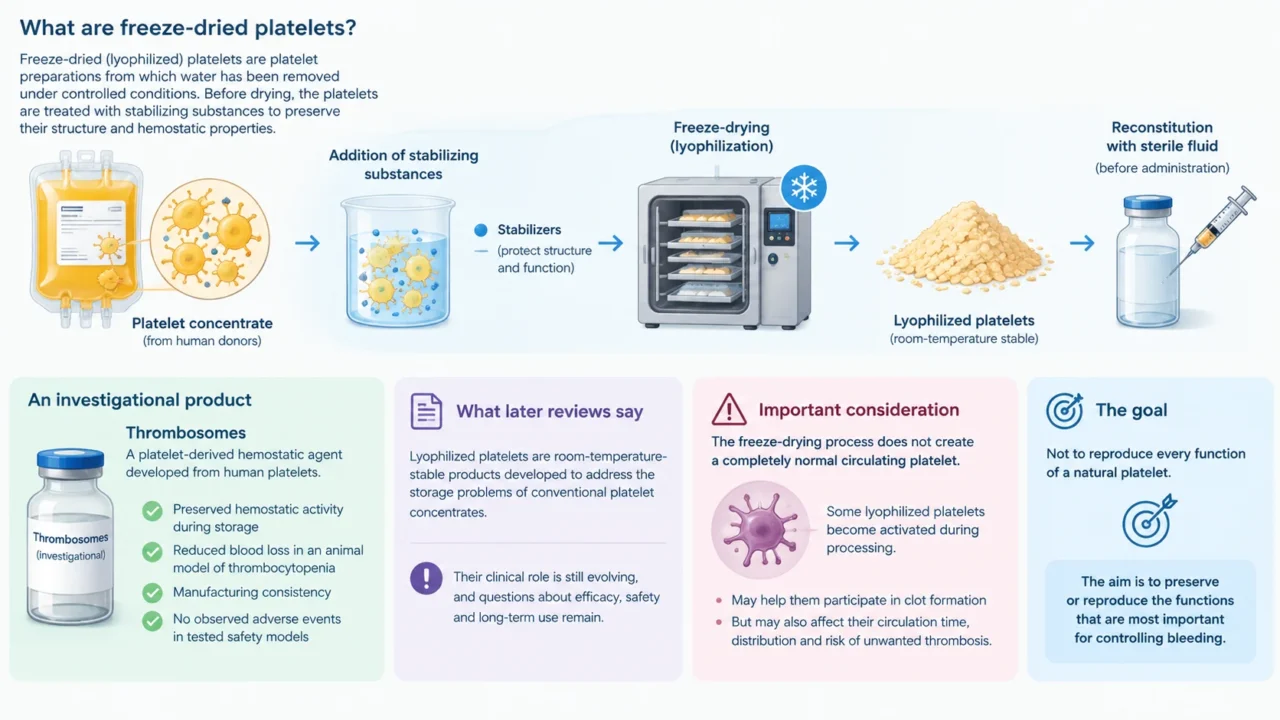
Freeze-dried, or lyophilized, platelets are platelet preparations from which water has been removed under controlled conditions. Before drying, the platelets are treated with stabilizing substances intended to preserve their structure and hemostatic properties. The dried material can later be reconstituted with sterile fluid before administration.
One investigational product is Thrombosomes, a platelet-derived hemostatic agent developed from human platelets. Earlier studies reported that Thrombosomes preserved hemostatic activity during storage and reduced blood loss in an animal model of thrombocytopenia. In that study, the product showed manufacturing consistency and no observed adverse events in the tested safety models.
A later review described lyophilized platelets as room-temperature-stable products developed to address the storage problems of conventional platelet concentrates. The same review also emphasized that their clinical role is still evolving and that questions about efficacy, safety and long-term use remain.
The freeze-drying process does not create a completely normal circulating platelet. Some lyophilized platelets become activated during processing. This may help them participate in clot formation, but it may also affect their circulation time, distribution and risk of unwanted thrombosis.
Therefore, the goal is not necessarily to reproduce every function of a natural platelet. The aim is to preserve or reproduce the functions that are most important for controlling bleeding.
What are synthetic platelet substitutes?
Synthetic platelet substitutes are engineered particles that imitate selected platelet functions. They are not made from donor platelets and do not attempt to reproduce every biological property of a normal platelet.
One example is SynthoPlate, a platelet-inspired synthetic nanoparticle being developed by Haima Therapeutics. The product is designed to support clot formation at sites of vascular injury and to amplify the body’s natural hemostatic response.
According to the company’s published preclinical data, SynthoPlate reduced blood loss and improved hemodynamic stability in animal models of traumatic hemorrhage. It has also been studied in lyophilized form, with the aim of creating a dry, portable product for intravenous or intraosseous administration.
A 2026 study reported that intraosseous administration of lyophilized synthetic platelets was feasible in a rat model of traumatic hemorrhage. Intraosseous delivery may be useful when intravenous access is difficult or delayed, although the study does not establish safety or effectiveness in human patients.
Synthetic platelets may offer greater control over manufacturing than donor-derived products. Researchers can potentially adjust their size, surface chemistry, binding properties and concentration. However, the simplified design is also a limitation because natural platelets perform many complex functions that synthetic particles may not reproduce.
Why could these Products be Useful in Trauma?
The main potential advantage is not that artificial platelets are more powerful than natural platelets. It is that they may be available when natural platelets are not.
A shelf-stable product could be stored in ambulances, helicopters, rural hospitals, military medical units and disaster-response caches. It could potentially be used during transport, before the patient reaches a major trauma center.
This could be important in patients with bleeding that cannot be controlled with external pressure or a tourniquet. Examples include pelvic hemorrhage, abdominal bleeding, major vascular injury and some types of traumatic brain injury.
Early administration may also be useful because trauma-induced coagulopathy can develop soon after severe injury. Hypoperfusion, tissue damage, acidosis, hypothermia and dilution from intravenous fluids can all impair the patient’s ability to form a stable clot.
A product that supports early hemostasis could help slow bleeding while the medical team arranges surgery, interventional radiology or definitive blood-product transfusion.
The Role of Platelets in Trauma-Induced Coagulopathy
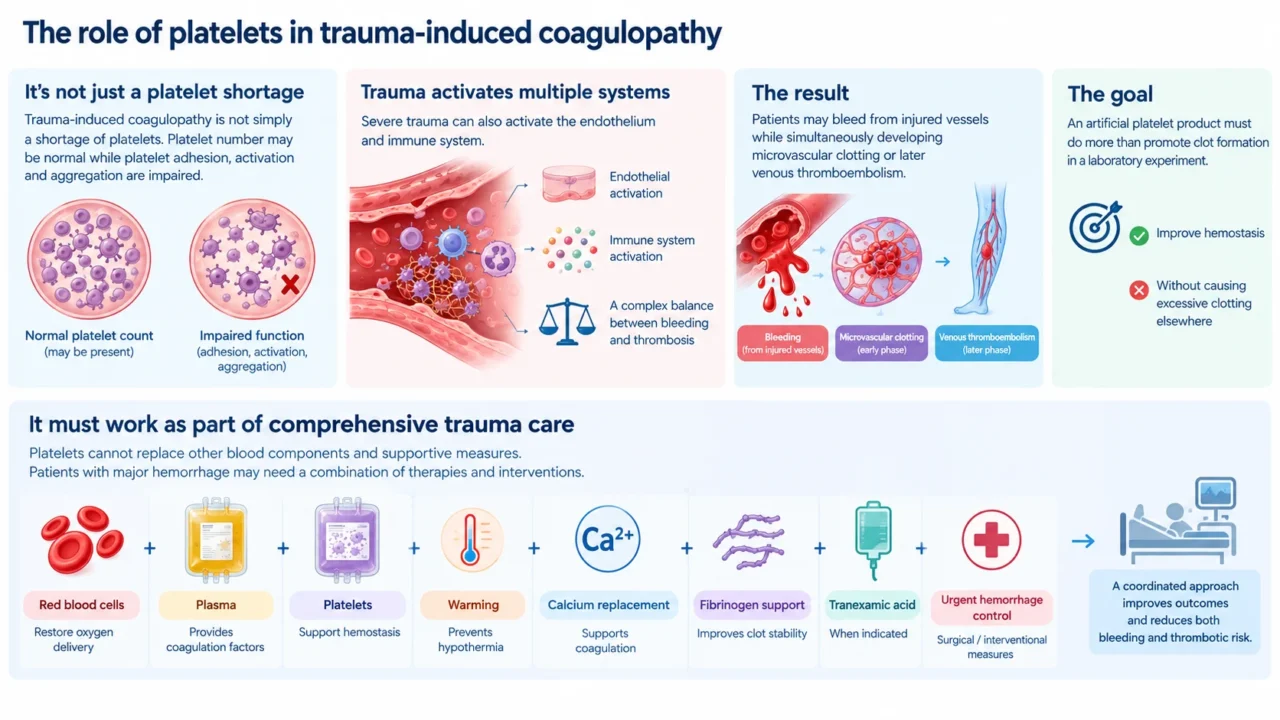
Trauma-induced coagulopathy is not simply a shortage of platelets. Platelet number may be normal while platelet adhesion, activation and aggregation are impaired.
Severe trauma can also activate the endothelium and immune system. The result is a complex balance between bleeding and thrombosis. Patients may bleed from injured vessels while simultaneously developing microvascular clotting or later venous thromboembolism.
This means that an artificial platelet product must do more than promote clot formation in a laboratory experiment. It must improve hemostasis without causing excessive clotting elsewhere.
The treatment would also need to work alongside other components of trauma care. Platelets cannot replace red blood cells, which restore oxygen delivery, or plasma, which provides coagulation factors. Patients with major hemorrhage may need whole blood or a combination of red cells, plasma and platelets, together with warming, calcium replacement, fibrinogen support, tranexamic acid when indicated and urgent hemorrhage control.
What does the Research Show?
The current evidence includes laboratory studies, animal research and early-stage human studies. The results are encouraging, but they are not yet sufficient to confirm clinical benefit.
In a 2013 preclinical study, Thrombosomes demonstrated consistent manufacturing characteristics, preserved hemostatic function and reduced blood loss by more than 80 percent in a thrombocytopenic ear-bleeding model. No adverse events were observed in the safety models used in that study. However, this was not a human trauma trial.
Research on pre-activated lyophilized platelets in rabbits found a hemostatic effect that was not inferior to fresh platelets in models of traumatic bleeding and shock. Animal studies can support further development, but they cannot determine whether a product reduces mortality or disability in humans.tandfonline
SynthoPlate has also shown promising results in animal models. Company-reported findings describe reduced blood loss and improved hemodynamics after traumatic arterial or abdominal bleeding. These results are useful for development, but they should be interpreted as preclinical data because the product remains in the process of preparing for first-in-human evaluation.
For Thrombosomes, clinical trials have been registered to compare the investigational product with standard liquid-stored platelets in bleeding patients. One registered study is evaluating the product in acute thoracic aortic surgery. The existence of a registered trial does not mean that efficacy has already been proven; it means that the product is being formally evaluated in humans.
Could they be Used before Hospital Arrival?
This is one of the most important potential applications.
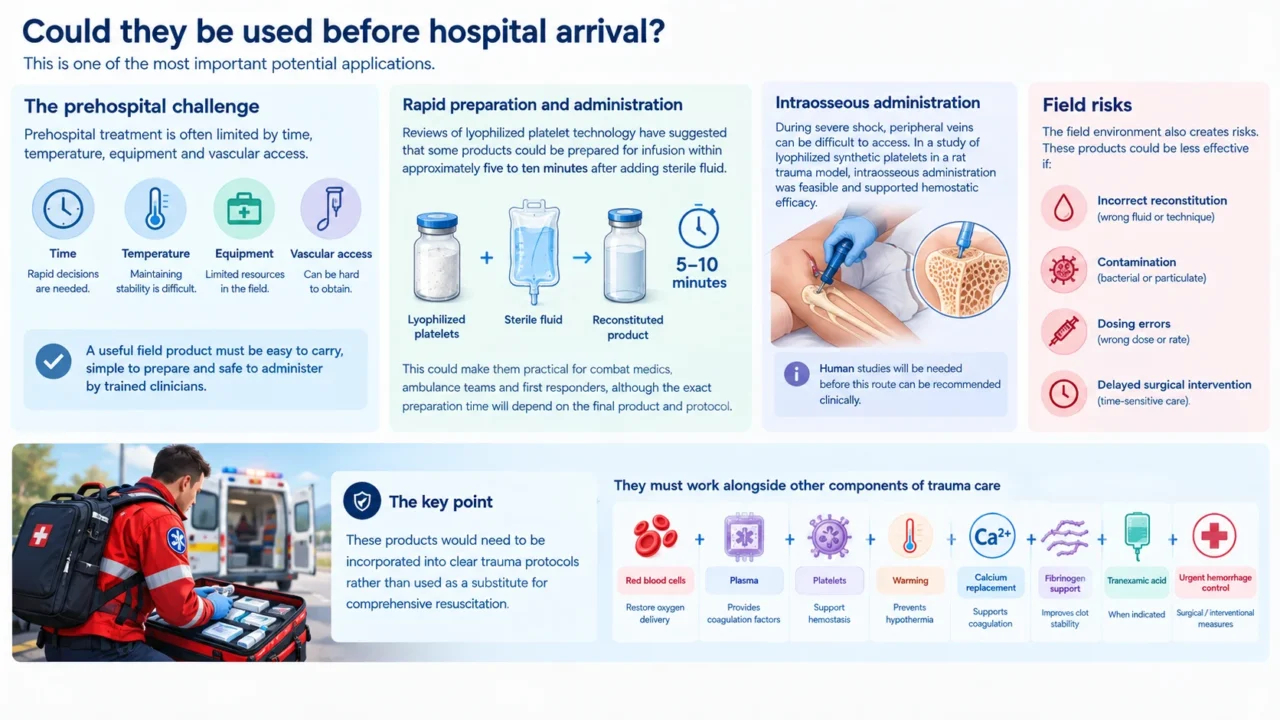
Prehospital treatment is often limited by time, temperature, equipment and vascular access. A useful field product must be easy to carry, simple to prepare and safe to administer by trained clinicians.
Reviews of lyophilized platelet technology have suggested that some products could be prepared for infusion within approximately five to ten minutes after adding sterile fluid. This could make them practical for combat medics, ambulance teams and first responders, although the exact preparation time will depend on the final product and protocol.
Intraosseous administration may provide another option. During severe shock, peripheral veins can be difficult to access. A study of lyophilized synthetic platelets in a rat trauma model found that intraosseous administration was feasible and supported hemostatic efficacy. Human studies will be needed before this route can be recommended clinically.
The field environment also creates risks. Incorrect reconstitution, contamination, dosing errors or delayed surgical intervention could reduce the benefit. These products would need to be incorporated into clear trauma protocols rather than used as a substitute for comprehensive resuscitation.
What about Traumatic Brain Injury?
Traumatic brain injury is a particularly important area of research because bleeding inside the skull can expand quickly, while treatment that increases clotting could theoretically cause unwanted thrombosis.
A 2026 preclinical study from UCSF evaluated a freeze-dried platelet product in cell, organoid and mouse models of traumatic brain injury. The researchers reported reductions in vascular leakage, intracranial bleeding and inflammation. They proposed that platelet-derived factors might help stabilize damaged blood vessels in addition to supporting clot formation.
These findings are scientifically important, but they remain experimental. The study did not prove that freeze-dried platelets improve neurological outcomes in human patients.
Future clinical trials will need to examine hematoma expansion, intracranial pressure, the need for neurosurgery, neurological recovery, disability and mortality. Radiographic improvement alone will not be enough to establish clinical value.
The Main Safety Concern: Thrombosis
The central safety question is whether an artificial platelet can improve hemostasis without causing harmful thrombosis.
Potential complications could include deep-vein thrombosis, pulmonary embolism, myocardial infarction, ischemic stroke and microvascular thrombosis. Trauma patients may already have increased thrombotic risk because of inflammation, tissue injury, immobility, endothelial activation and, in some cases, cancer or inherited thrombophilia.
The activation state of the product is particularly important. A highly activated platelet product may form a clot quickly at the site of injury, but it may also be cleared rapidly or interact with intact vessels.
Researchers must also study immune and inflammatory effects. Products derived from human platelets may contain biologically active membrane components, while synthetic nanoparticles may activate complement or interact with leukocytes.
These risks do not eliminate the potential value of the technology. They show why clinical development must measure both bleeding control and thrombotic complications.
Could they Replace Whole Blood?
No. Artificial platelets are not a complete blood replacement.
Whole blood provides red blood cells, plasma and platelets in one product. Red blood cells carry oxygen, plasma supplies coagulation factors and platelets support primary hemostasis. A platelet surrogate can address only one part of this system.
The most realistic use would be as an early hemostatic product when whole blood or conventional platelets are delayed or unavailable. A patient could receive artificial platelets during transport and later receive whole blood or standard components at a trauma center.
A broader strategy could combine lyophilized plasma with freeze-dried or synthetic platelets. The U.S. Army has discussed this type of combined lyophilized product approach for forward resuscitation, where conventional blood logistics may be limited.
This would not make blood donation unnecessary. It would create an additional layer of protection when donated blood cannot reach the patient quickly enough.
What must be Proven Before Routine Use?
Before these products become standard treatment, clinical trials must show that they improve outcomes that matter to patients.
Researchers need to determine whether they reduce blood loss, decrease transfusion requirements, improve blood pressure and reduce the need for emergency surgery. Most importantly, studies must establish whether they reduce mortality or improve functional recovery.
Safety outcomes are equally important. Trials must carefully record intracranial hemorrhage, major extracranial bleeding, venous thromboembolism, arterial thrombosis, immune reactions and organ complications.
The most effective product may also differ according to the type of bleeding. A formulation useful for thrombocytopenia may not perform identically in pelvic trauma, traumatic brain injury, abdominal bleeding or patients taking antiplatelet drugs.
Researchers will therefore need to define the right dose, the best administration route, the timing of treatment and whether repeat dosing is safe.
A Practical Future for Trauma Care
The future is unlikely to be a choice between donor blood and artificial platelets. More likely, trauma systems will use several products according to availability and the patient’s condition.
A patient could receive a shelf-stable platelet product at the site of injury, followed by blood products during transport and surgery or interventional radiology at the hospital. Point-of-care coagulation testing could help determine whether additional platelets, plasma, fibrinogen or other treatments are needed.
This approach could be especially valuable in remote regions, military operations and mass-casualty events. It could also reduce the time spent transporting conventional platelets and allow hospitals to maintain emergency reserves for longer periods.
The most important change would be logistical. Hemostatic treatment would no longer depend entirely on having a functioning blood bank close to the patient.
A New Frontier in Prehospital Hemostasis
Freeze-dried human platelets and synthetic platelet substitutes represent a promising approach to one of trauma medicine’s most difficult problems: controlling severe bleeding before conventional transfusion is available.
Their potential advantages include longer storage, easier transportation, reduced dependence on the cold chain and possible use in ambulances, helicopters, remote hospitals and military settings. Preclinical research has shown improved hemostasis in several animal models, while early clinical studies of platelet-derived products are now evaluating safety and efficacy.
However, the technology is not yet ready to replace standard platelet transfusion or whole blood. The most important unanswered questions concern mortality, functional recovery, thrombosis, immune effects, dosing and effectiveness in different types of trauma.
The most realistic future is a combined trauma-resuscitation system in which artificial platelets provide rapid, portable hemostatic support while conventional blood products and definitive surgical care are being arranged. If human trials confirm that they are effective and safe, freeze-dried artificial platelets could become an important tool for saving lives during the critical period between injury and hospital treatment.
Frequently Asked Questions
1. What are freeze-dried artificial platelets?
They are dried platelet-based or synthetic products that help control bleeding after reconstitution.
2. Why are they needed?
They may last longer and be easier to store than conventional platelets.
3. Are they made from human platelets?
Some are; others are fully synthetic.
4. Can they replace whole blood?
No. They do not provide red blood cells or plasma clotting factors.
5. Could they be used in ambulances?
Potentially, if clinical trials and regulatory approval support their use.
6. How quickly can they be prepared?
Some products may be reconstituted within five to ten minutes.
7. Can they be administered through an intraosseous line?
Possibly. This has been shown in animal studies but needs human confirmation.
8. Could they cause thrombosis?
Yes. Unwanted clotting remains an important safety concern.
9. Are they approved for routine trauma care?
No. Most are still investigational.
10. What is their main promise?
They could provide rapid, portable bleeding control before hospital care is available.
Written by Anna Stepanyan, MD
Stay updated with Hemostasis Today.
-
Oct 6, 2026, 13:10Vinicius Fornazari: New Perspectives In Interventional Radiology From SOBRICE
-
Oct 6, 2026, 12:39Sarah Garvey: Putting The Patient Experience At The Heart Of VTE Care
-
Oct 6, 2026, 12:03Louise St. Germain Bannon: Supporting the World Thrombosis Day
-
Oct 6, 2026, 11:39Joining the Hemophilia and Bleeding Disorders Community at the EHC 2026 – WFH
-
Oct 6, 2026, 10:56Moustafa Abdou: LE Cells and the Early Diagnosis of Lupus
-
Oct 6, 2026, 10:35Caitlin Raymond: Understanding IgA Deficiency and Anaphylaxis Risk
-
Oct 6, 2026, 10:15Zeeshan Ali Baig: AI-Designed Peptide for Rare Bleeding Disorder
-
Oct 6, 2026, 10:12Srivatsan Rangachari: Stem Cell Transplant for 12-Year-Old with Fanconi Anaemia
-
Oct 6, 2026, 09:56Anitha Narayanamurthy: A Possible Missing Link in Unexplained Blood Test Abnormalities