


Aya Akmal Amin: Antiphospholipid Syndrome Management and Risk Stratification
Aya Akmal Amin, Consultant in Rheumatology, Rehabilitation, and Physical Medicine at Zagazig University, shared a post on LinkedIn:
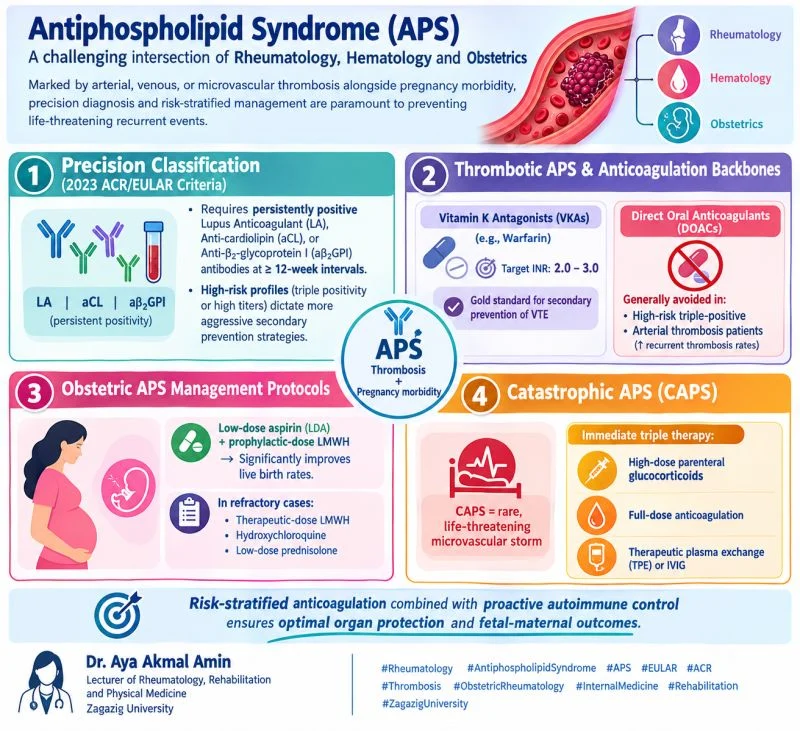
”Antiphospholipid Syndrome (APS) presents a formidable clinical challenge at the crossroads of rheumatology, hematology, and obstetrics.
Marked by arterial, venous, or microvascular thrombosis alongside pregnancy morbidity, precision diagnosis and risk-stratified management are paramount to preventing life-threatening recurrent events.
Key clinical imperatives in modern APS management:
Precision Classification (2023 ACR/EULAR Criteria): Accurate identification requires rigorous serological validation—persistently positive Lupus Anticoagulant (LA), Anti-cardiolipin (aCL), or Anti-\beta_2-glycoprotein I (\text{a}\beta_2\text{GPI}) antibodies at \ge 12-week intervals. High-risk profiles (triple positivity or high titers) dictate more aggressive secondary prevention strategies.
Thrombotic APS and Anticoagulation Backbones: Vitamin K Antagonists (VKAs, like Warfarin) with a target INR of 2.0–3.0 remain the gold standard for secondary prevention of venous thromboembolism (VTE). Direct Oral Anticoagulants (DOACs) are generally avoided in high-risk triple-positive or arterial thrombosis patients due to increased recurrent thrombosis rates.
Obstetric APS Management Protocols: For women with obstetric APS, low-dose aspirin (LDA) combined with prophylactic-dose Low Molecular Weight Heparin (LMWH) significantly improves live birth rates. In refractory cases, therapeutic-dose LMWH, hydroxychloroquine, or low-dose prednisolone may be integrated.
Catastrophic APS (CAPS) Rapid Intervention: CAPS—a rare, life-threatening microvascular storm—demands immediate triple therapy: high-dose parenteral glucocorticoids, full-dose anticoagulation, and therapeutic plasma exchange (TPE) or intravenous immunoglobulins (IVIG).
Risk-stratified anticoagulation combined with proactive autoimmune control ensures optimal organ protection and fetal-maternal outcomes.”
Stay updated with Hemostasis Today.
-
Oct 16, 2026, 13:10Emanuel Sueldo: CAHT 2026 Celebrates Scientific Progress and Team Achievements
-
Oct 16, 2026, 13:05Maha Othman: Queen’s Health Sciences Advances CAT Risk Models and Pediatric ISTH-BAT Cut-Offs
-
Oct 16, 2026, 13:03Thrombosis Awareness Must Lead to Timely Action – Roche
-
Oct 16, 2026, 12:49Wolfgang Miesbach: 5-Year CBDR Data Confirms Emicizumab Safety and Efficacy in Hemophilia A
-
Oct 16, 2026, 12:40Edward Lee Carter: How Factor XI Inhibition Could Transform Anticoagulation Therapy
-
Oct 16, 2026, 12:40Marc Carrier: Looking Ahead to ISTH 2027 in Vancouver
-
Oct 16, 2026, 12:30Bob Lempke: How One Blood Donation Can Save Up to Three Lives
-
Oct 16, 2026, 12:30Why VWF Therapies Belong on the EU Critical Medicines List – EHC
-
Oct 16, 2026, 12:17How New Blood Vessels Shape Venous Thrombus Resolution – ISTH