


Lakshmi Kattamuri: Contemporary Evidence on Antithrombotic Therapy in AF and Chronic Coronary Disease
Lakshmi Kattamuri, Cardiology Fellow at West Virginia University, shared a post on X about a recent article she and her colleagues co-authored, published in Current Vascular Pharmacology, adding:
“Does your patient with AF plus prior PCI really need lifelong aspirin?
More antithrombotic therapy is not equal to better outcomes.
Our new article in Current Vascular Pharmacology examines the evidence from landmark trials.
A practical Cardio Twitter thread the clinical dilemma AF plus CAD presents two competing risks:
- Bleeding from combined antithrombotic therapy
- Ischemic events, including stent thrombosis.
The key question: when can we safely discontinue antiplatelet therapy?
Early after ACS/PCI
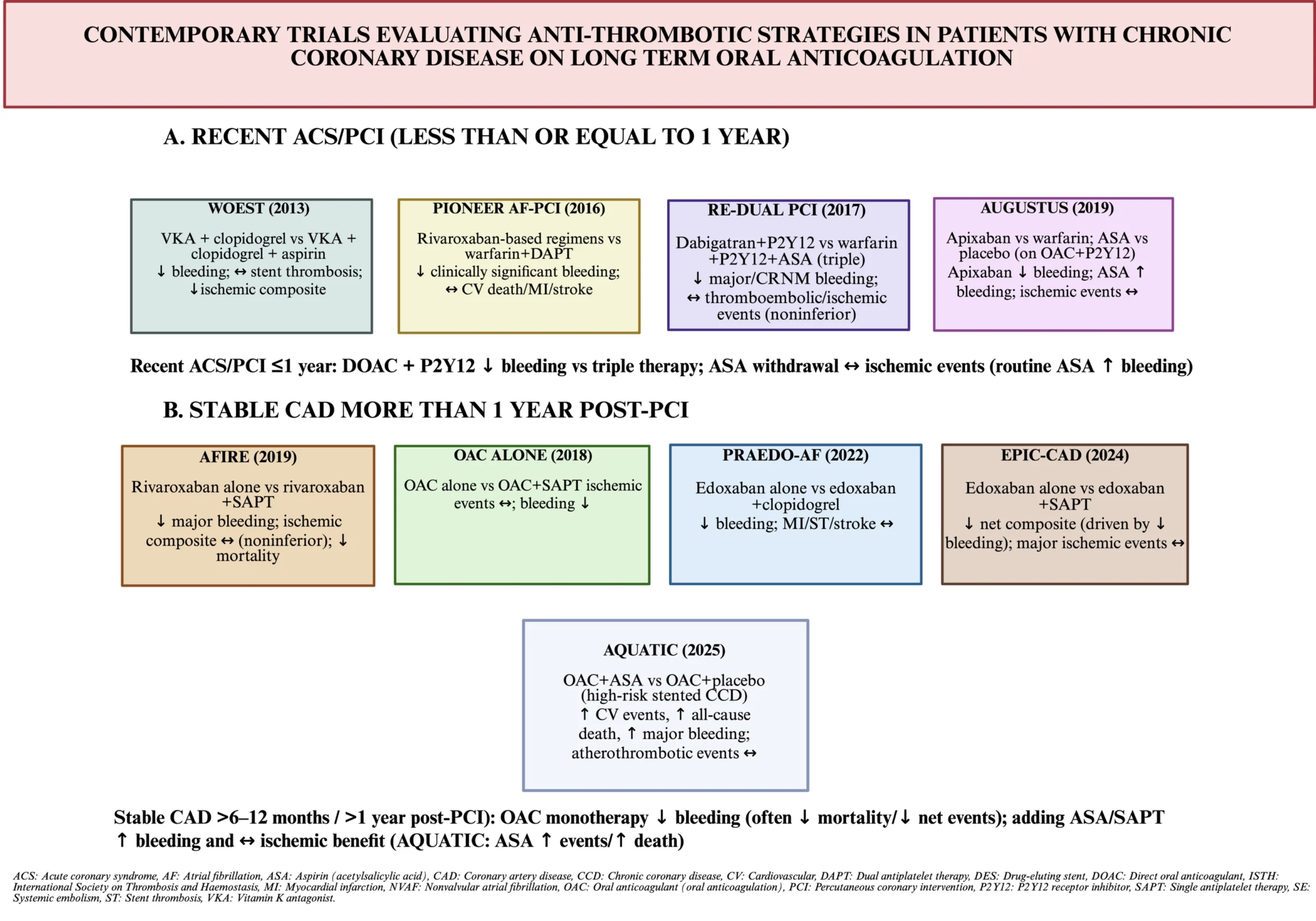
Four landmark trials changed practice:
- WOEST (2013)
- PIONEER AF-PCI (2016)
- RE-DUAL PCI (2017)
- AUGUSTUS (2019)
Less bleeding with dual therapy.
Early aspirin withdrawal in most patients.
Individualize for stent thrombosis risk.
AUGUSTUS: The Aspirin question.
Among patients with AF plus recent ACS/PCI receiving a P2Y12 inhibitor:
Major/CRNM bleeding: 16.1 percent with aspirin versus 9.0 percent with placebo HR 1.89!
Aspirin increased bleeding substantially without a significant reduction in overall ischemic events.
What about stable CAD?
Beyond 1 year after PCI, the evidence increasingly favors OAC monotherapy.
- AFIRE
- OAC-ALONE
- PRAEDO-AF
- EPIC-CAD
Collectively: less bleeding with OAC alone, without a demonstrated increase in major ischemic outcomes.
AQUATIC (2025): A striking finding.
Even in high-atherothrombotic-risk patients with prior stenting on long-term OAC:
- CV composite: 16.9 percent versus 12.1 percent
- Major bleeding: 10.2 percent versus 3.4 percent
- All-cause death: 13.4 percent versus 8.4 percent
All higher with aspirin versus placebo!
Practical takeaway.
For most patients with AF plus stable CAD requiring OAC:
- >1 year after PCI: OAC alone is generally preferred.
- Avoid indefinite aspirin without a compelling indication.
- Reassess ischemic and bleeding risks.
Prior stent thrombosis warrants individualized assessment.”
Title: Antithrombotic Therapy in Patients with Chronic Coronary Disease on Anticoagulation: Evidence from Contemporary Trials
Authors: Sukhila Reddy, Lakshmi Kattamuri, Muhammad Asif, Debabrata Mukherjee

Stay updated on all scientific advances with Hemostasis Today.
-
Oct 17, 2026, 17:10Habib Bennaceur: Strengthening Collaboration in Haemophilia, Sickle Cell Disease and Thalassaemia in India
-
Oct 17, 2026, 16:58Danny Hsu: Building Connections at the AUSNBled Collaborative Dinner in Auckland
-
Oct 17, 2026, 16:48Kalyan Roy: Enhancing Patient Experience Through Learning and Collaboration
-
Oct 17, 2026, 16:43Wilfried Dinh: Antiplatelet Therapy in 2026: Duration is Becoming a Dynamic Decision
-
Oct 17, 2026, 16:37Ian Setchfield: Dr. Evans Presents on Safe Anticoagulation Prescribing at East Kent Hospitals
-
Oct 17, 2026, 16:33Lewis Thomas: Connecting Through Shared Experiences at ASCAT 2026
-
Oct 17, 2026, 16:29Nilesh Jethwa: Yasmin Adverse Event Reports Exceed 23,000 Over Two-Year Period
-
Oct 17, 2026, 16:24W. Alberto Sifuentes Giraldo: Exploring Peripheral Macrovascular Thrombosis in CAPS
-
Oct 17, 2026, 16:17Rishabh Jain: Could Rusfertide Transform Polycythemia Vera Management?