


Kalyan Roy: Platelet Conservation Through Evidence-Based Transfusion Practice
Kalyan Roy, Transfusion Medicine Specialist at Square Hospitals LTD, shared a post on LinkedIn:
“Platelet Transfusion: From Evidence To Clinical Decisions
Are we transfusing platelets because the patient needs them—or simply because the platelet count is low?
The 2025 AABB and ICTMG International Clinical Practice Guidelines, published in JAMA, provide an important evidence-based framework for optimizing platelet transfusion practice.
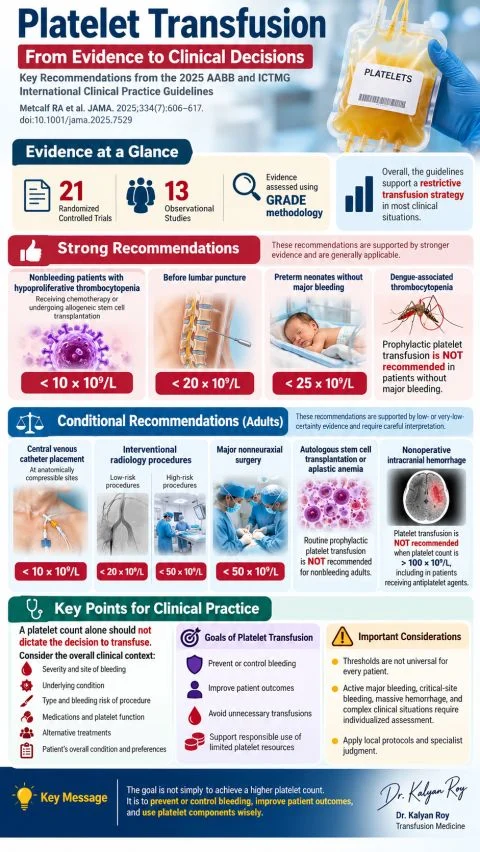
Evidence at a Glance
- 21 randomized controlled trials
- 13 observational studies
- Evidence assessed using the GRADE methodology
- A consistent shift toward restrictive, clinically appropriate transfusion strategies
The findings suggest that restrictive strategies generally do not increase bleeding or mortality across the clinical populations studied, while helping reduce unnecessary transfusions, transfusion-related risks, costs, and pressure on limited platelet supplies.
Key Clinical Recommendations
1. Strong recommendations
- Below 10 × 10⁹/L: Nonbleeding patients with hypoproliferative thrombocytopenia receiving chemotherapy or undergoing allogeneic stem cell transplantation.
- Below 20 × 10⁹/L: Patients undergoing lumbar puncture.
- Below 25 × 10⁹/L: Neonates with consumptive thrombocytopenia without major bleeding.
- Dengue-associated thrombocytopenia: Prophylactic platelet transfusion is not recommended in patients without major bleeding.
2. Conditional recommendations for selected clinical settings
- Below 10 × 10⁹/L: Adults undergoing central venous catheter placement at anatomically compressible sites.
- Below 20 × 10⁹/L: Adults undergoing low-risk interventional radiology procedures.
- Below 50 × 10⁹/L: Adults undergoing high-risk interventional radiology procedures or major non-neuraxial surgery.
- Autologous stem cell transplantation and aplastic anemia: Routine prophylactic platelet transfusion is not recommended for nonbleeding adults in these specified populations.
- Nonoperative intracranial hemorrhage: Platelet transfusion is not recommended when the platelet count is above 100 × 10⁹/L, including in patients receiving antiplatelet agents.
Conditional recommendations are supported by low- or very-low-certainty evidence and require careful interpretation in the individual clinical setting.
The Transfusion Medicine Perspective
These guidelines reinforce three essential principles:
- Patient blood management: Transfuse when the expected clinical benefit justifies the risks.
- Evidence-based practice: Apply appropriate thresholds to the relevant patient population rather than adopting a universal platelet count trigger.
- Responsible stewardship: Every platelet component is a valuable, perishable therapeutic resource.
Take-Home Message
The goal is not simply to achieve a higher platelet count.
It is to prevent or control bleeding, improve patient outcomes, and use platelet components wisely.”
Stay updated with Hemostasis Today.
-
Oct 20, 2026, 16:51Suzan Nakasendwa: A Growing Stroke Challenge in Uganda
-
Oct 20, 2026, 16:38Steve Moon: How Does Smoking Cessation Duration Affect Ischemic Stroke Risk
-
Oct 20, 2026, 16:25Cedrice Mentor: Reducing Platelet Wastage Through Cold Storage
-
Oct 20, 2026, 16:09Thirunavukkarasu Angappan: Can a Purified Fibrinogen Concentrate Replace Cryoprecipitate
-
Oct 20, 2026, 15:28Stacy E. Croteau: 33 Countries, One Mission – Better Bleeding Disorder Care
-
Oct 20, 2026, 15:19Teresa Barnes: What Does a Pulmonary Embolism Mean for Jalen Hurts?
-
Oct 20, 2026, 15:04Laura S.: Could Speaking Up Prevent Maternal Deaths from Thrombosis?
-
Oct 20, 2026, 14:44Pete Stibbs: VTE in Professional Athletes – When Fitness Is Not Enough
-
Oct 20, 2026, 14:39Jan Hartmann: How Hemophilia Care Has Advanced Over the Past Decade