


Thirunavukkarasu Angappan: Can a Purified Fibrinogen Concentrate Replace Cryoprecipitate
Thirunavukkarasu Angappan, Vice President of Operations and Manufacturing at PopVax, shared a post on LinkedIn:
“Bleeding After Heart Surgery: Cryoprecipitate or Fibrinogen Concentrate?
A 735-Patient Trial Tested the Swap.
When a cardiac surgery patient bleeds and fibrinogen is low (hypofibrinogenemia), two plasma-derived options exist: cryoprecipitate, a non-purified product supplied by the blood bank, or a purified, pathogen-reduced fibrinogen concentrate.
Which works better?
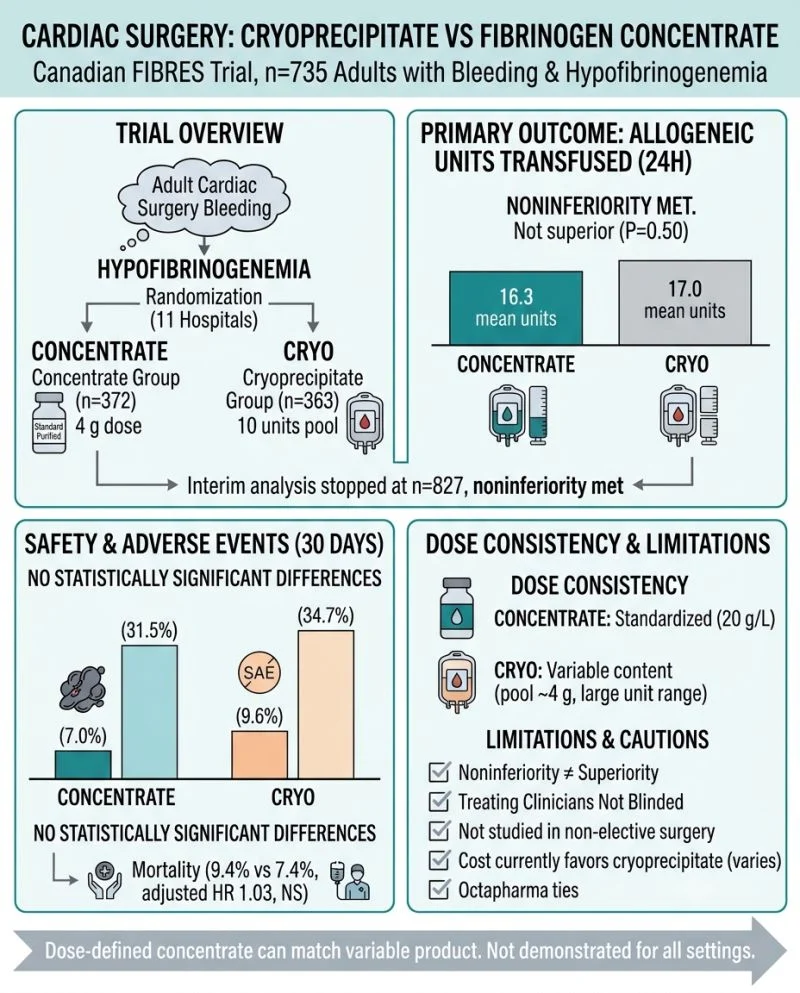
- The Canadian FIBRES trial (registration NCT03037424) was randomized and ran at 11 hospitals. Adults bleeding after cardiopulmonary bypass with hypofibrinogenemia were enrolled (median age 64; 30 percent women). Of 827 randomized, 735 were analysed: 372 had 4 g of concentrate and 363 had 10 units of cryoprecipitate.
- Primary outcome: allogeneic blood component units (red cells, platelets, plasma) transfused in 24 hours. The mean was 16.3 with concentrate and 17.0 with cryoprecipitate (ratio 0.96; upper confidence bound 1.09). This met the prespecified noninferiority margin of 1.2. Superiority was not shown (P = 0.50).
- The trial stopped at an interim analysis, after 827 of 1,200 planned patients, because noninferiority was met.
- Safety: thromboembolic events were 7.0 percent with concentrate and 9.6 percent with cryoprecipitate. Any adverse event: 66.7 percent versus 72.7 percent. Serious adverse events: 31.5 percent versus 34.7 percent. None of these differences was statistically significant.
- Deaths were 9.4 percent versus 7.4 percent (hazard ratio 1.28, 95 percent confidence interval 0.77–2.12, not significant). The authors attributed this to more critically ill patients before surgery in the concentrate group; risk adjustment brought the hazard ratio to 1.03.
- Dose consistency: as per the authors, fibrinogen content of cryoprecipitate ranges from 3 to 30 g/L per unit. A 10-unit pool averages about 4 g, so some patients likely received far more or less. Concentrate is standardized at 20 g/L.
Read the limits carefully:
- Noninferior is not superior.
- Treating clinicians could not be blinded to the product.
- Concentrate was not shown noninferior in non-elective surgery, and secondary outcomes were not corrected for multiple testing.
- Only adults were studied. As per the authors, cost currently favours cryoprecipitate, and this varies by region.
- Octapharma gave an unrestricted grant and supplied the concentrate, and several authors reported Octapharma ties.
For plasma fractionators, this shows a dose-defined concentrate can match a variable product in one setting.
It does not show that it should replace cryoprecipitate everywhere.
Should hospitals choose fibrinogen products by grams delivered, or by cost and local supply?”
Other posts featuring Thirunavukkarasu Angappan on Hemostasis Today.
-
Oct 20, 2026, 16:51Suzan Nakasendwa: A Growing Stroke Challenge in Uganda
-
Oct 20, 2026, 16:38Steve Moon: How Does Smoking Cessation Duration Affect Ischemic Stroke Risk
-
Oct 20, 2026, 16:25Cedrice Mentor: Reducing Platelet Wastage Through Cold Storage
-
Oct 20, 2026, 16:01Kalyan Roy: Platelet Conservation Through Evidence-Based Transfusion Practice
-
Oct 20, 2026, 15:28Stacy E. Croteau: 33 Countries, One Mission – Better Bleeding Disorder Care
-
Oct 20, 2026, 15:19Teresa Barnes: What Does a Pulmonary Embolism Mean for Jalen Hurts?
-
Oct 20, 2026, 15:04Laura S.: Could Speaking Up Prevent Maternal Deaths from Thrombosis?
-
Oct 20, 2026, 14:44Pete Stibbs: VTE in Professional Athletes – When Fitness Is Not Enough
-
Oct 20, 2026, 14:39Jan Hartmann: How Hemophilia Care Has Advanced Over the Past Decade