


Giacomo Buso: Lifelong Carotid Risk vs. Late-Stage Trial Neutrality
Giacomo Buso, Internal Medicine Physician, Angiologist FMH at Spedali Civili Hospital, shared ESC’s post on LinkedIn:
“An interesting apparent paradox around Lp(a).
From the one hand, elevated Lp(a) seems to track with the entire continuum of carotid atherosclerosis.
Yet, only a few weeks ago, the Lp(a)HORIZON trial reported that pelacarsen, despite lowering Lp(a), did not significantly reduce MACE in patients with established ASCVD.
These findings are more complementary than contradictory.
Suita addresses the long-term association between lifelong exposure to Lp(a) and development of atherosclerosis, whereas HORIZON asks a very different question: whether pharmacologically lowering Lp(a) relatively LATE in the disease course can modify clinical outcomes in patients with already established vascular disease.
The neutral HORIZON result does not necessarily question the causal role of Lp(a). It may instead suggest that lowering Lp(a) late in the disease course is not enough, or that the degree and duration of reduction are crucial for translating biological effects into fewer clinical events.
Full HORIZON results will clearly be essential before drawing firmer conclusions.”
ESC Working Group on Aorta and Peripheral Vascular Diseases shared a post on LinkedIn about a recent article by Masayuki Teramoto, published in European Journal of Preventive Cardiology, adding:
“Lp(a) and carotid atherosclerosis: from plaque initiation to stenosis
A new study from the Suita Study, published in the European Journal of Preventive Cardiology, examined the long-term association between Lp(a) and the full continuum of carotid atherosclerosis.
Among 3,272 participants free from CV disease and carotid plaque at baseline, Lp(a) ≥50 mg/dL was associated with:
- 27% higher risk of incident carotid plaque
- Faster progression of carotid IMT
- More than two-fold higher odds of progression to ≥50% carotid stenosis
These associations persisted after adjustment for traditional CV risk factors.
The findings suggest that elevated Lp(a) may contribute not only to plaque initiation, but also to the progression toward clinically relevant carotid disease.
An important addition to the growing evidence linking Lp(a) to atherosclerotic burden across vascular territories.”
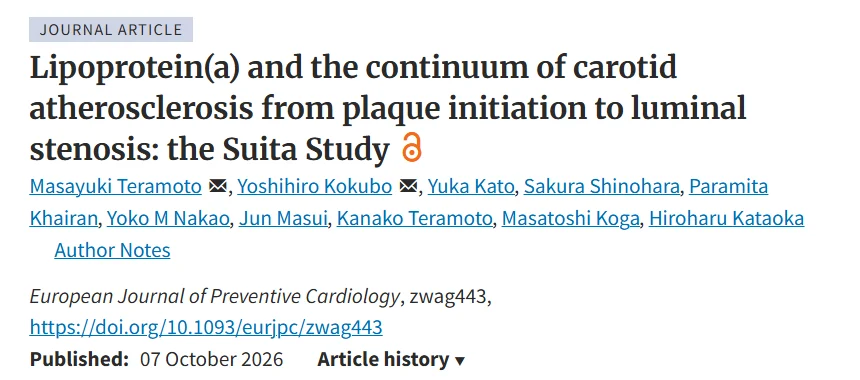
Title: Lipoprotein(a) and the continuum of carotid atherosclerosis from plaque initiation to luminal stenosis: the Suita Study
Authors: Masayuki Teramoto, Yoshihiro Kokubo, Yuka Kato, Sakura Shinohara, Paramita Khairan, Yoko M Nakao, Jun Masui, Kanako Teramoto, Masatoshi Koga, Hiroharu Kataoka
Stay updated on all scientific advances with Hemostasis Today.
-
Oct 22, 2026, 06:35Aastha Gupta: Navigating the Diagnostic Challenge of Restricted NK-Cell Repertoires in Flow Cytometry
-
Oct 22, 2026, 06:25Ahmed Alotaibi: Platelet Refractory, But HLA-negative – What Are You Missing?
-
Oct 22, 2026, 06:17Alessandra Bosch: Swiss Medical Weekly Publishes National Guidance on Desmopressin for Bleeding Disorders
-
Oct 22, 2026, 05:24Archil Jaliashvili: Hemoglobin Dose in Red Cell Transfusion
-
Oct 22, 2026, 03:40Hussein Burestom: Blood and Plasma as Strategic Resources for National Health Security
-
Oct 22, 2026, 03:28João Paulo Marochi Telles: Antibiotic Treatment in Febrile Neutropenia
-
Oct 21, 2026, 18:13Wolfgang Miesbach: Hereditary Hemorrhagic Telangiectasia Is an Overlooked Bleeding Disorder
-
Oct 21, 2026, 17:55Gayatri Kotwal։ New Review on Anemia, Pain, and Nutritional Deficiencies in Cancer Patients
-
Oct 21, 2026, 17:40Tetsuzan Ron: Iron Deficiency Without Anemia Clinical Impact and Management