

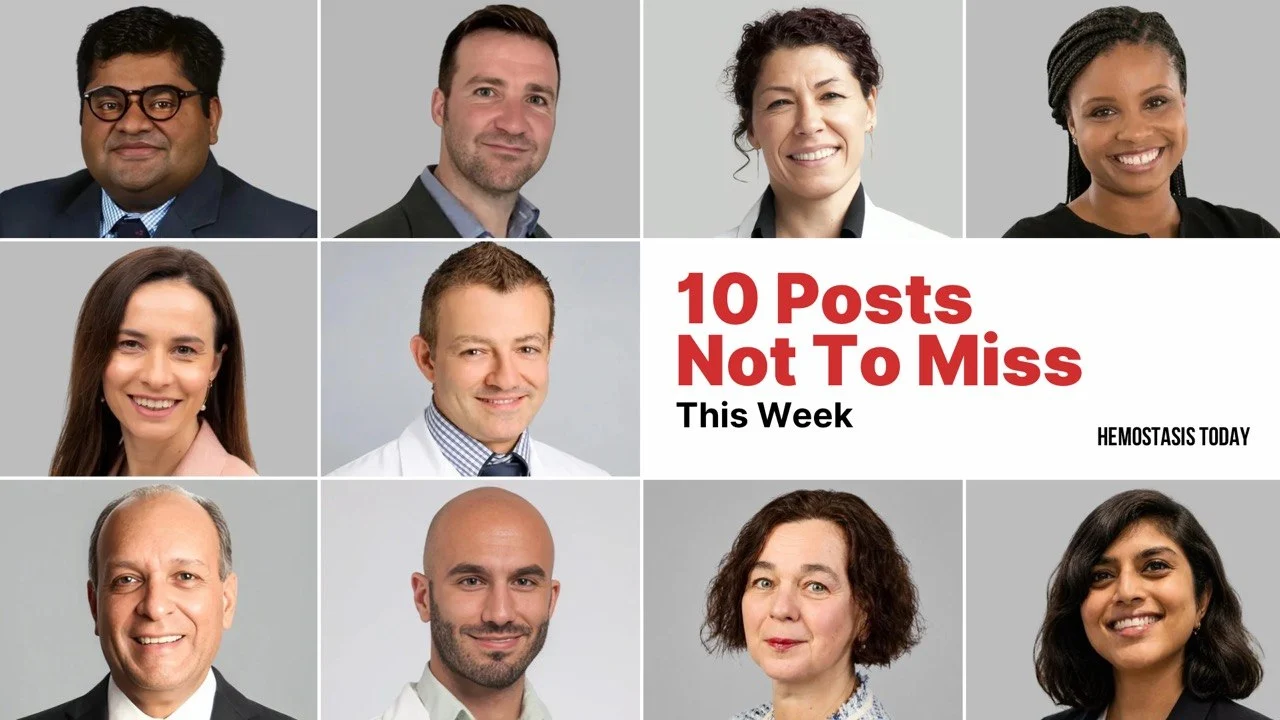
10 Posts Not to Miss This Week
This week’s highlights in hematology and hemostasis explore developments across myeloproliferative neoplasms, hemophilia treatment, gene therapy, thrombosis prevention, and transfusion medicine.
From emerging evidence on less frequent prophylactic dosing in hemophilia A to the practical lessons of gene therapy implementation, these discussions highlight the evolving balance between treatment efficacy, patient needs, and long-term clinical outcomes.
Other notable topics include the management of elderly and frail patients with MPNs, the importance of uninterrupted access to immunoglobulin therapies in Europe, and the role of multidisciplinary collaboration and clinical research in advancing hematology care.
Contributions from experts also address antiplatelet therapy after coronary stenting, bleeding-risk prediction in factor VII deficiency, and clonal dynamics in the bone marrow during sepsis.
Explore 10 posts from this week’s selected discussions, research insights, and perspectives from the hematology and hemostasis community.
Priya Sriskandarajah, Consultant Haematologist at Guy’s and St Thomas’ NHS Foundation Trust:
“Very pleased to share our recently published narrative review in Hematology Reports MDPI covering the management of MPNs in elderly and frail patients- we discuss challenges not only in treatment selection but also balancing thrombosis vs bleeding as well as symptom management.
Importantly we highlight the importance of applying a MDT approach through collaboration with elderly care, pharmacists and nurse specialists.
Huge well done to our trainees Saima Afridi and Jeuela Ravindran for putting this together.”
Akshat Jain, Hematology Pediatric Workforce Task Force at American Society of Hematology:
“Treatment burden is one of the biggest day-to-day challenges for people living with hemophilia A.
Fewer injections without giving up bleed protection is the goal, so I was glad to see these results from FRONTIER4 in Blood Advances (Matsushita et al.).
Unanswered questions:
- Detailed information on Q4Week ABR data would be useful.
- Why the FDA setback to Novo Nordisk, if the data looks good, remains an ambiguity? Manufacturing? Safety? Scaling up?
- Median ABR data and HJHS in recipient’s meaningful end points we would love to see in this and all MIM8 cohort.
- What does factor 8 equivalency look for this mimetic agent?
- The study: 37 people with hemophilia A, with or without inhibitors, had previously been on denecimig in the FRONTIER1 extension. They moved to dosing once every two weeks (Q2W) for 26 weeks.
What they found:
- Mean annualized bleed rate (ABR) of 0.38
- 83.8 percent of patients had zero treated bleeds
- Injection-site reactions in 2.9 percent of injections (14 of 484), across 2 patients
- Adverse events were mild to moderate, and none led to discontinuation
- No thromboembolic events
- No clinical evidence of neutralizing antibodies
Why it matters: Q2W dosing sits between the weekly and monthly options, which gives patients and clinicians more room to match a regimen to a person’s life and preferences. Bleed protection looked strong, and the safety profile showed no new concerns.
Context: This is an interim, open-label analysis of a small cohort that was already familiar with the drug, so longer follow-up and broader populations will matter. Part 2 of FRONTIER4 is evaluating weekly, Q2W and monthly dosing over the long term.
Unanswered questions
- Q4Week dose cohort ABR data would be very exciting to see
- What prompted the FDA setback to Novo Nordisk? If the data looks good, what really delayed the PDUFA? Manufacturing? Safety? Scaling up?
- Median ABR data and HJHS in these recipient’s are meaningful end points I would look forward to review in this and all MIM8 cohort’s.
- What would the factor 8 equivalency look like in recipient’s of Mim8?
- Thrombin Generation data.”
Isabella Presch, Senior Medical Director of Rare Diseases, Advanced Therapies and Pediatrics at Fortrea,
“Interesting talks this morning European Society of Gene and Cell Therapy ESGCT 2026 about uptake of gene therapy, hurdles and learnings in hemophilia.
Wolfgang Miesbach shared key insights, success factors and achievements from Germany:
What worked well:
- Patient organisations involved early
- Consensus guidance on centres, hub-and-spoke care and SOPs (WFH, EAHAD, ISTH, GTH)
- Independent registries
- Documentation platform: GENTS
- Education and shared decision-making tools.
Key learnings:
- Communicate ranges and non-responders (not cure)
- Patient-relevant endpoints and standardised factor assays early in development
- Broader trial populations
- Early dialogue with HTA bodies
- Funding for centre infrastructure, monitoring and 15-year follow-up
- Follow-up regardless of commercial fate; early notice of market exits
Amit Nathwani described considerations involved in decision making in the UK:
- For Patients: Why change? Will it last? Monitoring burden
- For clinical teams: Eligibility assessment, Follow-up capacity, Coordinated care
- For NHS: Contracts and liability, Service readiness, Reliable supply.”
Dave Cartland, Medical Doctor, Health Coach:
“There are 5137 cerebral thromboembolism AEs reported in (VAERS) the 3 years (36 months) after COVID-19 vaccines compared to 52 AEs for the influenza vaccines over the past 34 years (408 months) and 282 AEs for all other vaccines (excluding COVID-19) over the past 34 years (408 months).
The PRR’s are significant when comparing AEs by time from COVID-19 vaccines to that of the influenza vaccines (p < 0.0001) or to that of all other vaccines (p < 0.0001).”
Cece Calhoun, Associate Chief of Operations at Smilow Cancer Hospital, Medical Director of Adult Sickle Cell Program at Yale Cancer Center:
“One of the most full circle moments of my professional career has been supporting the next generation of Hematologists as faculty in the American Society of Hematology Clinical Research Training Institute, a program that shaped the trajectory of my career.
Under the mentorship of Allison King, CRTI opened up a new path to impact for me through clinical research; one I never could have realized on my own.
If you are a trainee thinking about clinical research, be bold and invest in your future.
If you are a mentor, encourage your mentees to apply.
Hematology needs you.
…and yes that is picture of me as a trainee many moons ago.”
Mohammed Alo, Cardiologist at Toledo Cardiology:
“A stent fixes one blockage.
It does not fix the disease that put it there.
That is why stopping your aspirin or P2Y12 inhibitor on your own, because you feel fine, a bruise scared you, or your dentist told you to skip it, is one of the most dangerous moves you can make after a stent.
Stent thrombosis, a clot forming inside that stent, kills 15 to 45 percent of the people it happens to.
Duration of those meds is individualized.
The decision to pause them for any reason is your cardiologist’s call, not yours.”
Marilena Vrana, Vice President of Public Affairs and EU Operations at Plasma Protein Therapeutics Association (PPTA):
“As discussions progress on the review of the European Medicines Agency ’s Union List of Critical Medicines, it is important to ensure that decisions remain firmly grounded in patients’ needs.
For those who depend on immunoglobulin therapies, uninterrupted access is essential.
The Union List is more than a technical exercise: it flags medicines that require particular attention from policymakers and can support efforts to strengthen the resilience and security of Europe’s medicines supply.
Read PPTA Europe’s latest statement calling for immunoglobulins to remain on the Union List of Critical Medicines, and why keeping them there matters for patients across Europe.”
Cesar Garrido, The President of World Federation of Hemophilia (WFH):
“We were able to attend the Annual Congress of the Spanish Society of Thrombosis and Hemostasis (SETH) and the Spanish Society of Hematology and Hemotherapy (SEHH).
These organizations have strengthened their ties with the CLAHT group and invited the WFH.”
Flora Peyvandi, Professor of Internal Medicine-Hemostasis and Thrombosis Unit, University of Milan:
“Genetic and laboratory predictors of bleeding severity in AFVII deficiency: insights from the PRO-RBDD and a EN-RBD databases.”
Carmelo Gurnari, Hematologist/Oncologist and Researcher at the Cleveland Clinic:
“What happens in the bone marrow clonal dynamics during sepsis?
We studied by looking at emergency hematopoiesis in the ICU setting.”
Stay updates with Hemostasis Today.
-
Nov 1, 2026, 14:37Christina Pohlman: Understanding and Managing Brain Fog in Antiphospholipid Syndrome
-
Nov 1, 2026, 14:35Heghine Khachatryan: ITP Care in Low- and Middle-Income Countries-Challenges and Priorities
-
Nov 1, 2026, 14:31Travis Phelan: Advancing Anticoagulation Stewardship Through Research and Innovation at RMH
-
Nov 1, 2026, 14:23Miguel Hueso: Mechanical Valve Anticoagulation in a Dialysis Patient With Calciphylaxis
-
Nov 1, 2026, 14:23Shamee Shastry: New Handbook Highlights In-House Reagent Preparation for Transfusion Medicine
-
Nov 1, 2026, 14:11Cesar de Almeida Neto: REDS-IV Study on Donor Deferrals Wins Best Scientific Paper at HEMO 2026
-
Nov 1, 2026, 13:08Mark Gabot: Subcostal 4-Chamber View – PE with McConnell Sign
-
Nov 1, 2026, 12:58Alejandro González Veliz: More Mechanical Support Does Not Mean Better Survival
-
Nov 1, 2026, 12:49Asim Alam: Could Longer Shelf Life Reduce Platelet Waste?