


Sophie Bots: In Situations Where RCTs and Observational Studies Do Not Align, Who Is ‘Right’?
Sophie Bots, Assistant Professor in Pharmacoepidemiology Method at Utrecht University, shared a post on LinkedIn:
“In situations where RCTs and observational studies do not align, who is ‘right’?
This is one of the key challenges of observational epidemiology, which resurfaced when direct oral anticoagulants (DOACs) seemed less effective in observational studies than the RCTs suggested.
In these situations, channelling bias might be at play, where the new medication is prescribed to a (in this case) high-risk subset of patients.
For his MSc thesis, the stellar Raoul van den Hemel visualised patient characteristics of DOAC users and the comparative effectiveness and safety versus warfarin over time to disentangle preferential prescribing effects from those of the medication in the CPRD dataset.
We saw that over time, as DOAC and warfarin users became more similar, the medication’s effects approached RCT findings. So in the end, both were ‘right’.
Interested in the details?
Many thanks to my co-lead Lourens Bloem and co-authors Magdalena Gamba, Patrick Souverein, Olaf Klungel and Aernoud Fiolet for their valuable input and support.”
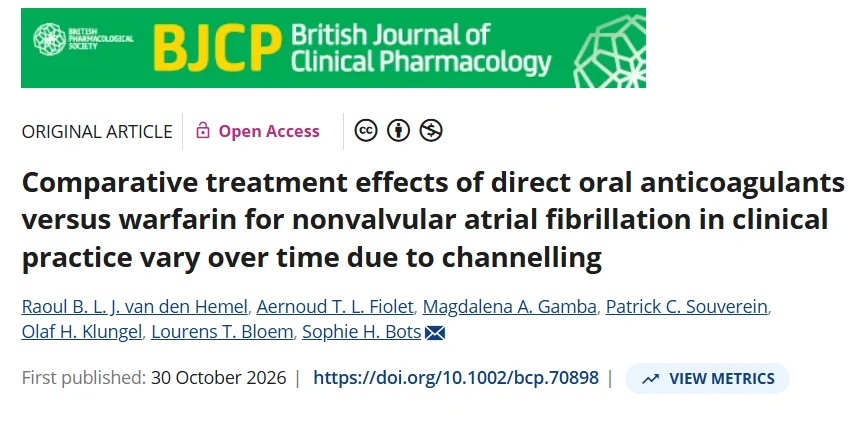
Title: Comparative treatment effects of direct oral anticoagulants versus warfarin for nonvalvular atrial fibrillation in clinical practice vary over time due to channelling
Authors: Raoul B. L. J. van den Hemel, Aernoud T. L. Fiolet, Magdalena A. Gamba, Patrick C. Souverein, Olaf H. Klungel, Lourens T. Bloem, Sophie H. Bots
Stay updated on all scientific advances with Hemostasis Today.
-
Nov 7, 2026, 17:26Sneha Sarkar: Comparative Safety and Effectiveness Profile of Direct Oral Anticoagulants in AF
-
Nov 7, 2026, 17:08Wolfgang Miesbach: Immune-Engineered AAV Capsids Displaying IL-10 Enhance Gene Therapy Safety and Efficacy
-
Nov 7, 2026, 17:03Nicole Dobkin: Survey Reveals Major Disconnect Between Access to Apheresis and Patient Utilization in Sickle Cell Care
-
Nov 7, 2026, 16:58Muhammad Essa: Comparing Indobufen and Aspirin in Acute Ischemic Stroke
-
Nov 7, 2026, 16:42Inderpaul Birdi: Warfarin or Newer Blood Thinners?
-
Nov 7, 2026, 16:31Arwa Z. Al-Riyami: EMR Transfusion Medicine Featured in October 2026 Issue of ISBT Transfusion Today
-
Nov 7, 2026, 16:31Rafael Gomes: Is Dual Antiplatelet Therapy Still Necessary After LAAO?
-
Nov 7, 2026, 16:15Mazyar Shadman: Novel BTK Inhibitors and DOACs A Multicenter Study of Bleeding Risk
-
Nov 7, 2026, 15:54Hassan Raza: Beyond the 100 Minus Age Rule in Bone Marrow Cellularity