


Stefan Prendić: Can Algorithms Support Antibody Identification in Immunohematology?
Stefan Prendić, Quality Control Specialist at Bio-Rad Medical Diagnostics GmbH, shared a post on LinkedIn:
”Can algorithms support antibody identification in immunohematology?
A recent study published in Transfusion (2026) caught my attention.
Researchers developed IrregulAB, an open-source, rule-based tool designed to support the interpretation of red blood cell antibody identification panels.
The system applies traditional serological principles, including antigen exclusion, dosage effects, and enzyme-phase reactivity, to identify possible antibody combinations.
Key findings:
The study evaluated 143 antibody identification panels using Bio-Rad gel-card technology.
In the independent validation group of 35 panels:
91 percent retained all reference antibodies during the initial screening stage.
89 percent produced at least one valid explanatory antibody combination.
However, the study also revealed important limitations, particularly with variable antigen expression, dosage effects involving anti-P1 and anti-M, and atypical reaction patterns.
For me, this highlights an important aspect of modern laboratory medicine:
Automation can improve consistency and support quality assurance, but expert interpretation remains essential.
What makes this research particularly interesting is its transparent, rule-based approach. Unlike a black-box system, its decision logic can be examined and evaluated.
As laboratory technologies continue to evolve, I believe the combination of automation, reliable reagents, and professional expertise will play an increasingly important role in transfusion medicine.”
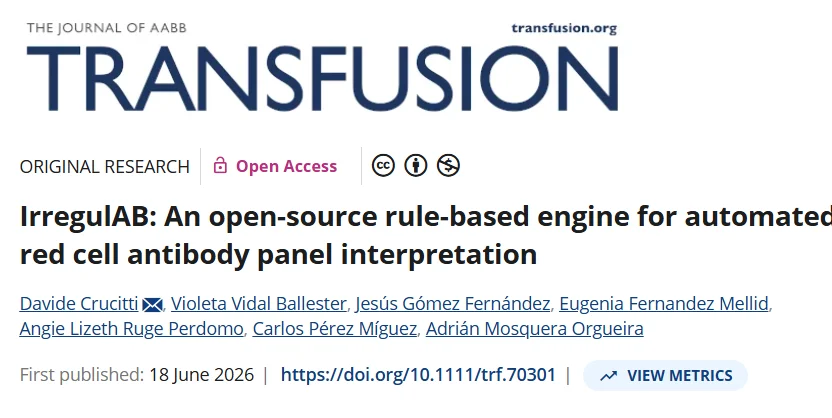
Title: IrregulAB: An open-source rule-based engine for automated red cell antibody panel interpretation
Authors: Davide Crucitti, Violeta Vidal Ballester, Jesús Gómez Fernández, Eugenia Fernandez Mellid, Angie Lizeth Ruge Perdomo, Carlos Pérez Míguez, Adrián Mosquera Orgueira
Stay updated on all scientific advances with Hemostasis Today.
-
Nov 11, 2026, 15:42Tareq Abadl: The Clinical Impact of Kell Alloimmunization
-
Nov 11, 2026, 15:30Alejandro González Veliz: Does PCI Change The Long-Term Outcome In Stable Coronary Artery Disease?
-
Nov 11, 2026, 15:25Preparing for the SoHO Regulation – EBA Board Convenes in Vienna – European Blood Alliance
-
Nov 11, 2026, 15:20Vaidehi Prasanth: IV Iron in Heart Failure – Exploring Hospitalisation Benefits vs. Infection Risk in Open Heart
-
Nov 11, 2026, 15:12Perioperative Challenges in Hemophilia Patients on Rebalancing Therapies
-
Nov 11, 2026, 15:03Maria Elisa Mancuso: World-Renowned Faculty and 33 Global Participants Unite at Hemophilia Academy 2026
-
Nov 11, 2026, 15:01Hassan Raza: The JAK2 V617F Revolution
-
Nov 11, 2026, 14:57Edward Lee Carter: Factor Xla Inhibition Enters Clinical Practice – FDA Approval of Asundexian
-
Nov 11, 2026, 14:45ITP Is More Than a Platelet Count: Why Patient Perspectives Matter – ITP Australia and New Zealand