


Akshita Singh: The Remarkable Process of Blood Clotting
Akshita Singh, Aspiring Medical Student, shared a post on LinkedIn:
“Blood Clotting: A Small Injury, A Remarkable Process
I recently studied the topic of blood clotting, and I found it quite interesting how our body manages to prevent excessive blood loss whenever a blood vessel gets injured.
What seems like a simple process from the outside actually involves several steps and different components of our blood working together.
Here’s a little about what I learned:
1. Vasoconstriction
The moment a blood vessel gets injured, it begins to narrow, reducing blood flow to the affected area. Substances like serotonin, released by activated platelets, contribute to this process. Endothelin released by endothelial cells also plays an important role.
2. Platelet Plug Formation
Platelets, which are tiny cell fragments present in our blood, rush towards the injured site. They stick to the damaged area and to one another, forming a temporary platelet plug.
3. Activation of the Clotting Cascade
This is where things get particularly interesting! A series of proteins called clotting factors become activated through a chain of reactions. These reactions eventually lead to the formation of an enzyme called thrombin.
4. Formation of Fibrin
Thrombin converts a soluble blood protein called fibrinogen into insoluble fibrin strands. These strands form a mesh-like network that traps blood cells and strengthens the platelet plug, creating a stable blood clot.
5. Clot Stabilisation and Healing
The fibrin network is stabilised by factor XIII, making the clot stronger. Meanwhile, the body begins repairing the damaged tissue.
Something else I found interesting is that our body doesn’t just need the ability to form clots; it also needs to regulate them. Too little clotting can cause excessive bleeding, while unwanted clot formation can lead to conditions such as thrombosis.
It’s fascinating to realise how many different components of our blood work together to protect us from something as ordinary as a small injury.
Still learning, but definitely one of the more interesting topics I’ve studied in human physiology!”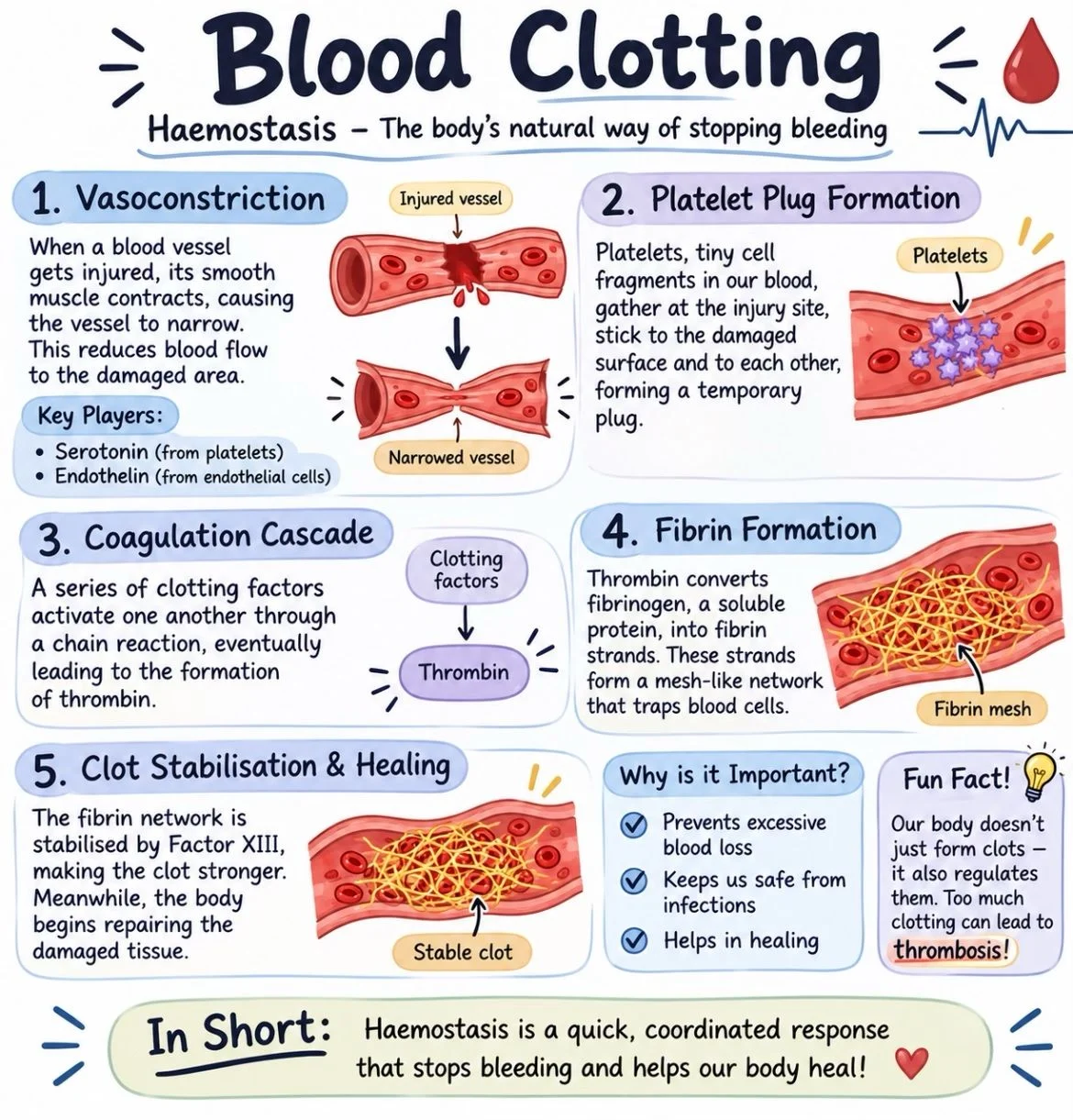
Stay updated with Hemostasis Today.
-
Nov 13, 2026, 03:21Abdul Muqtadir Abbasi: Iron Deficiency Beyond Anemia and the Importance of Finding the Cause
-
Nov 13, 2026, 03:05Marc Carrier: Aspirin vs Anticoagulants for VTE Prevention After Joint Replacement
-
Nov 13, 2026, 02:28Julia Sjöberg: ROCK1 Inhibition and Red Blood Cell Recovery After Chemotherapy
-
Nov 13, 2026, 02:07Tonie Reincke: Understanding Deep Vein Thrombosis and Vascular Health
-
Nov 12, 2026, 22:52Milka Koupenova: The Role of Platelet RIG-I in Regulating Thrombotic Responses
-
Nov 12, 2026, 22:50Arun V J: Why Has India Still Not Achieved 100% Voluntary Blood Donation?
-
Nov 12, 2026, 22:49Sickle Cell Disease Deserves to Be Prioritised in Ghana – ISCC
-
Nov 12, 2026, 22:47Samir Kumar Beura: Delighted to Serve as a Topic Editor for a Research Topic in Frontiers in Neuroscience
-
Nov 12, 2026, 22:46Ashish Sharma: In-Hospital Mortality and Bleeding Complications in APL