


Abdul Mannan: Why Is HbS or HbD Approximately 40% in Heterozygotes Rather Than 50%?
Abdul Mannan, Consultant Haematologist at Betsi Cadwaladr University Health Board, shared a post on LinkedIn:
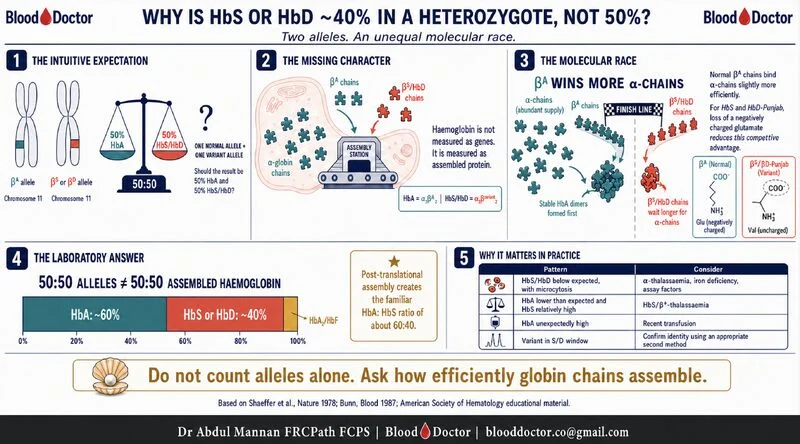
“Both β-globin alleles are switched on in sickle cell trait. So why is the result never 50:50?
Ask a trainee about HbAS and most will quote HbA around 60% and HbS around 40%. Correct.
But few can say why. If both alleles are transcribed equally, you would expect equal amounts of each haemoglobin.
You don’t.
The answer sits after translation, not before it.
Here is what is actually happening:
Both βA and βS chains are made in similar amounts.
They then compete for a limited pool of α chains during assembly.
βA wins.
HbS carries the Glu6Val change, swapping a negative charge for a neutral one, which weakens its affinity for α chains.More stable α2βA2 is assembled than α2βS2.
Hence the familiar 60:40.
This is a post-translational assembly effect, not unequal inheritance. Shaeffer showed that even with equal βA and βS supplied, more HbA formed when α chains were the bottleneck (Nature 1978).
A practical hook: co-inherited α-thalassaemia makes α chains scarcer and pushes the HbS fraction down further.
A high HbS with low HbA should make you think HbS and β+ thalassaemia instead. Recent transfusion lifts HbA.
Same logic explains HbA D-Punjab too.
What is the lowest HbS percentage you have seen reported as ‘trait’?”
Other posts featuring Abdul Mannan with Hemostasis Today.
-
Oct 16, 2026, 15:18Carmine Liberatore: Limited Accuracy of VTE Risk Scores in Multiple Myeloma
-
Oct 16, 2026, 14:55Alex Borstein and the Bleeding Phenotype of Hemophilia A Carriers
-
Oct 16, 2026, 13:59Aya Akmal Amin: Antiphospholipid Syndrome Management and Risk Stratification
-
Oct 16, 2026, 13:10Emanuel Sueldo: CAHT 2026 Celebrates Scientific Progress and Team Achievements
-
Oct 16, 2026, 13:05Maha Othman: Queen’s Health Sciences Advances CAT Risk Models and Pediatric ISTH-BAT Cut-Offs
-
Oct 16, 2026, 13:03Thrombosis Awareness Must Lead to Timely Action – Roche
-
Oct 16, 2026, 12:49Wolfgang Miesbach: 5-Year CBDR Data Confirms Emicizumab Safety and Efficacy in Hemophilia A
-
Oct 16, 2026, 12:40Edward Lee Carter: How Factor XI Inhibition Could Transform Anticoagulation Therapy
-
Oct 16, 2026, 12:40Marc Carrier: Looking Ahead to ISTH 2027 in Vancouver