


Akshaya Sharon: Qfitlia as a Shift in Treatment Strategy for Hemophilia A and B
Akshaya Sharon, Pharmacy student at JKK Nattraja College of Pharmacy, shared a post on LinkedIn:
“A major leap in hemophilia care – less frequent dosing, broader applicability.
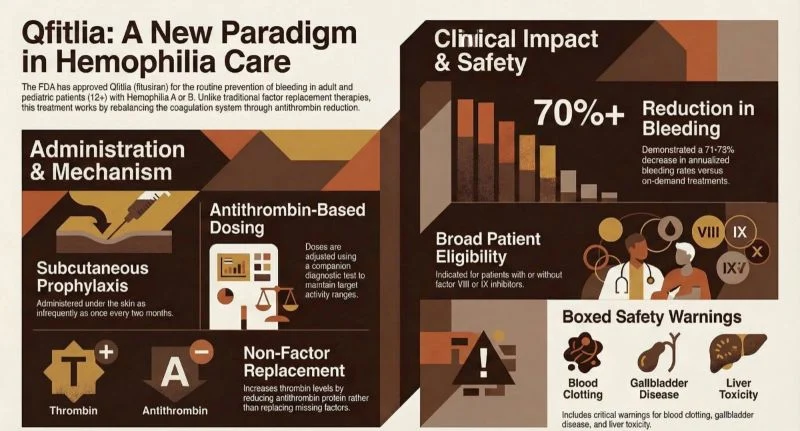
On March 28, 2025, the U.S. FDA approved Qfitlia (fitusiran) – a novel prophylactic treatment for patients with Hemophilia A and B, with or without factor inhibitors.
This approval stands out not just as another drug launch – but as a shift in treatment strategy.
Unlike traditional therapies that replace missing clotting factors, Qfitlia works differently:
- It targets antithrombin, indirectly increasing thrombin generation
- This enhances clot formation without directly supplying FVIII or FIX
Why this matters:
- Extended dosing interval – administered once every 2 months
- Effective across both inhibitor and non-inhibitor patients
- Demonstrated ~70% reduction in annual bleeding rates
- Moves care closer to precision-guided dosing using companion diagnostics
The integration of the Innovance Antithrombin diagnostic test is especially notable – marking a step toward personalized prophylaxis, where dosing is adjusted based on biological response rather than fixed schedules.
However, innovation comes with caution.
Qfitlia carries serious safety considerations:
- Risk of thrombotic events
- Liver toxicity monitoring required
- Potential gallbladder complications
This approval reflects a broader trend in therapeutics:
- Moving from replacement therapies – pathway modulation
- From frequent dosing – long-acting precision care
For clinicians and researchers, this opens new discussions around balancing efficacy with safety, especially in long – term management.
For patients, it offers something equally powerful – convenience with improved outcomes.
A promising step forward in redefining hemophilia management.”
Stay updated on all scientific updates with Hemostasis Today.
-
Oct 13, 2026, 21:05Francisco Chacón-Lozsán: Heparin-Induced Thrombocytopenia – When an Anticoagulant Triggers Thrombosis
-
Oct 13, 2026, 21:04Aref Zribi: Isolated Tumor Thrombus and the Role of Prophylactic Anticoagulation
-
Oct 13, 2026, 21:01Alex Larson: Why Normal Bloodwork Does Not Always Tell the Whole Story
-
Oct 13, 2026, 20:58Juan Jauregui-Lozano: How Replication Stress Impairs Red Blood Cell Maturation
-
Oct 13, 2026, 20:55Caitlin Raymond: Understanding Platelet Refractoriness Before Ordering More Platelets
-
Oct 13, 2026, 20:54Sanja Seratlic: How Cow Feeding Systems Influence the Anti-Platelet Properties of Cheddar Cheese
-
Oct 13, 2026, 20:50Ruchika Goel: Cord Blood Red Blood Cells as a Physiologically Aligned Transfusion Strategy
-
Oct 13, 2026, 20:47Sophia Delicou: Strengthening Transfusion Safety Through Advanced Screening and Haemovigilance
-
Oct 13, 2026, 20:45Lydia Pecker: Alloimmunization and Transfusion Indications in Sickle Cell Disease Pregnancy