

Aktham El-rekaby: Immunothrombosis in Acute Ischaemic Stroke
Aktham El-rekaby, Clinical Associate Lecturer at Angela Ruskin university, shared a post on LinkedIn:
”Acute Ischaemic Stroke:
Thrombosis with an Immunological Interface
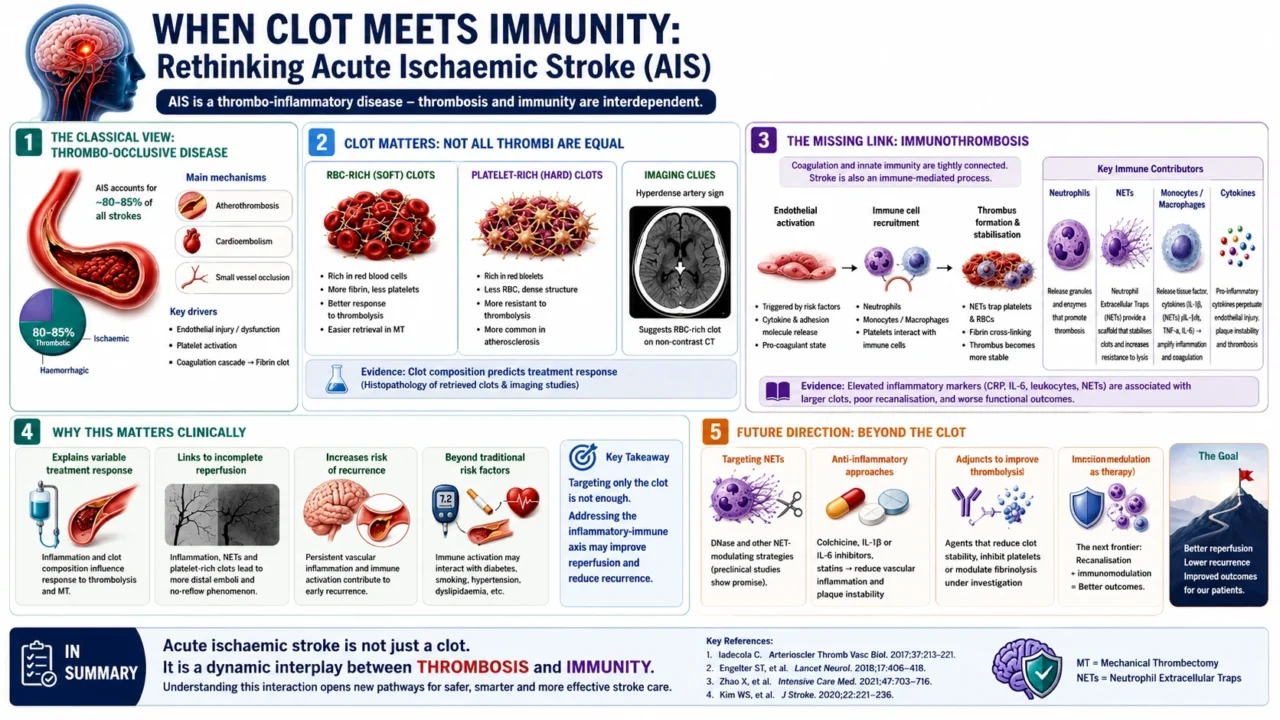
Acute ischaemic stroke (AIS) is fundamentally a thrombo-occlusive disease, most commonly resulting from atherothrombosis, cardioembolism, or small vessel occlusion.
In clinical practice, ischaemic stroke accounts for approximately 80–85percent of all strokes, consistently exceeding haemorrhagic stroke globally, although regional variation exists, with relatively higher haemorrhagic proportions reported in some Asian populations.
Traditionally, the pathophysiology of AIS has been framed around vascular pathology and coagulation dynamics including endothelial injury, platelet activation, and fibrin-rich clot formation.
This paradigm has guided risk stratification and acute therapies such as intravenous thrombolysis and, more recently, mechanical thrombectomy (MT).
Clot Composition and Treatment Response:
Pre-thrombectomy era observations already suggested that clot composition influences treatment efficacy. Thrombolysis is more effective in fibrin-rich (‘soft’) thrombi, whereas platelet-rich or erythrocyte-poor (‘hard’) thrombi tend to be more resistant.
Advances in imaging (e.g., hyperdense artery sign on CT) and histopathological analysis of retrieved thrombi in the MT era have confirmed that:
- Red blood cell (RBC)-rich clots are generally more responsive to thrombolysis and easier to retrieve.
- Platelet-rich clots, often associated with atherosclerosis, are more resistant and structurally compact.
- Clot architecture evolves over time, influenced by platelet activation, fibrin cross-linking, and inflammatory cell infiltration.
The Role of Immunothrombosis
Emerging evidence reframes thrombosis in AIS as part of a broader concept known as immunothrombosis the interaction between the coagulation system and innate immunity.
Key mechanisms include:
- Endothelial activation triggering both coagulation and inflammatory cascades
- Recruitment of neutrophils and monocytes, contributing to clot structure
- Formation of neutrophil extracellular traps (NETs), which stabilize thrombi and increase resistance to thrombolysis
- Release of pro-inflammatory cytokines, amplifying vascular injury and promoting further thrombogenesis.
This suggests that there is an immune-mediated process.
Clinical Implications
Recognizing the immunological contribution to AIS has several implications:
- Explaining variability in treatment response: Differences in clot composition and immune activity may underlie resistance to thrombolysis or incomplete reperfusion with MT.
Risk of recurrence - Persistent inflammatory or immune activation may contribute to ongoing vascular risk beyond traditional factors.
Therapeutic innovation: There is growing interest in immunomodulatory strategies, including:
- Targeting NETs (e.g., DNase-based approaches in experimental models)
- Anti-inflammatory therapies to stabilise plaques and reduce thrombo-inflammation.
- Adjunctive treatments to enhance thrombolysis efficacy.”
Stay updated with Hemostasis Today.
-
Sep 29, 2026, 22:45Victor Agunyego: Paracetamol – The Most Common Drug We Underestimate
-
Sep 29, 2026, 22:42Nova Sinclair: Advancing the Future of Hematology – Meet Our 2027 Organizing Committee
-
Sep 29, 2026, 22:41Lorenz Räber: Intracoronary Imaging in PCI – Why, When, How, and Which Modality?
-
Sep 29, 2026, 22:31Selma Turkovic: Pleased to Deliver the Opening Presentation at Kingston Hospital
-
Sep 29, 2026, 22:31Miguel Teran: Ultrasound and Simulation in Arterial Blood Sampling
-
Sep 29, 2026, 21:47Javed Anees: DADA2 – When a Young Stroke Is More Than a Stroke
-
Sep 29, 2026, 22:28Mohammad Refaei: Navigating Your Career in Hematology From Training to Practice
-
Sep 29, 2026, 22:27Matteo Foschi: 10 Clinical Pearls for Antithrombotic Therapy in Secondary Stroke Prevention
-
Sep 29, 2026, 22:26A Global Call for Action on Cardiovascular Health on World Heart Day – ISTH