


Augustina Isioma Ikusemoro: Platelet Inventory – The Most Unpredictable Balancing Act in Healthcare
Augustina Isioma Ikusemoro, Hematology and Transfusion Medicine Specialist at Sharjah Blood Transfusion and Research Center, shared a post on LinkedIn:
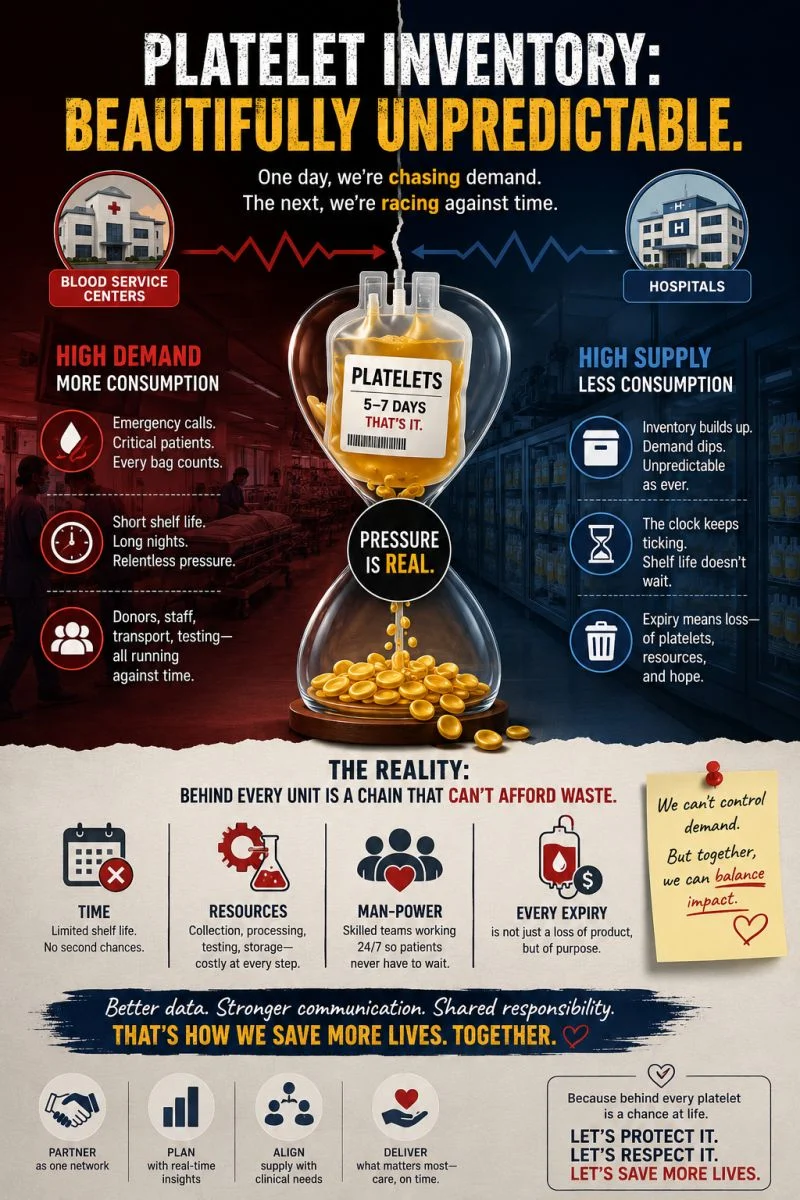
“Platelet Inventory: The Most Unpredictable Balancing Act in Healthcare
One week, hospitals are calling urgently for more platelets to support trauma victims, oncology patients, transplant recipients, and critically ill patients.
The next week, inventory shelves are full, demand slows down, and the countdown to expiration begins.
This is the reality of platelet inventory management.
Unlike red blood cells, platelets have a very short shelf life—typically only 5–7 days. Every unit collected represents a significant investment of donor commitment, staff effort, laboratory processing, quality testing, storage, transportation, and financial resources.
Yet despite meticulous planning, platelet demand remains highly unpredictable.
High Demand and High Consumption
- Emergency transfusions increase
- Oncology and haematology requirements surge
- Blood centres struggle to maintain adequate stock
High Supply and Low Consumption
- Inventory accumulates
- Expiry dates approach rapidly
- Valuable resources risk being lost
Between these two extremes lies a constant challenge: ensuring the right platelet product reaches the right patient at the right time.
Every expired platelet unit is more than a discarded blood component.
It represents: A donor’s generosity
- Hours of professional work
- Operational resources
- An opportunity to save a life
The solution is not simply collecting more platelets. It requires strong collaboration, real-time communication, accurate demand forecasting, responsible clinical utilisation, and a shared commitment between blood services and healthcare institutions.
In transfusion medicine, success is not measured only by the units we collect—it is measured by how effectively we align supply with patient needs while minimising wastage.
Behind every platelet unit is a patient waiting, a donor giving, and a healthcare team working tirelessly against time.
Let’s protect every donation. Let’s optimise every unit. Let’s save more lives together.”
Find more posts featuring Augustina Isioma Ikusemoro on Hemostasis Today.
-
Sep 28, 2026, 16:43Scott Sutton: Community and Connection in Immune Thrombocytopenia
-
Sep 28, 2026, 16:24Pankti Solanki: ISBT Recognized JAMA as the 49th Human Blood Group System
-
Sep 28, 2026, 15:52Kassa Tameru: Antithrombotic Management in GI Bleeding and Elective Endoscopy
-
Sep 28, 2026, 15:51Chengappa Kavadichanda: How Do aPLs Change Over Time in Early Lupus?
-
Sep 28, 2026, 15:18Linda Shore-Lesserson: Celebrating 25 Years of PBM at the SABM Meeting
-
Sep 28, 2026, 14:45Access Real-Time Bleeding Disorder Guidelines with the New WFH Resource Hub – WFH
-
Sep 28, 2026, 14:44Subham Banerjee: When Routine Blood Grouping Hid a Rare Diagnosis
-
Sep 28, 2026, 14:41Francois Roubille: Can Low-Dose Colchicine Prevent Atrial Fibrillation After CABG?
-
Sep 28, 2026, 14:39William Aird: Gulliver’s Atlas – Mapping the Evolution of the Vertebrate Red Cell