


Bahram Alamdary Badlou: Platelets as First Responders in Hemostasis, Immunity, and Inflammation
Bahram Alamdary Badlou, Managing Director at BBAdvies and Research, shared Abdul Mannan‘s post on LinkedIn:
“In this POSTCOVID-19 War era AITTS copy-paste without consent, etc. (PLATELETS Updates 2027), Highlights over Human Blood Platelets as Multifunctional Sentinel Cells.
My Book is over the MK-Pro-Platelets (PLTS) function in Health and Diseases:
PLTS are recognized as the Primary-Central Cellular Actors-First Responders- Antimicrobial Agents- Lifesaving Blood Cells- the most important Initiators and Mediators of Thrombosis and Hemostasis (PCCAFRAA-LSBCIMT and H).
However, more than 100000 Research published over the last several decades in Nature, The Lancet, Nature Reviews Immunology, Nature Reviews Rheumatology, Scientific Reports, and related hi-impact Journals, which has established that (MK-Pro-)Platelets are multifunctional circulating cells with certain mitochondrial RNA plus communicating abilities with cells with DNAs for certain (re)actions i.e. Satelitism during inflammation and infections, with essential roles far beyond simple blood clotting, defined in 20st Century.
PLTS’ PCCAFRAA-LSBCIMTandH capacities are now considered ‘The key regulators’ of cancer metastasis and cancer survival, vascular homeostasis, immunity, inflammation, and many mutations during cancerogenic processes.
PLTS are indispensable for survival following trauma, surgery, battlefield injuries, and accidental bleeding because they rapidly initiate PCCAFRAA-LSBCIMT and H to manage all 0- to 100 supportive (pro-anti)coagulation cascades.
PLTS, at the same time, act as innate immune sentinels by detecting all relevant microbial products through pattern-recognition receptors(PRRs), interacting directly with antigens and coordinating host defense responses in less than a minute.
PLTs (half)actively communicate with ;All cells with DNA;, thereby ;linking Management; of PCCAFRAA-LSBCIMT and H with both innate PLTS and adaptive immunity.
Recent discoveries show that PLTs contain biologically active (mitochondrial) RNA, release extracellular vesicles, exchange molecular information with surrounding cells, and respond to extracellular nucleic acids, including DNA-associated inflammatory signals.
Although anucleate, (Pro)Platelets possess remarkable signaling capabilities and can modify their behavior according to environmental challenges.
PLTS interaction with cancerogenic cells has led to the concept of tumor-educated PLTS, highlighting their role in cancer progression, metastasis, and survival Chance(EU-CAT projects).
Phenomena such as (PRO)Platelet satellitism during infection or inflammation further illustrate PLTS capacity for dynamic cellular communication.
Collectively, modern evidence supports the view that PLTS are highly specialized circulating surveillance and the most rapidly responding blood cells, which can manage all PCCAFRAA-LSBCIMT and H incl. Regenerative, antimicrobial, cardiovascular, and oncological functions, making them indispensable for human survival or adaptation on Earth and even in SPACE.(Bahram Alamdary Badlou, Platelets Physiology 2027).”
Abdul Mannan, Consultant Haematologist, Director Haemophilia Centre, Haematology Lab Lead at Betsi Cadwaladr University Health Board, shared a post LinkedIn:
“Platelets are often called blood cells.
Strictly speaking, they are not complete cells.
That distinction matters, particularly when we teach haemostasis.
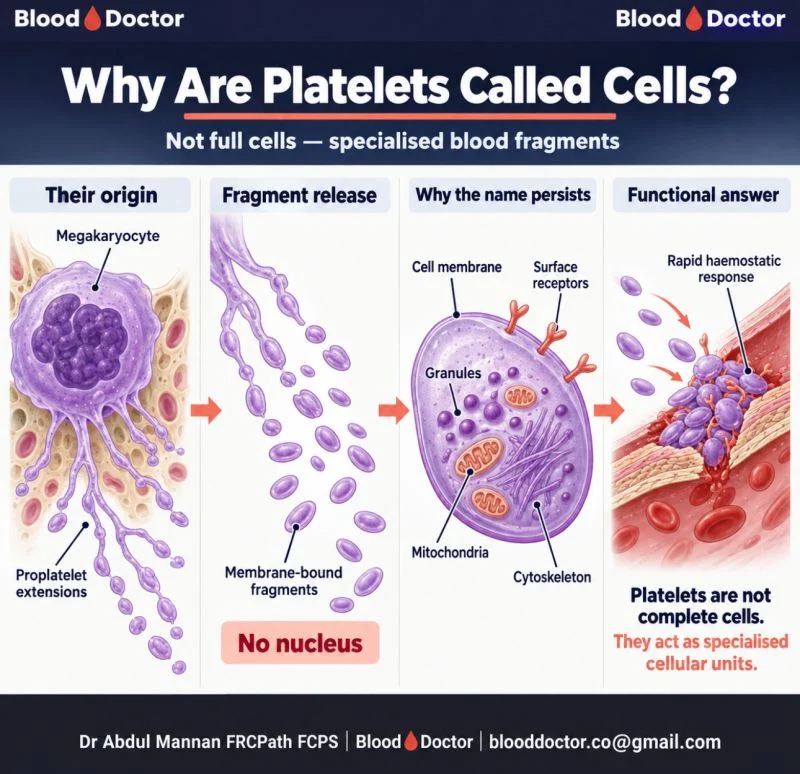
Platelets are small, membrane-bound fragments released from megakaryocytes through long proplatelet extensions.
They have no nucleus, so they cannot be described as whole cells in the usual biological sense.
Here is the useful way to frame it:
- Platelets arise from megakaryocytes.
- They are anucleate cytoplasmic fragments.
- They retain mitochondria, granules, receptors and a dynamic cytoskeleton.
- They sense vascular injury, change shape, signal and help build the platelet plug.
So ‘platelet’ is the precise term.
‘Blood cell’ is useful clinical shorthand.
The teaching pearl: platelets are not complete cells, but they function as highly organised cellular units.
A classic review of platelet biogenesis describes how megakaryocyte proplatelets give rise to circulating platelets: Patel, Hartwig and Italiano, Journal of Clinical Investigation, 2005.
How do you explain this distinction to trainees without making it sound like a semantic trap?”
Other posts featurig Abdul Mannan on Hemostasis Today.
-
Oct 11, 2026, 22:22Vipin Singh: New Publication on Hippo-YAP Signaling and Platelet Activation
-
Oct 11, 2026, 22:21Trygve Berge: New AFNOR Paper on AF-related Stroke in Norway
-
Oct 11, 2026, 22:09Omar Alomari: Our New Publication on Apixaban vs Rivaroxaban for VTE
-
Oct 11, 2026, 21:22Shayan Roshan: Happy to Share Two Research Milestones in Trauma Care and Pancreatic Cancer
-
Oct 11, 2026, 21:16Chokri Ben Lamine: Anemia in Myelofibrosis – Multiple Mechanisms, Limited Responses
-
Oct 11, 2026, 21:03Carmela Walker: Supporting Warriors Living With SCD Through Dental Care and Advocacy
-
Oct 11, 2026, 21:00Rishdha Roshad: Intraoperative Cell Salvage – Turning Blood Loss into an Opportunity for Recovery
-
Oct 11, 2026, 20:59Anthony R. Sloan: Honored to Share Our Work at the 20th Midwest Platelet Conference
-
Oct 11, 2026, 20:55Vipin M. Vashishtha: Mild COVID-19 and Malaria Leave Measurable Fingerprints on the Clotting System