


Bastu Odoka: Why Blood Should NOT be Left at the Bedside to ‘Warm’
Bastu Odoka, Transfusion Scientist at Effia-Nkwanta Regional Hospital, shared a post on LinkedIn:
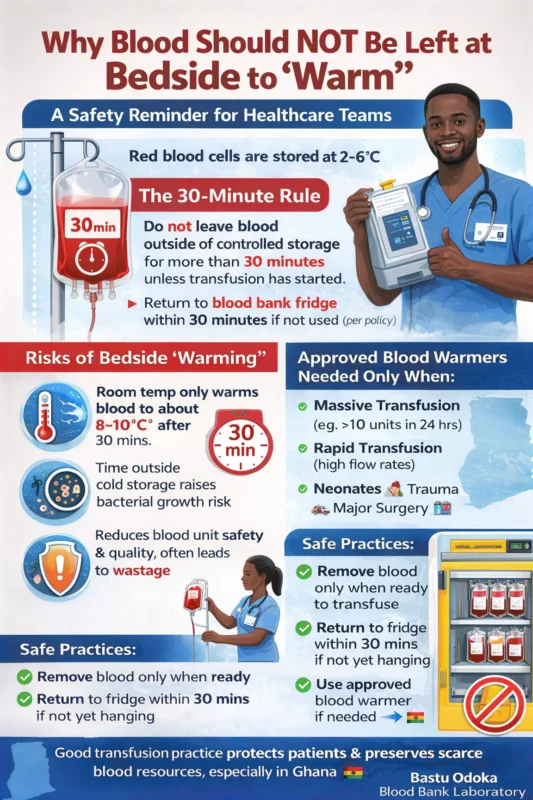
”Blood should NOT be left at the bedside to ‘warm’.
This is still a common practice in many clinical settings. The intention is good. The risk, however, is real.
Red blood cells are stored at 2–6°C to maintain safety and quality. Once a unit leaves controlled storage, the clock starts.
The 30-Minute Rule
If transfusion has not started within 30 minutes, the blood should be returned to the blood bank refrigerator. After this window, the unit may become unsafe for use due to temperature exposure and bacterial growth risk.
Many assume leaving blood at room temperature helps it warm. Evidence shows otherwise. Blood left out for 30 minutes typically only reaches about 8–10°C, which provides no clinical benefit.
In a routine transfusion, blood can safely be administered cold. The patient’s circulation warms rapidly.
When warming is actually required
Blood warming should only be used in specific situations, such as:
- Massive transfusion (large volumes in a short time)
- Rapid transfusion at high flow rates
- Neonates or patients at high risk of hypothermia
And importantly, warming must be done using approved medical blood warmers, never improvised methods.
- Safe practice protects patients
- Reduces wastage of scarce blood resources
- Supports better transfusion outcomes, especially in resource-limited settings
Safe blood use saves lives.
I’m interested to hear how different facilities enforce the 30-minute rule in practice.”
Stay updated with Hemostasis Today.
-
Oct 9, 2026, 12:03Heather Case: Bridging Awareness and Action in Women’s Hemophilia Care
-
Oct 9, 2026, 11:58Brandon Luu: Can Iron Deficiency Cause Fatigue Without Anemia?
-
Oct 9, 2026, 11:51Sumaiya Dickens: Marginal Zone B Cells in Transfusion Medicine and Hemophilia A Research
-
Oct 9, 2026, 11:44Ayyappan V Nair: PRP and Rehabilitation – Can It Help Athletes with Partial Rotator Cuff Tears?
-
Oct 9, 2026, 11:29Jigesha Dholakia: Supporting the Hemophilia Community Through the Unite Walk
-
Oct 9, 2026, 11:06Nobles Green: How siRNA Therapy Helps the Body Form Stronger Clots
-
Oct 9, 2026, 10:53Switching From Emicizumab to Denecimig in Hemophilia A – Rare Disease Advisor
-
Oct 9, 2026, 10:40What New U.S. Data Reveal About GT – Glanzmann’s Research Foundation
-
Oct 9, 2026, 10:32Anjali Pandey: The Morphologic Clues to MDS With del(5q)